Dual carbon goals call for systematic actions









Editor's note: With less than half a year remaining before the conclusion of the 14th Five-Year Plan (2021-25), China is on track to exceed its nonfossil energy consumption targets. The share of electricity in end-use energy consumption has already risen to around 30 percent. Zhou Dadi, former director of the Energy Research Institute of the National Development and Reform Commission, spoke to the 21st Century Business Herald about the achievements of the 14th Five-Year Plan in energy transition as well as the priorities in the 15th Five-Year Plan (2026-30). Below are excerpts from the interview. The views don't necessarily represent those of China Daily.
The policy framework of the 15th Five-Year Plan will continue to adhere to the core vision of the dual carbon goals. China aims to peak carbon dioxide emissions before 2030. The success of its energy transition hinges on whether clean energy can build cost advantages and market competitiveness. Only if there is an economically viable low-carbon energy supply system can fossil fuels be genuinely replaced.
China has made remarkable progress in new energy development, but coal consumption remains a transitional challenge due to its economic viability.
To achieve the carbon peak in the 15th Five-Year Plan period coal use must be reduced through targeted policies, building on existing measures to control its consumption.
Coal, oil and natural gas should peak in stages during the next five years, followed by sustained and substantial reductions in the medium to long term.
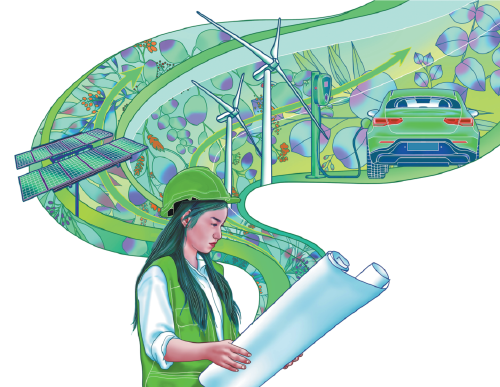
The primary pathway to achieving carbon neutrality before 2060 is to replace fossil fuels with nonfossil energy-based electricity — solar, wind, hydropower, nuclear and energy storage — potentially approaching near 100 percent substitution. The power system must achieve zero-carbon transformation ahead of schedule, with both primary and end-use energy highly electrified.
Besides, it is important to advance green, low-carbon and rational consumption patterns. With the continued growth of electricity demand driven by the digital economy and artificial intelligence, the solution is not to simply restrict energy consumption, but to promote energy-saving technologies, enhance efficiency and advocate reasonable consumption in order to avoid wasting energy.
The focus of energy policy should now shift to structural optimization and low-carbon transformation. There is broad consensus in the international community that developing clean energy and promoting green, low-carbon transformation can address the problem of climate change.
In addition to restructuring the energy system, electrification in key sectors such as transportation and construction must also be accelerated. With rapid technological progress and declining costs, batteries, electric vehicles and electrified machinery are quickly gaining market share. Since the start of the 14th Five-Year Plan, the electrification of transport has pushed the oil and gas industry into transition, and China's refined oil consumption has already peaked ahead of schedule.
This peaking and subsequent decline in refined oil consumption have put pressure on the petrochemical industry to pursue its own low-carbon transformation. In the future, zero-carbon synthetic fuels and chemicals, based on green hydrogen and biomass, will be gradually developed.
These are expected to gradually replace current oil — and gas-based petrochemicals starting from 2040.
For the residential sector, high levels of electrification will be the main pathway for a green, low-carbon transformation. Heating systems will shift from coal — and gas-based centralized heating to distributed electric heating, including direct electric heating and heat pumps. Electrification in cooking is also emerging, with electric stoves increasingly available.
The potential rooftop solar capacity of urban and rural buildings is estimated at nearly 3 billion kilowatts, but this resource remains largely untapped. Significant progress is expected in this area during the upcoming five-year plan.