Electric railway to ease commuting for Chileans









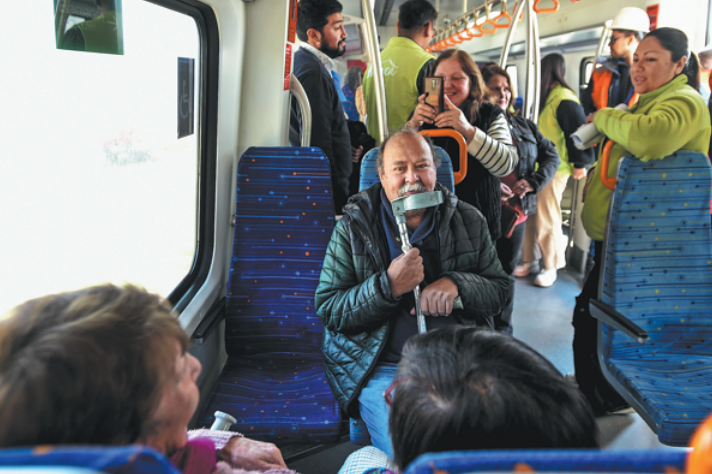
For Norell Morales, a 40-year-old resident of Santiago, Chile, who runs an e-commerce business, the city's transport system is both a lifeline and a daily battle.
Deliveries often take her across the country's capital, and during rush hour, she braces herself for almost intolerable overcrowding. "The buses are packed, and so is the metro. There are times it takes me four hours to deliver something or pick it up," she said.
The capital is known for its vibrant culture, stunning mountain backdrops and sometimes horrific commutes into the city center. Traffic is heavy and public transportation is often packed. The metro and buses work well enough in the relatively small geography of the city center, but life on the periphery is a different story. Long commutes are a routine for anyone who relies on intercity buses that funnel into the capital along highways.
"Although the urban bus system has expanded within the city limits, many people have to continue beyond and therefore use intercity buses," said Renzo Burotto, a researcher at the University of Chile's Institute of International Studies in Santiago.
Some improvements may be at hand. Last month, Chile's State Railway Company sealed a $470-million agreement with Constructora Gran Andes SpA, a consortium led by China Railway Construction Corp, or CRCC, to build the Santiago-Batuco electric railway.
The contract, signed in Renca on Aug 25, sets in motion the process of building a 26-kilometer line running through eight stations between Quinta Normal and Batuco. Once completed, this electric railway line will slash travel times in and out of the city core from about 90 minutes by bus to just 24 minutes by train. Some 35 million passengers will be able to make the trip every year.
"This is very good news for the entire northern sector of the capital," said Transport Minister Juan Carlos Munoz after signing the contract for the new railway, noting the service will connect with other metro lines, making travel more efficient.
The system will rely on 10 electric trains, each accommodating up to 800 passengers, every six minutes at rush hour and every eight minutes off-peak. Built in China, the trains will be equipped with Wi-Fi and meet high safety standards.
For people like Burotto, the project reflects both strategic foresight and practical necessity. The delivery timeline of making it a full service by 2030 demonstrates Chile's reliance on a partner with proven expertise.
"China is a pioneer in high-tech, high-speed trains at very competitive prices," he said. "I believe it's a very positive development to turn to China … to cover a crucial sector of the transportation infrastructure that will be used daily by the population living north of Santiago but working in the city."
The Santiago-Batuco line will not only improve transport efficiency but also reshape daily life for residents in Santiago's northern outskirts, many of whom depend on the city center for work and study.
Burotto also pointed to the project's environmental and social significance. Marketed as a step toward green sustainability, the line is expected to benefit more than a million people while contributing to Chile's climate goals. Having experienced China's high-speed trains firsthand, he sees the technology as reliable, affordable, and capable of delivering tangible improvements to commuters.
"I rode high-speed Chinese trains in China, and I can confirm this technology will greatly benefit us in terms of price and quality, as well as the daily commute of hundreds of thousands of workers," he said.
The Santiago-Batuco project is part of a broader railway revival.
Chinese firms have become central players in this agenda. In March, construction began on the Alameda-Melipilla Rail Depot Project, co-built by China Railway Seventh Group. With a $90 million investment, the 17.83-hectare facility will be Chile State Railway Company's largest and most advanced workshop.
The writer is a freelance journalist for China Daily.