


Archaeological discoveries confirm Qin governance system









Pottery fragments and jars bearing a seal that reads "lang xian", which archaeologists believe is an abbreviation for "langya xian" or Langya county, have recently been unearthed in a village of the West Coast New Area in Qingdao, East China's Shandong province.
Archaeologists agree that the seal imprint is the first official seal-type relic discovery that directly confirms the establishment of Qin Dynasty (221-206 BC) commanderies and counties in the region.
The excavations were conducted from March to May by the Qingdao Institute of Cultural Relics Protection and Archaeology, in collaboration with the West Coast Museum, at the site, approximately 800 meters north of Yingqian village in Langya town.
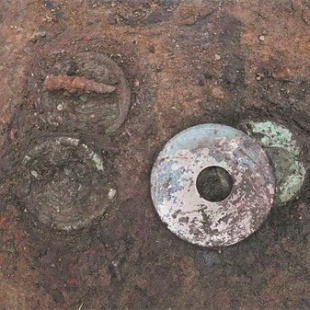
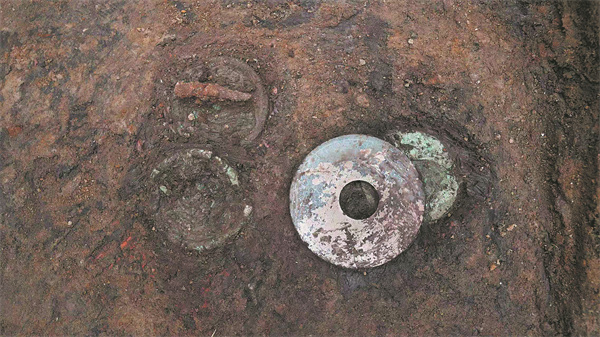
The excavation team unearthed 112 sets of artifacts from 51 ruins, including 13 tombs, six wells, and nine ash ditches. The pottery jars and fragments that bear the seal imprint "lang xian" were found in two ancient wells, making them the excavation's most important findings. Other unearthed artifacts include jade-ornamented swords and burial goods.
"The shape of the seal imprint and the font of the characters match known Qin Dynasty official imprints, marking the first time that official seal-type relics have been excavated, and confirming that the region embraced a commandery-county governance system during the Qin Dynasty," says Peng Yu, head of the Archaeological Research Department of the Qingdao Institute of Cultural Relics Protection and Archaeology.
"The unearthing of 'lang xian' inscriptions is a major breakthrough. It is like a missing piece of a puzzle that helps us better understand the history of the Qin Dynasty," Peng says.
Archaeologists have also uncovered a well-preserved network of ancient water facilities at the Yingqian village north site, offering new insights into handicraft production during the transition period from the Warring States Period (475-221 BC) to the Qin and Han (206 BC-AD 220) dynasties.
The discovery, located in the excavation site's lower-lying western section, features an orderly, arranged complex, including two parallel ditches, 17 square pits, and two water wells, all predating the Han Dynasty tomb area found in the site's higher eastern section.
Yin Fengchao, director of the Qingdao institute, says: "The integrated system using wells dug at higher elevations, ditches for water transport, and storage pits, reveals sophisticated hydraulic planning."
"While its exact function requires further study, preliminary analysis suggests it supported water-intensive handicraft production," he adds.
The discovery at the Yingqian village north site corroborates historical records and, alongside the remains of high-status architectural complexes and kiln sites of the Qin Dynasty at the Langyatai Ruins, collectively testifies to the dynasty's governance in Language — including imperial tours to the east — as part of its broader unification campaign, says Yin.
The Langyatai Ruins are also located in Langya town, 6 kilometers from the Yingqian village.
Excavation of the Langyatai Ruins revealed structural foundations atop the mountain, along with vestiges of rooms, pathways, and an advanced drainage system.
The Langyatai Ruins were identified in January as a major state project constructed during Emperor Qinshihuang's (259-210 BC) eastern tours.
"The findings will deepen our research into the area's political and cultural shifts during this pivotal era, offering new insights into China's territorial integration in its early age," says Yin.
"The discovery has not only turned the history of the Qin Dynasty's governance system in Qingdao from texts in historical books into physical evidence, but sketched a vivid historical picture of Langya as a regional administrative center, with its dignified burial relics and intricately arranged handicraft remnants," he adds.