



Huangyan reserve a milestone in ocean governance









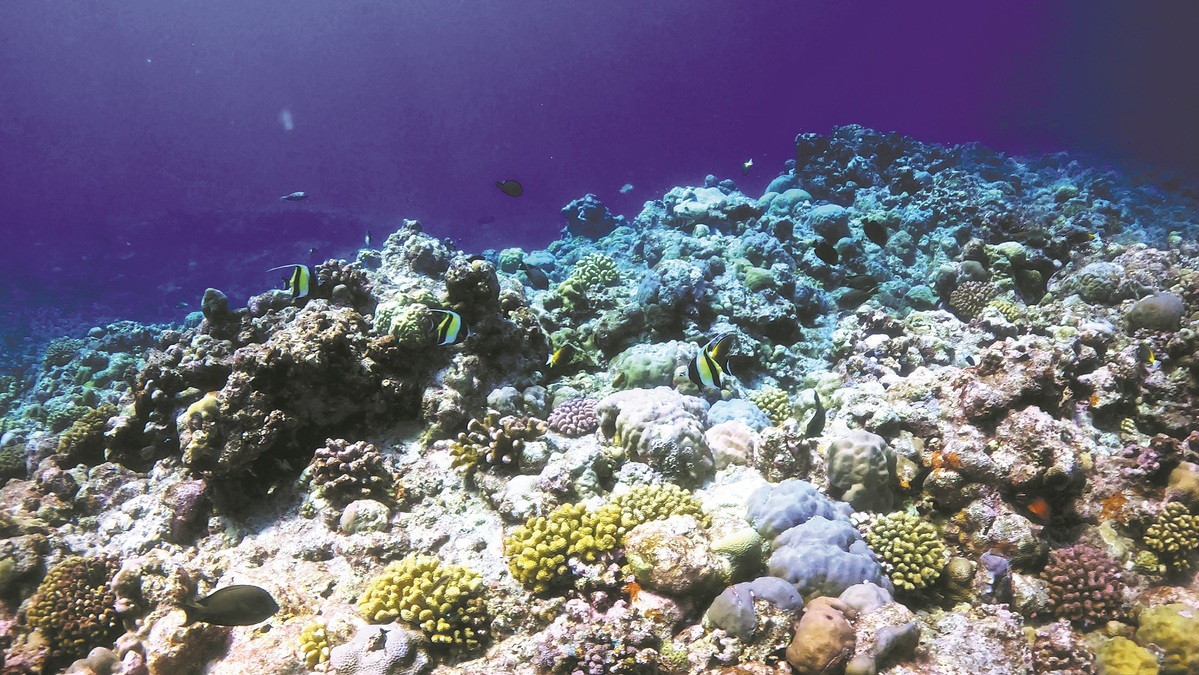
The State Council, China's Cabinet, approved the establishment of the Huangyan Island National Nature Reserve on Sept 10 in what is being hailed as a strategic decision reflecting the country's role as a responsible maritime power, conservator of marine ecology and promoter of regional cooperation.
The Huangyan Island nature reserve's main aim is to safeguard the coral reef ecosystems around Huangyan Island and help reinforce China's legitimate administrative presence in the region. In both environmental and geopolitical terms, the move will have constructive implications.
Huangyan Island has been an inherent part of Chinese territory since ancient times, and China has exercised jurisdiction over the island and its surrounding waters for decades. Establishing a national-level nature reserve is therefore an act of governance, in accordance with domestic laws and regulations.
The establishment of the reserve reaffirms China's sovereignty over Huangyan Island and its surrounding waters. By delineating boundaries and creating functional zones, China is exercising its sovereign rights over the island and its surrounding waters through peaceful and lawful means.
Importantly, China's commitment to protect the marine environment around Huangyan Island is not a recent development. In fact, the establishment of the nature reserve is based on a solid foundation of long-term scientific research, eco-monitoring and proactive management.
An apt example of how China protects the marine environment around the island is the "Investigation and Assessment Report on Marine Ecology and Environment Status of Huangyan Dao" by the Ministry of Ecology and Environment. Based on extensive surveys and data analyses, the report says Huangyan Island's marine environment is generally in a healthy condition, with good water quality, stable coral reef ecosystems and relatively high biodiversity.
The report not only provided scientific validation for China's previous ecological protection efforts but also laid a solid foundation for more advanced conservation measures, reflecting China's commitment to scientific and transparent governance in sensitive maritime areas.
The establishment of the Huangyan Island nature reserve also advances China's broader ecological policy. China has long viewed the ocean as an essential part of its ecological civilization, a vision anchored in sustainability and scientific management. The coral reefs around Huangyan Island play a vital role not only in preserving biodiversity but also in maintaining the health of fisheries, regulating climate, and protecting coastlines.
Despite that, however, the marine ecosystems face serious threats from illegal fishing, pollution and climate-related stress.
The new reserve is a key government measure toward implementing China's "sustainable blue economy", whose double-zone structure allows for both conservation and controlled scientific research, balancing ecological protection with the need for marine science and resource monitoring.
The move strengthens China's efforts to strengthen marine biodiversity, promote low-carbon maritime industries, and enhance the health of marine ecosystems.
On the global front, the initiative aligns with international frameworks such as the United Nations 2030 Agenda for Sustainable Development and the Convention on Biological Diversity, while consolidating China's status as a responsible maritime power that fulfills its global commitments, while setting benchmarks for ocean governance.
Also, the Huangyan Island nature reserve has the potential to become a regional cooperation platform. But since the South China Sea has, of late, been characterized by tension, there is a need to urge neighboring countries to shoulder joint responsibility and conduct joint studies to build ecological solidarity. By working together, the countries can turn the reserve into a model for regional collaboration in environmental monitoring, academic exchanges, capacity building, and sustainable resource management.
China looks forward to constructive engagement with neighboring countries and international partners to protect the marine environment and promote sustainable development. China's cooperative spirit shows that it is committed to building a maritime community with a shared future.
Besides, the decision to establish the nature reserve complements the ongoing efforts to advance the Code of Conduct in the South China Sea, and China's broader support for practical cooperation.
Also, the establishment of the Huangyan Island nature reserve reflects China's strategic transition from being a large maritime nation to a strong maritime power. China's transition, however, is not defined by expansionism, but by its capability to institutionalize ocean governance and provide public goods to the South China Sea region.
At a time when some external forces are continuing to make provocative moves in the South China Sea on the pretext of "freedom of navigation", China is offering an alternative path, a path based on law, conservation and cooperation. In this context, the marine nature reserve is more than a conservation initiative; it reflects China's forward-looking governance, strategic maturity, and use of peaceful means to deal with maritime affairs.
In other words, the establishment of the Huangyan Island National Nature Reserve is a new milestone in China's maritime policy. It is a rational, legal, and forward-looking measure that integrates sovereign responsibility with ecological vision. More importantly, it reflects China's determination to protect the ocean for the benefit of humanity.
The author is an associate research fellow at Huayang Center for Maritime Cooperation and Ocean Governance, Haikou, China.
The views don't necessarily represent those of China Daily.
If you have a specific expertise, or would like to share your thought about our stories, then send us your writings at opinion@chinadaily.com.cn, and comment@chinadaily.com.cn.





