



Sino-US talks a silver lining amid clouds









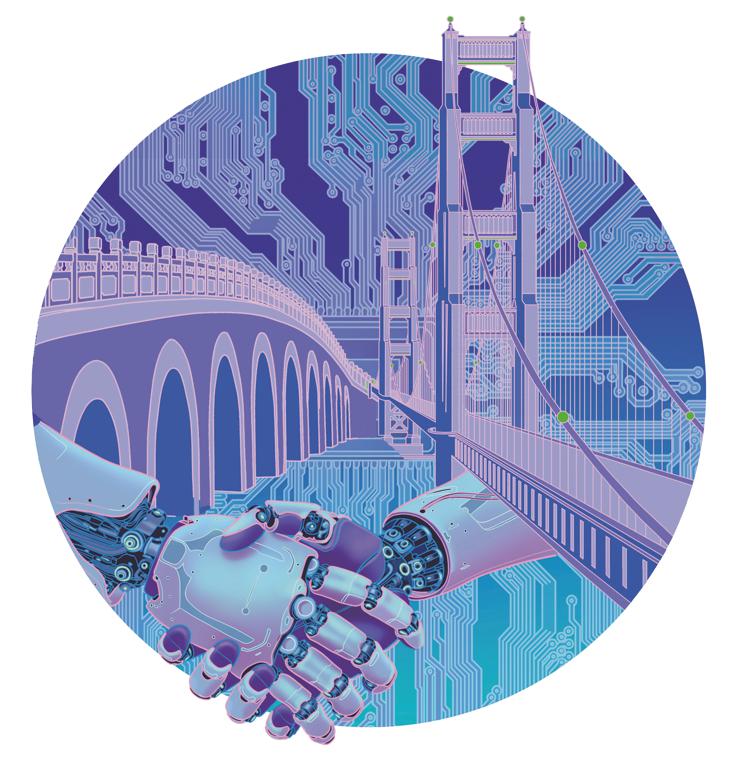
A breakthrough has been achieved in the high-profile TikTok issue. On Sept 14-15, Chinese and US economic delegations, led by Chinese Vice-Premier He Lifeng and US Treasury Secretary Scott Bessent, held talks on economic and trade issues in Madrid, and agreed to jointly resolve the TikTok and other issues.
The Madrid talks opened a window of opportunity to address the issues preventing the normalization of Sino-US relations and resolution of the disputes on advanced technology.
The trajectory of the dispute over TikTok shows the United States is in a structural predicament over its technology policy toward China: its strategy of putting excessive pressure on China is significantly constrained by domestic political, economic and social factors.
The US administration, for some years now, has been using "national security" as a pretext to justify its unilateral policies, but its failure to provide evidence to justify its actions has prompted many international observers to view its moves as a form of protectionism, which undermines the very market principles the US purports to champion.
By exerting political pressure on TikTok and damaging the global company, the US has raised widespread concern over its business environment. This also conflicts with the US' aim of attracting more capital and maintaining its status as a financial and technological center.
Besides, the first half of this year was witness to an unprecedented phenomenon: the emergence of "TikTok refugees" — a large number of young Americans who, fearing a ban on TikTok, "migrated "to the Chinese social media platform, Xiaohongshu, or RedNote, where they interacted with local Chinese users. The "migration" also reveals a broader trend toward mutual understanding and cultural exchanges.
While domestic complexities and pressure were reflected in the US policymakers' arguments, the Chinese delegation's strategic approach was nuanced yet clear, an approach that balanced "adherence to core principles" with "openness and flexibility". Speaking of principles, Vice-Premier He stated unequivocally that China will resolutely defend its national interests and the legitimate rights of Chinese enterprises operating overseas.
In TikTok's case, this means the Chinese government will handle technology export approvals in accordance with its laws and regulations. The companies involved conduct negotiations with their partners based on market principles and equality.
This adherence to principles and flexibility highlights Beijing's political acumen in complex negotiations. Its ideological underpinnings can be traced to China's civilizational philosophy of "harmony in diversity" and "seeking common ground while reserving differences". In modern diplomatic parlance, this translates into a strategy of principled negotiation: identifying non-negotiable core interests while seeking mutually beneficial solutions in other areas.
This approach is in stark contrast to the zero-sum ultimatums of Western governments. For China, maintaining flexibility and openness while adhering to the core principles is not a reluctant compromise but a proactive strategic choice: to maximize the potential for cooperation and dialogue while safeguarding its core interests.
Yet the fact that the two sides could reach a "basic framework consensus" on a contentious issue like TikTok shows that Sino-US relations cannot be defined by confrontation alone. It is far more complex and multidimensional.
In an era of economic and technological globalization, the two countries are connected through countless threads of multinational corporations, cultural products and people-to-people exchanges. This multi-layered and multi-domain interdependence makes the cost and risk of any "decoupling" prohibitively high. This also explains the stark contrast between Washington's "decoupling" rhetoric and the "voting with their feet" reality of US companies.
Artificial intelligence, arguably the most intense area of competition between China and the US for now, offers a compelling example: open-source large AI models from China, such as DeepSeek and Qwen, are being adopted by an increasing number of US and Japanese start-ups due to their superior performance and cost-effectiveness. As Martin Casado, a partner at the top Silicon Valley venture capital firm Andreessen Horowitz, said, there's an 80 percent chance that startups pitching to his firm are using Chinese open-source AI models. In the face of this deeply integrated technological ecosystem, the US' decoupling narrative seems detached from reality.
The Madrid talks are a silver lining. Looking ahead, the normalization of Sino-US tech exchange — and the broader bilateral relationship — hinges on whether the US will stop politicizing and weaponizing economic and technological issues.
For the US, the key is to work with China to forge a new type of major-country relationship based on mutual respect, peaceful coexistence and win-win cooperation. In the final analysis, this is not only about the interests of two countries, but also about fostering an open, innovation-oriented and collaborative global technology ecosystem for the shared future of humanity.
The author is an assistant research fellow at the School of Marxism, Fudan University.
The views don't necessarily represent those of China Daily.
If you have a specific expertise, or would like to share your thought about our stories, then send us your writings at opinion@chinadaily.com.cn, and comment@chinadaily.com.cn.





