When composer Zhou Long received an unexpected phone call from an old friend — conductor Shui Lan, a fellow graduate from the Central Conservatory of Music — he was excited, though their conversation was brief.
The conductor, who had been working with multiple orchestras around the world, was appointed as the artistic adviser to the China National Symphony Orchestra a year ago. He told Zhou that a monumental project was in the works: a new symphonic piece to mark the 80th anniversary of the victory in the Chinese People's War of Resistance Against Japanese Aggression (1931-45) and the World Anti-Fascist War. He invited Zhou to compose the symphony, bringing together 14 orchestras for a national commission.
The task was both an honor and a challenge, Zhou says.
Shui shared the vision: a symphony that would not only reflect the historical significance of the victory but also embody the spirit of resilience, unity and hope. Deeply moved, Zhou immediately began to conceptualize the music — one that would blend traditional Eastern philosophy with the universal power of music.
The result was Grand Harmony, a four-movement musical work for orchestra and chorus that takes the listener on a sweeping journey through history, struggle, remembrance and finally, the peace that emerges from the trials of war. The composition had its world premiere in Beijing with a concert on Sept 20, which opened the 2025-26 season of the China National Symphony Orchestra.
In the first movement, Zhou draws inspiration from the ancient wisdom of The Book of Rites, which says that "music is an echo of the harmony between heaven and the Earth".
He crafts a soundscape that echoes the philosophies of the Tang Dynasty (618-907), blending traditional Chinese musical elements with Western orchestral techniques. The movement flows like a river, timeless and expansive, evoking the grandeur of ancient Chinese civilization while acknowledging its continuous evolution. The music moves gently at first, before growing into something more complex and majestic, a tribute to the enduring spirit of China's cultural legacy.
As the symphony progresses, the mood shifts sharply. The second movement bursts forth with relentless energy and rhythmic intensity. Through fast-paced percussion, powerful brass fanfares and rapid string sections, the composer captures the heroism and grit of those who fought to protect the nation. It's a celebration of the unyielding spirit to protect one's homeland. The music is fast, aggressive and filled with urgency — like the battle cries of those who stood strong in the face of adversity.
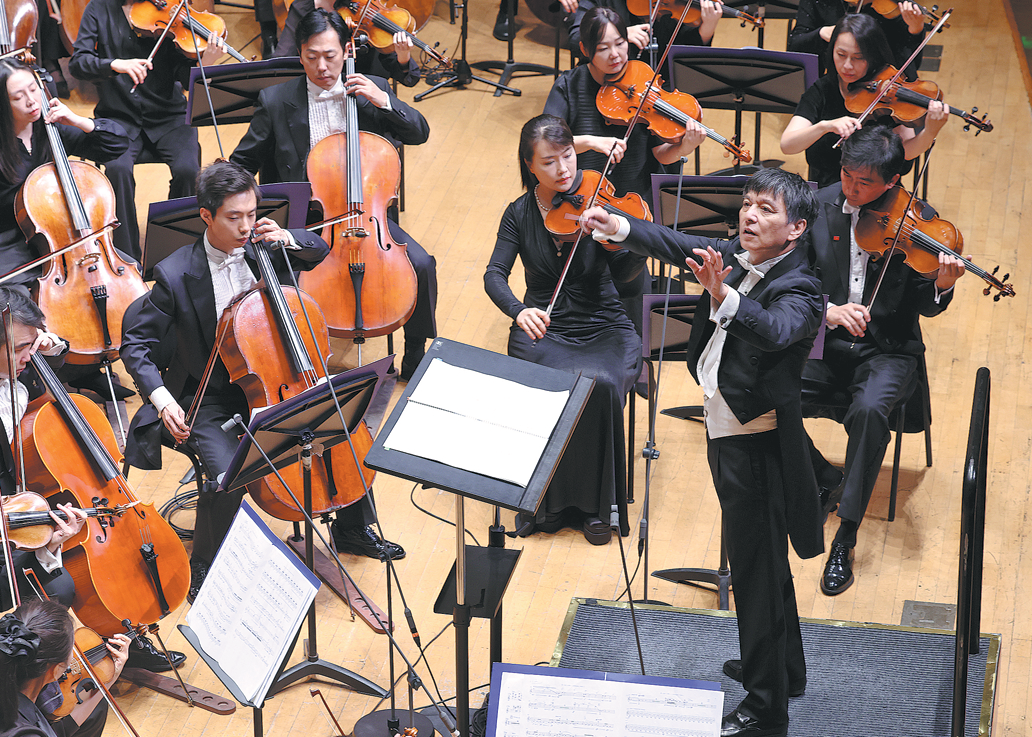
In stark contrast to the intensity of the second movement, the third movement introduces a somber, reflective tone. Employing the melody of a Cantonese folk song, titled Yue Guang Guang, or Bright Moonlight, the composer channels the sorrow and grief for the lives lost in the war. The melodies, slow and lyrical, are tender and melancholic, with strings and woodwinds creating an atmosphere of mourning.
"This movement is a musical meditation on sacrifice, a moment for the listener to pause, reflect and honor the memory of those who gave their lives for peace," notes Zhou, who observes that the use of the folk song makes the movement "soft yet powerful".
The final movement brings the symphony to a conclusion, symbolizing peace and unity. The music begins with the rhythmic pulse of timpani and brass, interspersed with bell chimes and horns, signaling a return to harmony. The full orchestra joins in, creating an uplifting, celebratory sound. This movement is a musical expression of peace, a collective affirmation that after struggle and sacrifice, there is hope for a united and harmonious future.
"The composer is known for his ability to bridge Eastern and Western musical traditions. The musical pieces serve as a universal language, an invitation for the world to join in the shared vision of peace and mutual respect," said conductor Shui at July's event in Beijing to announce the orchestra's new season.
After the premiere in Beijing, the composition was performed in Wuxi, Jiangsu province, on Sept 21.
"When I received this piece, I found that although it is set against the backdrop of war, it carries a core of love and peace," says Canadian conductor Marco Parisotto, who performed Zhou's Grand Harmony with the Wuxi Symphony Orchestra.
Born in Beijing, Zhou, 72, graduated from the Central Conservatory of Music in 1983. He traveled to the United States in 1985 under a fellowship to attend Columbia University, where he received a Doctor of Musical Arts degree in 1993.He is currently a professor of composition at the conservatory of the University of Missouri-Kansas City.
Zhou has also regularly traveled back to his home country to work with Chinese musicians and orchestras. In 2010, the Beijing International Music Festival commissioned Zhou to create the opera Madame White Snake based on a famous Chinese folk tale. With this work, he became the first Asian composer to win the prestigious Pulitzer Prize. In 2024, another of Zhou's compositions, Nine Songs — based on the classical Chinese series of poems written by patriotic poet Qu Yuan during the Warring States Period (475-221 BC) — was jointly commissioned by the Beijing International Music Festival, the Shanghai Symphony Orchestra and the Guangzhou Symphony Orchestra.
"Chinese culture has always been my inspiration and Chinese music is an indispensable part of Chinese culture," says Zhou, emphasizing the importance of Chinese musical traditions. "Western audiences are more interested in seeing how Chinese composers integrate their cultural roots into their music, rather than just focusing on their ability to compose for Western classical instruments. They want to understand how Chinese culture is expressed through music."
Contact the writer at chennan@chinadaily.com.cn