



New exhibition showcases wartime rescue of artifacts









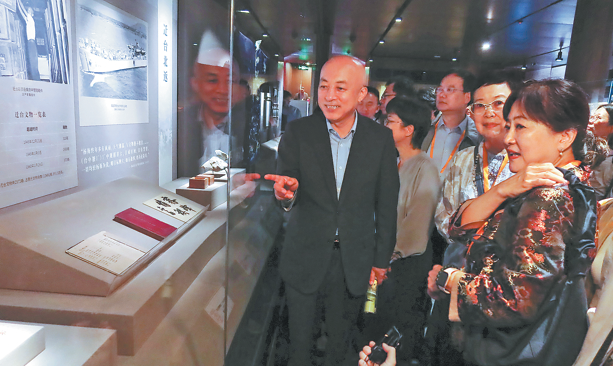
It was probably one of the largest wartime rescue missions of cultural relics in history.
In 1933, when invading Japanese forces had advanced to the Great Wall, staff of the Palace Museum in Beijing soon launched a project to evacuate precious cultural relics that were housed in this former Chinese imperial palace as well as other key venues in Beijing via a southward route in case the items fell into the enemy's hands.
Decades later, the bravery and determination of this mission was remembered on the 100th anniversary of the founding of the museum and the 80th anniversary of the victory in the Chinese People's War of Resistance Against Japanese Aggression (1931-45).
An exhibition commemorating the southward evacuation of the artifacts opened in the museum's Shenwumen (Gate of Divine Prowess) Gallery on Tuesday. Through cultural relics that were part of that trek — including porcelain, paintings and jade as well as related old photos, documents and other exhibits — an epic effort to safeguard the lineage of a country's civilization was unveiled for visitors.
"The arduous southward journey during the war of resistance, marked by numerous twists and turns, reflects the tumultuous national history and collective memory of the Chinese people," Wang Xudong, director of the Palace Museum, said at the opening ceremony of the exhibition.
"These cultural treasures represent the preservation and continuation of the brilliant Chinese civilization," he said. "They not only embody the unity and resilience of the Chinese nation in times of crisis, but also illustrate the enduring appeal of Chinese culture."
Wang said the museum had devoted itself to study relevant historical files and explore the value of the relocated relics, and the exhibition was the fruit of its endeavors.
The first batch of evacuated relics set off on its journey in February 1933 from the square before Shenwumen.
More than 13,400 crates of artifacts from the Palace Museum and around 6,000 crates from other venues, including Guozijian, the former imperial academy, were relocated.
After the evacuation of relics from Beijing to Shanghai and Nanjing — then China's national capital and present-day capital city of Jiangsu province — the relic protectors also built warehouses in Nanjing. Even during the tough years in the 1930s, some of these artifacts were escorted to the United Kingdom and the Soviet Union for exhibitions.
However, as the war spread to East China in 1937, these relocated treasures had to be evacuated again westward to Chongqing, as well as Hunan, Guizhou and Sichuan provinces. Following China's victory in the war in 1945, the relics began traveling again on the journey home.
"We also want to remind people how precious peace is through these relics that once endured the war and remained intact," said Xu Wanling, curator of the exhibition.
A wooden crate that once held the relics is displayed in the center of the Shenwumen Gallery. Covered by various seals through the years of turmoil and being a crucial witness to history, it had already become a key cultural relic as well, the curator noted.
Not a single artifact was lost in the yearslong trek, but not all relics finally returned to Beijing. For instance, about one-fifth of them were shipped to Taiwan in 1948 due to the civil war. They later became the cornerstone of the Palace Museum in Taipei.
"Numerous cultural workers participated in the mission to safeguard national treasures, and they were fearless in the face of difficulties and continued studies of the cultural relics," said Shih Chin-wen, secretary-general of Taiwan-based Sheen Chuen-Chi Cultural & Educational Foundation, a co-organizer of the exhibition.
"It reflected the Chinese nation's perseverance and an unstoppable cultural legacy," she said.
wangkaihao@chinadaily.com.cn


- International passenger train service links China, DPRK
- China plans 2026 pioneer satellite launch for low-latitude remote sensing constellation
- China's forest, grass coverage rate surpasses 56%: report
- LIVE: Deputies to the 14th NPC take passage interviews
- Macao establishes 4 state key laboratories: national political adviser
- Metronome and navigator: How China's five-year plans steer unprecedented modernization





