



Sino-Russian ties stronger on visa-free policy
China's 'extremely kind gesture' applauded by travelers, businesspersons










China's visa-free policy for Russian citizens holding ordinary passports sends a strong and positive signal to the business communities on both sides, and such measures will further strengthen economic ties between the two major economies, Russian business leaders said.
Chinese Foreign Ministry spokesman Guo Jiakun announced on Sept 2 that the country had decided to trial a visa-free policy for Russian ordinary passport holders starting from Sept 15, 2025, to Sept 14, 2026, allowing stays of up to 30 days for purposes such as business travel, tourism, as well as other private visits, people-to-people exchanges or transit.
"Russian holders of ordinary passports who come to China for business, travel and sightseeing, visiting relatives and friends, exchange visits, and transit for no more than 30 days can enter the country visa-free," Guo said, adding that, under the strategic guidance of the heads of state of both countries, Sino-Russia relations have been consistently healthy.
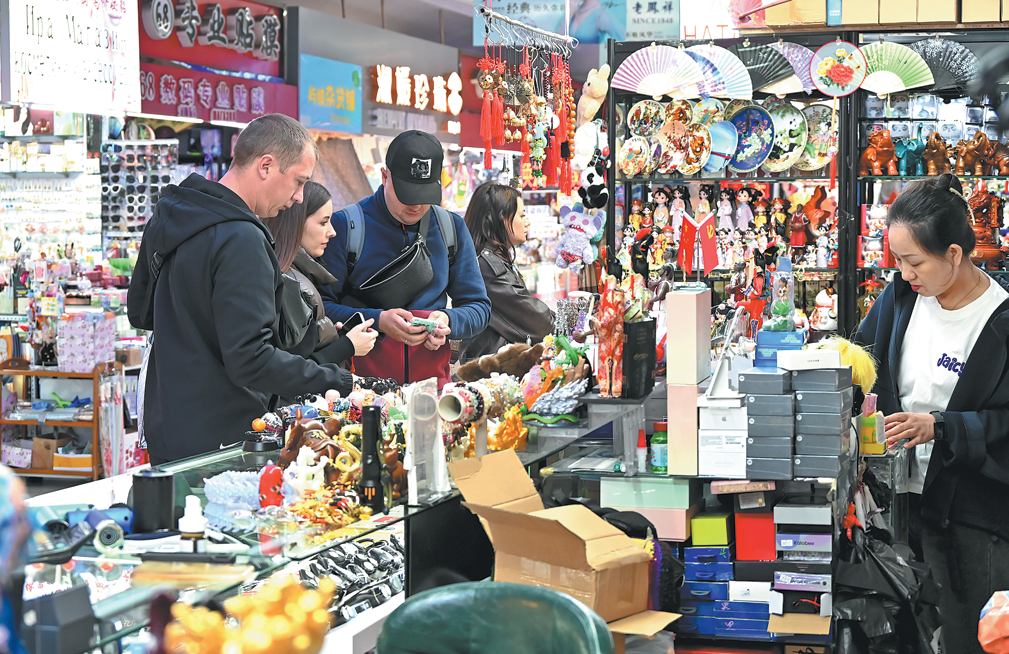
Two days later, Russian President Vladimir Putin responded to the friendly policy, describing it as "an extremely kind gesture" and claiming Russia would respond in kind.
"Undoubtedly, this will lead to more Russian citizens visiting China and contribute to the development of business, commercial ties and personal exchanges alike," Putin said, according to a release by the Kremlin website.
Pavel Titov, president of the Abrau-Durso Group of Companies, said the news excites the Russian business community as the policy makes it considerably easier for them to foster deeper, more trusting relationships with their Chinese partners.
The company, which is a leader in the sparkling wine market in Russia, has launched a flagship store on China's online retail giant JD. It is focusing on expanding its assortment on JD and deepening its engagement with Chinese wine lovers through livestreams and tastings.
"In our business, a handshake, a shared meal, and tasting wine together build a stronger foundation than any email ever could. Now, we can visit our partners more frequently to strategize, celebrate successes and address challenges face-to-face," Titov said.
The visa-free policy streamlines the logistics of business travel, said Rustem Muratov, CEO of Moscow-based Binnopharm Group, a biopharmaceutical major in the country.
Muratov said the company's subsidiary, Shanghai Binnopharm Chemical Co Ltd, has successfully integrated into the Chinese financial system through the use of banking instruments such as bank acceptance bills, and recently obtained its first corporate loan worth 5 million yuan ($701,825) at a favorable interest rate of 5 percent.
Muratov said the visa-free regime simplifies the logistics of business travel, and is especially important considering the significant number of contacts and projects requiring continuous in-person presence. Regular visits enable business partners not only to conduct negotiations, but also to establish solid, trust-based relationships with partners and take part in key industry events.
The need for Russian company executives and employees to travel to China had been increasing even before the policy was announced. Surana Radnaeva, CEO of Sinoruss, a Russian legal consultancy, said the number of business trips by Russian companies to China increased by 27 percent in the first half. China now accounts for 20 percent of all business trips by Russian businesses, compared to 15 percent a year earlier.
Russian businesspeople primarily visit Shanghai; Beijing; Guangdong province's Guangzhou and Shenzhen; and Harbin, Heilongjiang province, while the most active industry officials traveling to China are from the energy, oil and gas, and high-tech sectors, Radnaeva said.
Business trips by employees in the energy and oil and gas sectors grew by 58 percent, accounting for 43 percent of all trips, while trips by high-tech equipment suppliers saw a 93 percent increase, raising their share to 7 percent. Clearly, these numbers will grow significantly now that the full-fledged visa-free policy with China has been introduced, she said.
Marking China as a key export market, Russian integrated petrochemical company Sibur is jointly implementing large-scale and ambitious projects in the production of synthetic materials with China Petroleum and Chemical Corp, or Sinopec. One of the flagship projects is the Amur Gas Chemical Complex, which is scheduled to be commissioned in 2026.
A spokesperson for Sibur told China Daily that while the visa waiver initiative may not have a direct impact on business operations, it will significantly facilitate interactions between Sibur and its Chinese partners. The removal of visa requirements will make travel easier for Russian experts going to China.
"Thanks to the visa-free policy, a significantly larger number of Russian entrepreneurs will be able to attend global and regional business events in China, like forums, exhibitions, conferences, both industry-specific and general, such as the Canton Fair, China International Industry Fair, Yiwu International Commodities Fair," Radnaeva added.
Business visits from Russian regions to China will also become much easier, and more diverse, Radnaeva said. Last year saw the "Days of the Vologda Region" and "Days of the Irkutsk Region" held in China. At the end of 2025, the "Days of Primorsky Krai" will be held in Liaoning province. Visits by Russian governors and regional delegations of various levels, as well as business missions from industry organizations, will become more frequent. This will give a strong impetus to interregional business cooperation.
In terms of trade volume, China is by far Russia's leading partner, while last year Russia ranked fifth among China's foreign trade partners, according to the Russian leader.
Figures from China's General Administration of Customs released last month showed total trade between China and Russia stood at $19.14 billion in July, up 8.7 percent from June.
Moreover, bilateral trade in 2024 rose to $244.8 billion, making China the largest trading partner of Russia for 15 consecutive years.
Titov said Russian business sectors certainly have higher expectations for bilateral economic activity.
He noted that the visa-free policy is a powerful catalyst for business. Growth, he said, is driven not only by large corporations, but by the thousands of small and medium-sized firms that underpin trade.
"By removing a major barrier, China has enabled entrepreneurs to pursue opportunities more directly. We see this policy as a very pragmatic step that will undoubtedly stimulate economic energy and raise our business prospects in China," he said.
Radnaeva agreed. She said cross-border ties between the regions of the Russian Federation and China will strengthen, boosting trade, investment, industrial cooperation and more.
Russian entrepreneurs are seeking to find business partners in China, and the visa-free regime will greatly facilitate this process. Moreover, there is awareness in Russia of the opportunities and benefits of China's preferential economic zones, and there is a demand from Russian businesses to establish production in them, she added.
renqi@chinadaily.com.cn










