Yangtze porpoise swims back from the brink
The tragic loss of one species spurred the rescue of another









A painful setback can sometimes act as a catalyst for meaningful change. When the Baiji dolphin named Qiqi died in 2002, there was gloom in conservation circles. Qiqi, the sound of which means "rarity" in Chinese, had been living in captivity since it was rescued from the shallow waters of the Yangtze River in 1980.
The gloom turned to shock five years later, in 2007, when the Royal Society published an article declaring the Baiji functionally extinct. Functional extinction means that the population of a species has declined to an extent that it can no longer sustain reproduction under natural conditions. But the decline of the Baiji spurred the authorities to focus their efforts to conserve the Yangtze finless porpoise, another endangered species living in the Yangtze River ecosystem.
The Royal Society's article on the Baiji's decline was based on a sixweek field survey by scientists from seven countries, marking the first global extinction of a large vertebrate in over 50 years. Though it did not mean that the species was completely extinct, it underscored a far bigger problem plaguing the Yangtze River ecosystem.
The Baiji, or the Yangtze River dolphin, is classified as a separate family, which means that its functional extinction represents a significant gap from an evolutionary perspective, according to Wang Ding, secretary-general of the Chinese National Committee for the Man and the Biosphere Programme of UNESCO.
If the apex predator in the Yangtze River ecosystem could no longer survive, other species in the river would also gradually disappear under a domino effect, Wang added.
Wang said the dangers facing the Baiji were noticed almost three decades earlier. "As early as 1978, we became aware of the perilous situation facing the Baiji, with only about 300 dolphins remaining. Our research group was specifically established at that time for the study and conservation of the species," he said. The government and research institutions invested substantial human and financial resources in rescue efforts, including establishing protected areas and intensifying scientific research. However, the results were less than satisfactory and the number of Baiji dolphins steadily declined.
Qiqi's death in 2002 followed by the declaration of functional extinction in 2007 sealed the fate of the species. "It was a tremendous tragedy and also a painful lesson," Wang said. But the silver lining was that it shifted the focus of conservation efforts to the Yangtze finless porpoise — the sole extant cetacean in the Yangtze River.
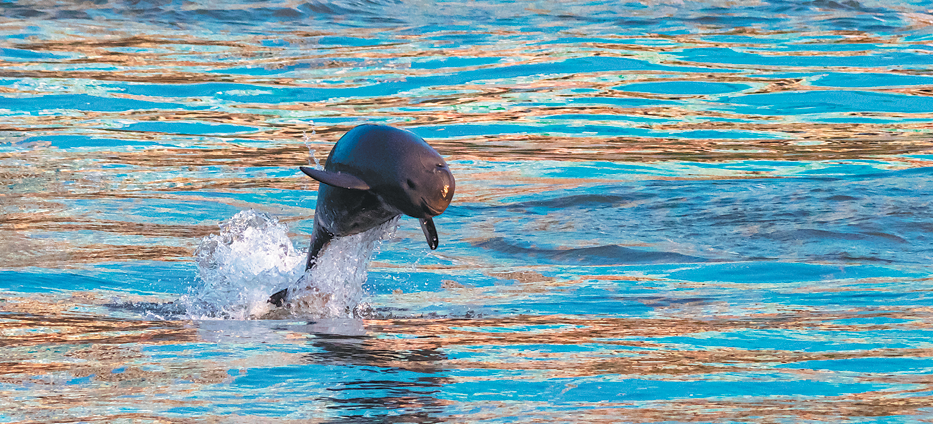
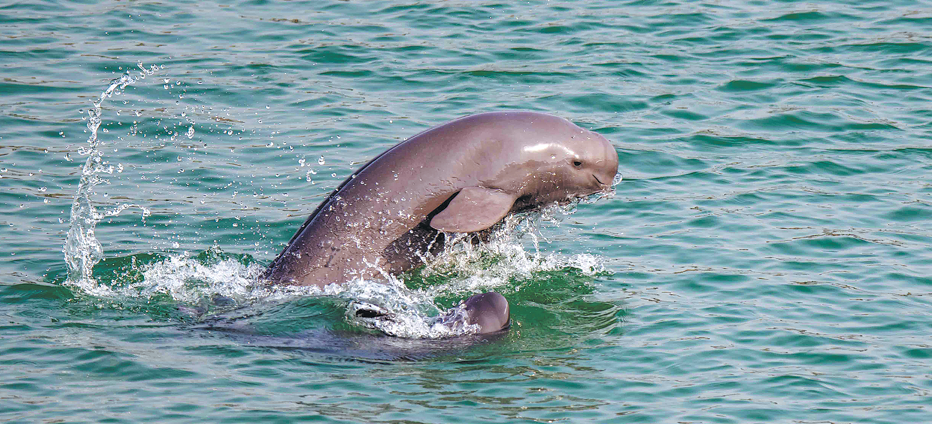
Compared to the Baiji, the Yangtze finless porpoise is smaller, lacks a dorsal fin, and has a shorter and broader rostrum. Wang Xi, a researcher from the Museum of Aquatic Organisms under the Institute of Hydrobiology, Chinese Academy of Sciences, said that the ancestors of the Yangtze finless porpoise migrated from the oceans hundreds of thousands of years ago, adapted to the freshwater environment and established habitats in the Yangtze River. Like the Baiji, they are also apex predators in the Yangtze ecosystem.
However, the spread of economic development and increase in human activities had led to a sharp decline in Yangtze finless porpoise population. Their numbers dropped from around 2,700 in the early 1990s to just about 1,800 in 2006. In 2012, a field investigation led by the Ministry of Agriculture and Rural Affairs found that only about 1,040 finless porpoises remained — 460 in Poyang Lake, 90 in Dongting Lake and the rest in the main stream of the Yangtze River. The alarming drop in numbers led the International Union for Conservation of Nature to classify the Yangtze finless porpoise as a critically endangered species in 2013.
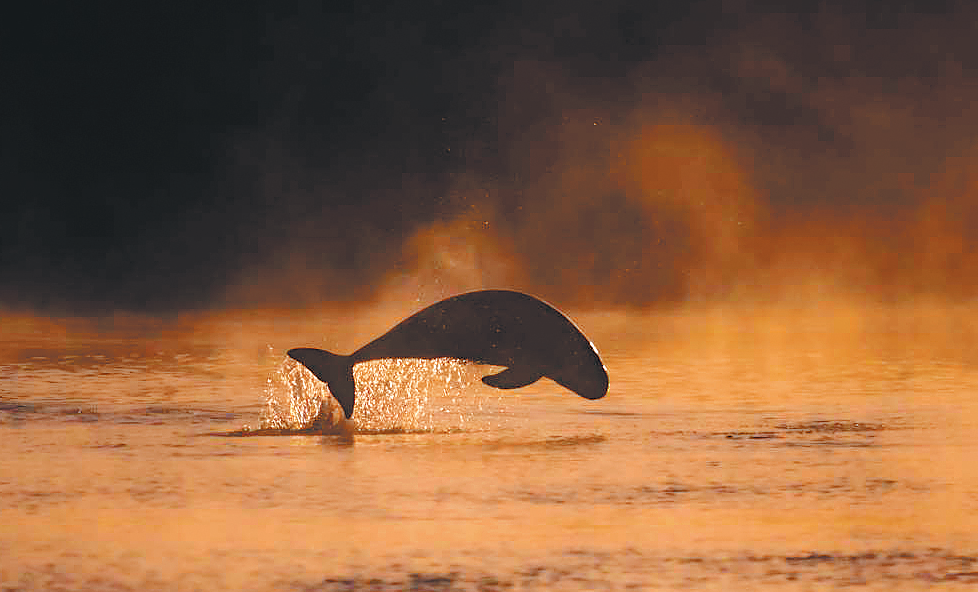
"The chief cause of the decline was the surge in vessel traffic in the river," Wang said. "As a cetacean species highly dependent on echolocation for foraging and communication, the Yangtze finless porpoise is extremely sensitive to underwater noise. The noise generated by motorised vessels disrupts their behavioral patterns, impairs echolocation efficiency and even poses lethal threats."
In addition, factors like vessel collisions, water pollution as well as habitat fragmentation caused by hydropower projects and dock construction further exacerbated population pressures.
As a first step, the implementation of a three-pronged protection strategy was intensified. The strategy includes ex-situ conservation, in-situ conservation, and captive breeding and rearing.
"Ex-situ conservation is a critical strategy and acts as a genetic reservoir. It involves relocating the Yangtze finless porpoises to enclosed or semi-enclosed water bodies with ecological conditions similar to the Yangtze River for dedicated protection," Wang said. These porpoises are later reintroduced into the wild once the river's environment improves.
The Tian'ezhou oxbow in Shishou, Hubei province, also a national nature reserve for the Baiji, was recognized as an ideal site for Yangtze finless porpoise ex-situ conservation because its water quality was comparable to the Yangtze River and there was no disturbance by ships. There are now more than 150 Yangtze finless porpoises living in the four ex-situ reserves and roughly 10 calves are born every year.
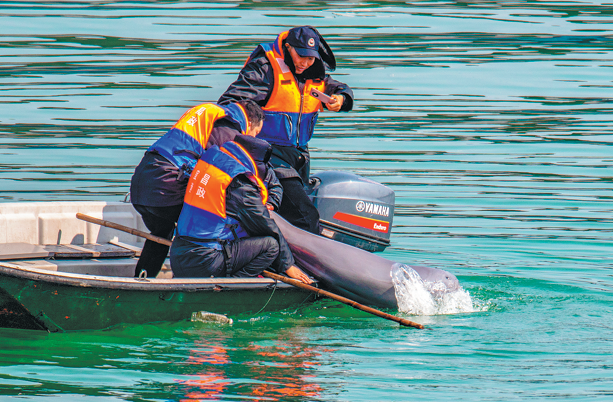
In-situ conservation involves establishing nature reserves in areas with dense Yangtze finless porpoise populations. China has established eight such conservation areas along the Yangtze River's main stream and in Dongting and Poyang Lakes, covering over 30 percent of the river's middle and lower reaches.
Captive breeding and rearing mainly take place at the Baiji Dolphinarium in Wuhan, where Qiqi once lived. The aquarium is now home to 12 finless porpoises, five of which were born under captive breeding conditions, including three second-generation porpoises, Wang said.
Thanks to the three-pronged strategy and the measures taken to protect and restore the Yangtze River, including the Yangtze River Protection Law and the 10-year fishing ban, the Yangtze finless porpoise population has rebounded in recent years. From 1,012 finless porpoises in 2017, the population increased to 1,249 in 2022, marking the first-ever rebound since monitoring began. Wang says this is "extremely rare", because freshwater cetacean populations are typically hard to recover once they begin to decline.
Wang Ding said that the survival conditions of many cetacean species worldwide are currently of great concern. Data from the IUCN show that, as of July 2020, there are 131 known cetacean species globally, among which 22 are classified as critically endangered and 20 as endangered.
"China's conservation efforts for the Yangtze finless porpoise have received high praise internationally, with its methods, like passive acoustic monitoring, being promoted in Southeast Asia. This technology is now used for monitoring and conserving Irrawaddy dolphins in Cambodia's Mekong River," Wang said.
Wang Ding added that Chinese scientists are exploring the use of artificial intelligence in cetacean conservation and are collaborating with various countries to develop tailored conservation and technological solutions for them.
"An IUCN expert once said that 'China's conservation practices for the Yangtze finless porpoise have illuminated the dawn for the global conservation of cetacean species'," Wang said. "This is our pride and also our long-lasting commitment," he added.
limenghan@chinadaily.com.cn
Doom to boom
The perilous journey of the Yangtze finless porpoise:
Early 1990s: Total population estimated at 2,700
2006: Numbers decline to 1,800
2012: Field investigation reveals only about 1,040 remain
2013: Put on critically endangered list by International Union for Conservation of Nature
2017: Numbers down to 1,012 but decline now slower
2020: A 10-year fishing ban in the Yangtze River basin is imposed
2021: Elevated to first-level State protection
2022: Population rebounds to 1,249