



Harnessing marine resources for sustainable development









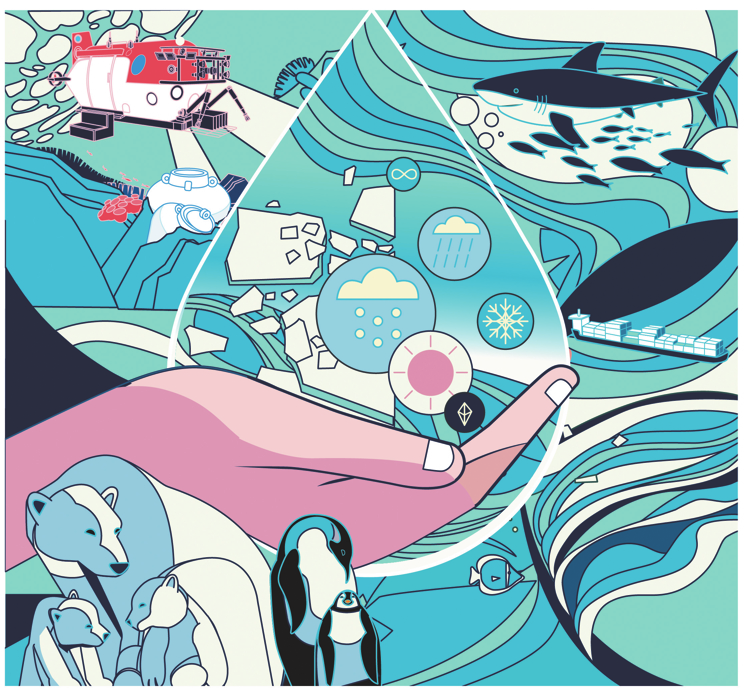
The vast ocean is a place where opportunities and challenges intertwine. With the surging global demand for deep-sea resource development, transition to green and low-carbon development, and smart ocean governance, the ocean has increasingly become a focal point of international attention.
Addressing climate change, developing marine renewable energy, enhancing blue carbon sequestration, achieving decarbonization in shipping, and combating marine pollution have become pressing global imperatives. It has emerged as an international consensus to coordinate ocean development and protection, foster a sustainable ocean economy, and build a more beautiful and abundant ocean.
I. The ocean is a cornerstone of human survival and sustainable development. We must deepen our care for, understanding of, and strategic management of the ocean.
The ocean plays a crucial role in sustaining the Earth's ecological balance. It is the planet's largest heat reservoir, absorbing 30 percent of global carbon dioxide emissions and 90 percent of the excess heat generated since the Industrial Revolution. Its carbon sink capacity is five times that of tropical rainforests, storing 38 trillion tonnes of carbon, thereby slowing the pace of global warming.
The ocean is also the Earth's greatest climate regulator: it produces 50 percent of the oxygen we need, supplies 86 percent of atmospheric water vapor, and, through ocean currents, transfers solar radiation from the equator to the poles, effectively regulating global climate and temperature distribution.
The ocean supports human survival and development. About 40 percent of the world's population lives within 100 km of the coast. Marine industries provide employment for more than 300 million people. The ocean nurtures 80 percent of the Earth's biodiversity and supplies over 20 percent of animal protein consumed by humans.
The ocean also holds 45 percent of the planet's oil and gas resources, while the development potential of offshore wind, tidal and wave energy could reach up to several times the world's electricity demand.
The ocean drives global economic growth. Since the 1970s, the global ocean economy has doubled nearly every decade, with its share of global GDP rising from 0.73 percent to over 4 percent.
If measured as a single economy by GDP, the ocean would rank as the world's seventh-largest. In many countries, the growth rate of gross ocean product (GOP) surpasses overall GDP growth. In 2024, the growth rate of China's GOP exceeded that of the national GDP by 0.9 percentage point.
The ocean carries humanity's future destiny. Today, as the world undergoes profound changes unseen in a century, challenges such as the depletion of land-based resources and climate change are unprecedented.
The ocean has thus become a strategic frontier for high-quality development in the future, with a new wave of the ocean economy rapidly emerging. At the same time, the question of how to balance development with ecological protection has become a new challenge for humanity.
International cooperation to jointly promote ocean prosperity and protect the marine environment has become the inevitable choice to address global challenges and advance the healthy development of the world economy.
II. China remains committed to the strategic management of the ocean, pursuing maritime strength, and actively promoting comprehensive and high-quality ocean development.
China's strategic management of the ocean has a long history. As early as the pre-Qin period, there were practices such as "boiling seawater to make salt." During the Tang and Song dynasties, the Maritime Silk Road connected the East and the West. In the first half of the 15th century, the renowned Chinese navigator Zheng He's seven voyages to the Western Seas marked a remarkable chapter in the human history of navigation.
Since the launch of reform and opening-up, China's ocean economy has entered a period of rapid growth. In recent years, to create a double development dynamic with the domestic economy as the mainstay and the domestic economy and international engagement providing mutual reinforcement, China has adhered to integrated land-sea planning, advancing ocean economic development, marine ecological civilization, and international cooperation in a coordinated manner, so as to achieve high-quality development of the ocean.
China's marine economy has continued to grow steadily. In 2024, the country's GOP reached 10.5 trillion yuan (about $1.48 trillion), up 5.9 percent year-on-year, accounting for 7.8 percent of GDP.
China maintains the world's largest port capacity, with seaborne trade volume and container throughput both exceeding one-third of the global total. The country has also built 169 national marine ranches, while its output of marine products has ranked first worldwide for 36 straight years.
Meanwhile, the country holds more than 50 percent of the global market share in ships and ocean engineering equipment, with shipbuilding capacity topping the world.
Its increase in sea crude oil output accounted for 75 percent of the total increase in crude production, while new and cumulative offshore wind power installations both made up over half of the global total.
China is also accelerating innovation in marine science and technology. A series of major facilities have been completed and put into operation, including the Mengxiang (Dream) ocean drilling vessel, the Antarctic Qinling Station, the deep-sea manned submersible Fendouzhe (Striver), the icebreaker Xuelong 2, and the Deep Sea No 1 oil and gas platform. The domestically developed MAZU ocean forecasting model has also been deployed, raising early-warning and forecasting capabilities to the world's advanced level.
Oil and gas exploration has advanced from waters 300 meters deep to 1,500 meters, while breakthroughs in core drilling technologies for deep-sea soft seabeds have enabled trial mining of combustible ice.
National-level innovation platforms have also been expanding, with national laboratories in marine fields such as Laoshan laboratory now in operation.
Notable progress has also been made in advancing ecological conservation. An integrated land-sea spatial planning system has been established, and land reclamation from the sea has been fully banned except for major national projects. A natural shoreline control mechanism has been improved, with marine areas, islands and coastlines now managed through layered and classified regulation.
Since the start of the 14th Five-Year Plan (2021-25), the country has approved the use of 9,858 square km of sea and island areas and revitalized 159 square km of existing reclaimed land.
Programs such as Blue Bays, Harmonious and Beautiful Islands, and Beautiful Coastlines have been launched. About 150,000 square kms of marine ecological protection redlines have been designated, along with 352 marine-related nature reserves.
From 2016 to 2024, China carried out 194 marine ecological protection and restoration projects, helping rehabilitate 1,780 km of coastline, restore more than 53,000 hectares of coastal wetlands, and expand mangrove forests to 31,000 hectares.
Meanwhile, China has deepened international cooperation in the marine sector. It has signed agreements with more than 50 countries and international organizations, and advanced practical cooperation with nations along the 21st Century Maritime Silk Road.
China has also actively taken part in the United Nations (UN) Ocean Conference and the APEC Ocean-Related Ministerial Meeting, while launching cooperation forums with Southeast Asian countries, African countries and small island states to share its proposals and initiatives.
The country has established a national committee to implement the UN Decade of Ocean Science for Sustainable Development (2021-30), drawing up an action framework and securing approval for one collaborative center, five implementation partners, nine major science programs and 21 projects.
China has also engaged actively in key international negotiations, including the BBNJ Agreement and regulations on the development of seabed mineral resources, contributing its ideas and solutions to global ocean governance as a responsible major country.
III. China will continue to develop and refine its maritime strategy, forging a path toward maritime strength with Chinese characteristics.
China has now embarked on a new journey of comprehensively advancing the great rejuvenation of the Chinese nation through Chinese modernization.
On July 1, Chinese President Xi Jinping emphasized at the sixth meeting of the Central Commission for Financial and Economic Affairs that advancing Chinese modernization requires promoting the marine economy's high-quality development and forging a Chinese path of leveraging marine resources to achieve strength.
This requires a greater focus on innovation-driven growth, efficient coordination, industrial renewal, harmony between human and the sea, and win-win cooperation.
To implement President Xi's key directives, focus should be placed on advancing six main areas of work:
First, to strengthen top-level design and policy support. China will implement major strategic deployments and reform tasks, including enhancing the institutions and mechanisms for promoting the development of the marine economy, and formulate the 15th Five-Year Plan (2026-30) for marine economic development. China will enhance territorial space governance over marine and coastal zones, comprehensively improve marine resource utilization efficiency, and develop blue finance by making coordinated use of financial instruments to support the green and low-carbon development of the marine economy.
Second, to enhance independent innovation capabilities in marine science and technology. China will optimize the layout of major innovation platforms, focus on deep-water, green and safety sectors, and achieve breakthroughs in core marine technologies. China will strengthen basic, frontier and strategic technology reserves in marine fields, implement major marine science and technology projects and programs, enhance technology transfer services, and promote deep integration of marine sci-tech innovation with industrial innovation.
Third, to strengthen, optimize and expand marine industries. China will accelerate the development of a modern marine industrial system, make forward-looking arrangements for future industries such as deep-sea and marine digital industries, and vigorously develop emerging marine sectors, including marine energy, marine pharmaceuticals and bioproducts, and seawater desalination. China will promote the green and low-carbon transformation of traditional marine industries and encourage and guide social capital to actively participate in marine economic development.
Fourth, to strengthen bay area economic development and integrated planning. China will promote the deep integration of the marine economy into major national regional strategies, create regional growth poles for the marine economy, and build strong maritime provinces, modern marine cities and marine economic development demonstration zones. China will optimize the spatial layout for marine development and protection, guide the optimization and integration of coastal port clusters, and facilitate the rational flow and efficient agglomeration of resources and factors.
Fifth, to reinforce marine ecological protection and restoration. China will strictly control and regulate sea reclamation, actively promote layered and three-dimensional utilization of sea areas, and strictly observe marine ecological protection red lines. China will establish a marine nature reserve system, construct marine ecological corridors and biodiversity conservation networks, continue implementing major projects for marine ecological protection and restoration, establish and improve the blue carbon trading system, and enhance the marine ecological early-warning and monitoring system.
Lastly, to deeply engage in global ocean governance. China will advance its "Blue Partnership" initiative, focusing on joint scientific expeditions, offshore oil and gas surveys, disaster prevention and mitigation and the blue economy. China will carry out comprehensive, multi-domain, and deep-level bilateral and multilateral cooperation with countries along the Belt and Road. Under the framework of the UN Decade of Ocean Science for Sustainable Development (2021-30), China will launch international science and technology programs and provide more public knowledge and service products.
China will always uphold the spirit of peace, development, cooperation and mutual benefit. Through concrete actions, China will practice the concept of building a maritime community with a shared future, work with all countries to actively address marine crises and challenges, continuously deepen practical cooperation in the marine economy and related fields, and jointly build the foundation for marine ecological civilization, so as to create a beautiful and abundant ocean, and achieve common development and prosperity.
The author is China's vice-minister of natural resources and head of the State Oceanic Administration. The views don't necessarily reflect those of China Daily.
If you have a specific expertise, or would like to share your thought about our stories, then send us your writings at opinion@chinadaily.com.cn, and comment@chinadaily.com.cn.





