Pheasant's plume
The rare Sclater's monal makes its home in Yunnan's high-altitude forests










Editor's note: As protection of the planet's flora, fauna and resources becomes increasingly important, China Daily is publishing a series of stories to illustrate the country's commitment to safeguarding the natural world.
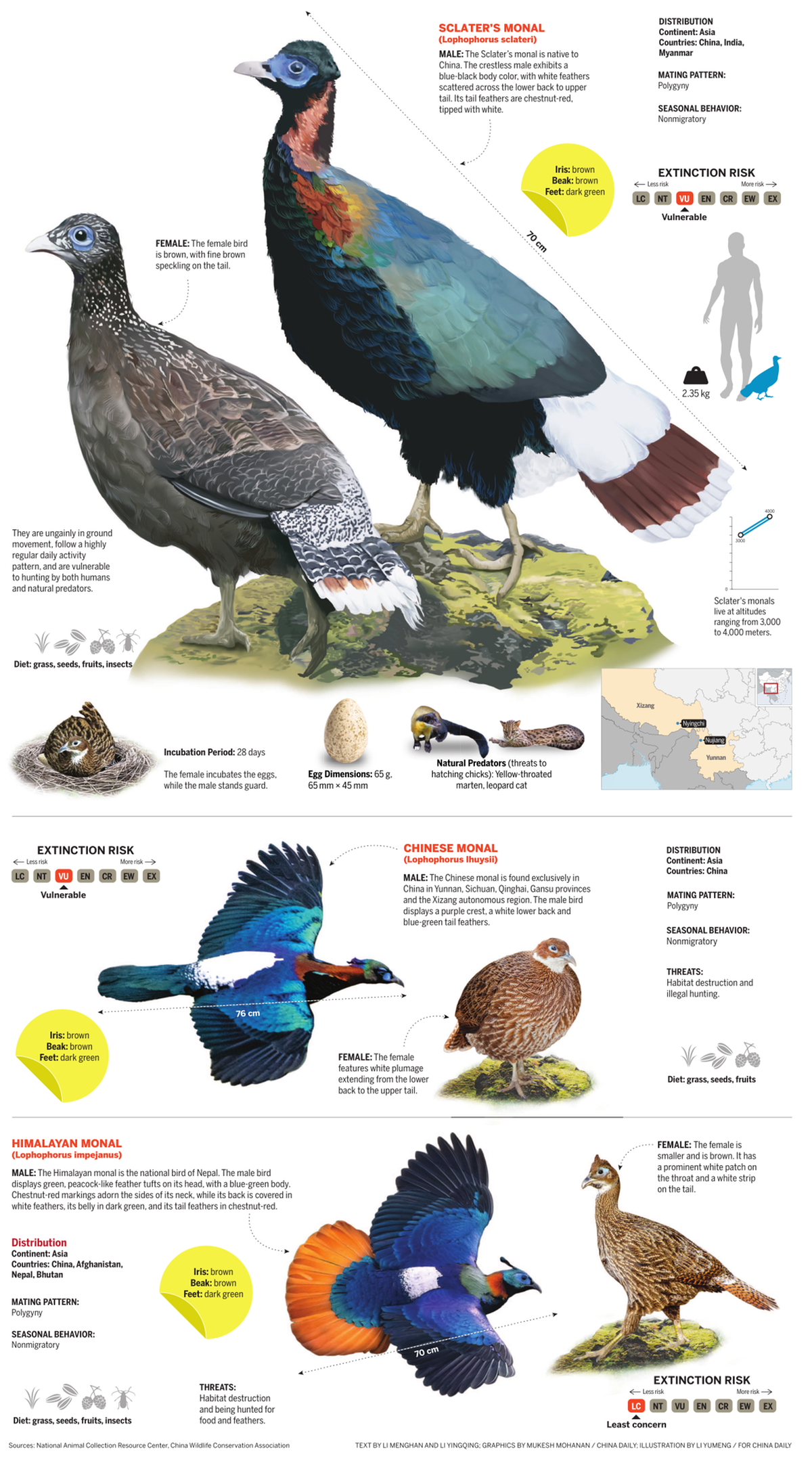
The Sclater's monal, a rare pheasant species that inhabits the mountain forests of southeastern Xizang autonomous region and western Yunnan province, is most well known for the purple-green plumage exhibited by its males.
The species, classified as "vulnerable" by the International Union for Conservation of Nature, has been most well-documented at the Gaoligongshan National Nature Reserve in Yunnan.
Wang Bin, an official from the Lushui administration bureau of the reserve, has been passionate about the conservation of nature for decades.
"The bird in this video is a male Sclater's monal (Lophophorus sclateri)," said Wang, pointing at his phone. "I took this video around 10 years ago when I first started to monitor these birds."
Known locally as the "snow goose" due to its distinctive goose-like call, Scalter's monals are found at altitudes of around 3,000 to 4,000 meters. Outside of China, these birds can also be found in India and Myanmar.
There are three species of monal pheasants, but what makes Sclater's monals unique is that the males are crestless.
The species has been threatened with habitat loss, overhunting and fragmented populations, resulting in China placing them under first-class State protection.
Wang attributes their small population partly to their high requirements for nest selection. If they fail to find a suitable nest for incubation, they will decline to breed.
"Due to the high altitude, the minimum temperature during their breeding season, which runs from April to June, can drop to 0 C," Wang said.
"Therefore, their primary requirement for a nest is that it must be sunlit and sheltered from the rain. In addition, the nest needs to be well-hidden to avoid being detected or approached by predators such as leopard cats and yellow-throated martens."
Similar to peacocks, male birds display their magnificent plumage to attract the attention of females during the breeding season. The males may fight with each other to compete for mating rights and territory.
Through observation, Wang found that the higher the altitude, the more formidable the males tend to be. He recalled one male, identified by a broken feather, had faced and won three fights in a single day.
Wang said that the males' vibrant plumage also serves as a way to protect their mates and offspring.
Sclater's monals typically lay a clutch of three eggs, with an incubation period of 28 days and a hatching success rate close to 100 percent.
The females are responsible for incubation, and leave the nest only every two days to forage and excrete, with each outing lasting no more than 30 minutes to prevent the chicks from freezing. The males are left on guard, using their colorful feathers to attract the attention of predators when danger arises.
Once the chicks hatch, they leave the nest with their mother to forage. However, their underdeveloped wings and feathers force these typically tree-dwelling animals to live on the ground, which poses a significant risk to the chicks' survival.
"For the timid Sclater's monal, we hope to take more photos of them. This way, we can learn about their habits and understand how they behave. But we always make sure not to disrupt their normal lives while doing our work," Wang said.
"Since they live in the core area of the national nature reserve, I think the best way to protect them is to keep a close eye on them. As long as they're living peacefully, we should just follow the natural order of things and prevent any interference," he added.
Contact the writers at limenghan@chinadaily.com.cn