China becoming a global leader in research









China is emerging as a leading research nation across a wide range of disciplines, with more original innovations being published in journals by the Netherlands-based publishing and information analytics company Elsevier, a senior executive of the company said.
Some of the research has been groundbreaking as decades of investment in basic and fundamental studies have begun to pay off, and more advances are expected, said Laura Hassink, managing director for scientific, technical and medical journals at Elsevier, whose titles include The Lancet and Cell. She spoke in an exclusive interview in Shanghai recently.
"We definitely see a growing number of research articles from China these years. What's even more important, we see that the quality continues to ascend, making the impact of the Chinese published articles grow. That echoes the high-quality research being done in China," Hassink said.
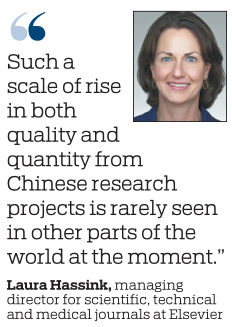
"Such a scale of rise in both quality and quantity from Chinese research projects is rarely seen in other parts of the world at the moment," she said during the Pujiang Innovation Forum, held in September in Shanghai, where Elsevier was an academic strategic partner.
International collaboration has been a key driver in China's systematic improvement in research quality, Hassink said.
China began to expand international research collaboration about a decade ago, and "what we see in general is that the more international, the better a research usually is," she said.
One notable example was a commission report on combating liver cancer, led by Chinese experts and published in The Lancet in July. The report involved more than 50 specialists from countries and regions that include Japan, South Korea, the United States, Spain, France and Italy.
According to the report, more than 60 percent of the world's liver cancer cases can be prevented by addressing risk factors. If the annual incidence rate is reduced by at least 2 percent, the rising trend of new cases and deaths could be reversed by 2050.
"It was the first time in the journal's more than two-century history that it had invited Chinese scholars to lead a cancer-related commission to address a major global health challenge," Hassink said, adding that China is also strong in fields such as physical science, material science and artificial intelligence.
Data from Elsevier showed that China's research output published in the top 1 percent of high-impact journals achieved a compound annual growth rate of 26 percent over the past five years. The country's field-weighted citation impact has also consistently remained above the global average.
"Something the Chinese governments are doing really well is that they have made scientific research a priority years ago and have been fairly steadfast along the journey to reach the ambitions at the end of the day," Hassink said.
China's investment in funding and its strategic approach to allocating resources are also impressive, she added. Different universities are designated focus areas, which allows them to advance science in specialized fields.
The surge in scientific activity and collaboration has also brought Hassink to China more often. This year marked her second visit, compared with once annually in the past since her first trip nearly two decades ago.
At the Pujiang Innovation Forum, Elsevier signed a strategic cooperation memorandum with the forum's organizer, an initiative aimed at enhancing high-level academic exchanges between China and other countries.
"We will promote scientific dialogues through recommending experts in international academic disciplines, cohosting high-end international academic conferences, and supporting the training of scientific and technological talent in Shanghai, allowing the global scientific community to unleash greater vitality," Hassink said.
On artificial intelligence, which Elsevier sees as a powerful tool for advancing scientific research, Hassink said the company has already built products that allow researchers to quickly scan literature. But she stressed that AI tools must adhere to principles of data privacy and transparency, with human oversight essential.
In the AI age, she added, ensuring the quality and trustworthiness of journals is more important than ever, given the overflow of misinformation.
zhouwenting@chinadaily.com.cn






- 10 dead and 84 injured in explosion at steel plant
- China unveils flexible urban planning rules to improve lives, foster new industries
- Ex–China Construction Bank executive gets 18 years for bribery, loan violations
- First batch of eco-friendly pioneer zones for construction of beautiful countryside unveiled
- Woodpeckers, finches captured in Jilin winter scenes
- Mainland reiterates 1992 Consensus as foundation for resuming cross-Strait dialogue