Emergency service










China's prioritizing of green development in its 14th Five-Year Plan has made it a catalyst for global sustainability
In late October, China will convene a plenum of the 20th Central Committee of the Communist Party of China to set the course for the 15th Five-Year Plan (2026-30), charting the next phase of the country's development. This upcoming plan is expected to build upon the foundation laid by the 14th Five-Year Plan (2021-25), which positioned "green development" as a central pillar of what China defines as "high-quality development".
This strategic emphasis reflects a growing recognition that environmental degradation is one of the defining challenges of our time — and that ecological sustainability must underpin long-term economic growth, not only for China but for the world at large.
Accordingly, two key features have defined this period: the strengthening of China's ecological and environmental policy framework, and the deepening of international cooperation on sustainable development.
China has made significant progress in placing green development at the core of its national strategy. This includes notable achievements in reducing the country's carbon intensity, expanding its renewable energy capacity and improving its environmental governance.
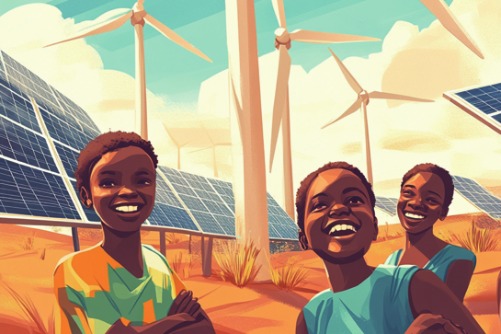
During the 14th Five-Year Plan period, China has emerged as the world leader in installed renewable energy capacity — particularly in solar and wind power — while making advances in energy storage technologies and accelerating the adoption of electric vehicles.
As of 2024, China accounted for more than 80 percent of the global production of solar panels. Massive investment in research and development, coupled with economies of scale, has driven down the cost of solar energy worldwide. Similarly, China dominates the wind energy sector, with the largest installed wind power capacity globally, both onshore and offshore.
China is also leading the charge in the EV industry. Domestic companies such as BYD and NIO, alongside joint ventures with global automakers, have helped make China the world's largest EV market. A robust ecosystem — bolstered by widespread charging infrastructure and policy incentives — is driving this transformation. These green industries are reshaping China's energy landscape and playing a vital role in decarbonizing global transportation and power generation.
China's commitment to green development has had a profound effect beyond its borders, especially in the Association of Southeast Asian Nations region. Through mechanisms such as the Belt and Road Initiative and the Regional Comprehensive Economic Partnership, China is promoting green infrastructure and low-carbon technologies across Southeast Asia.
In Malaysia, for example, Chinese investments have supported renewable energy projects, EV ecosystem development and green industrial parks. Companies such as Geely, in partnership with Malaysia's Proton, are advancing EV production in the country. Similarly, Chinese solar manufacturers are collaborating with local partners to build photovoltaic plants and supply solar modules, making solar power more accessible and affordable.
More broadly, the China-ASEAN blue economy partnership plays a vital role in promoting sustainable development in the South China Sea. Areas of collaboration include ecological conservation, renewable energy, sustainable fisheries and marine tourism. These joint efforts are accelerating the region's shift toward a more sustainable development model.
By leveraging China's advanced green technologies and manufacturing capabilities, ASEAN countries have the opportunity to bypass traditional, polluting industrial pathways and transition directly to cleaner, more efficient energy and transport systems. This model of technology transfer and investment is essential to help developing economies achieve their climate goals without compromising economic growth.
The United States has withdrawn from the Paris Agreement and downplayed the urgency of climate action, creating a leadership vacuum at a critical moment for global cooperation.
China, meanwhile, has reaffirmed its climate commitments. In a video speech to the United Nations Climate Summit 2025 in September, President Xi Jinping said: "China will, by 2035, reduce economy-wide net greenhouse gas emissions by 7 percent to 10 percent from peak levels, striving to do better …"
Earlier, in 2020 at the General Debate of the 75th Session of the UN General Assembly, President Xi pledged that China would strive to peak carbon dioxide emissions before 2030 and achieve carbon neutrality before 2060. These are ambitious targets, but they signal a strong, long-term commitment to sustainability.
In multilateral forums, China has become a central player in global climate governance, advocating the principle of common but differentiated responsibilities and supporting developing countries through the South-South cooperation, climate finance and technology sharing. Its leadership offers stability and strategic direction at a time when US-led Western climate policies have often been inconsistent.
As the world prepares for the 2025 UN Climate Change Conference, or COP30, this November in Brazil, China's role is increasingly vital. The conference is expected to mark a key step in scaling up Paris Agreement commitments, and China's blend of economic growth and environmental sustainability positions it as a crucial player.
China's policy tools, such as its ambitious green industrial policies, including subsidies and mandates for EV, offer insights into balancing State-led planning with market dynamics. Its rapid expansion of renewables and shift to low-carbon industries can guide other emerging economies.
China's growing ties with other countries in the Global South also support a more inclusive green transition. At COP30, the focus is likely to be on technology transfer, climate finance and capacity-building — areas where China already shows strong progress.
It is clear that the 14th Five-Year Plan not only largely achieved its high-quality development goals but also positioned China as a global leader in green development.
These accomplishments have benefited not only China but also the global fight against climate change — particularly for countries in the Global South. As China enters its next five-year plan period, it must build on the progress of the 14th Five-Year Plan and continue pursuing a model of economic growth that is both dynamic and sustainable.
The author is a research associate at the Malaysia-China Friendship Association and the former deputy director of the Institute of China Studies at the University of Malaya. The author contributed this article to China Watch, a think tank powered by China Daily.
The views do not necessarily reflect those of China Daily.
Contact the editor at editor@chinawatch.cn.