



Let us be better together: Building four betters – agrifood systems









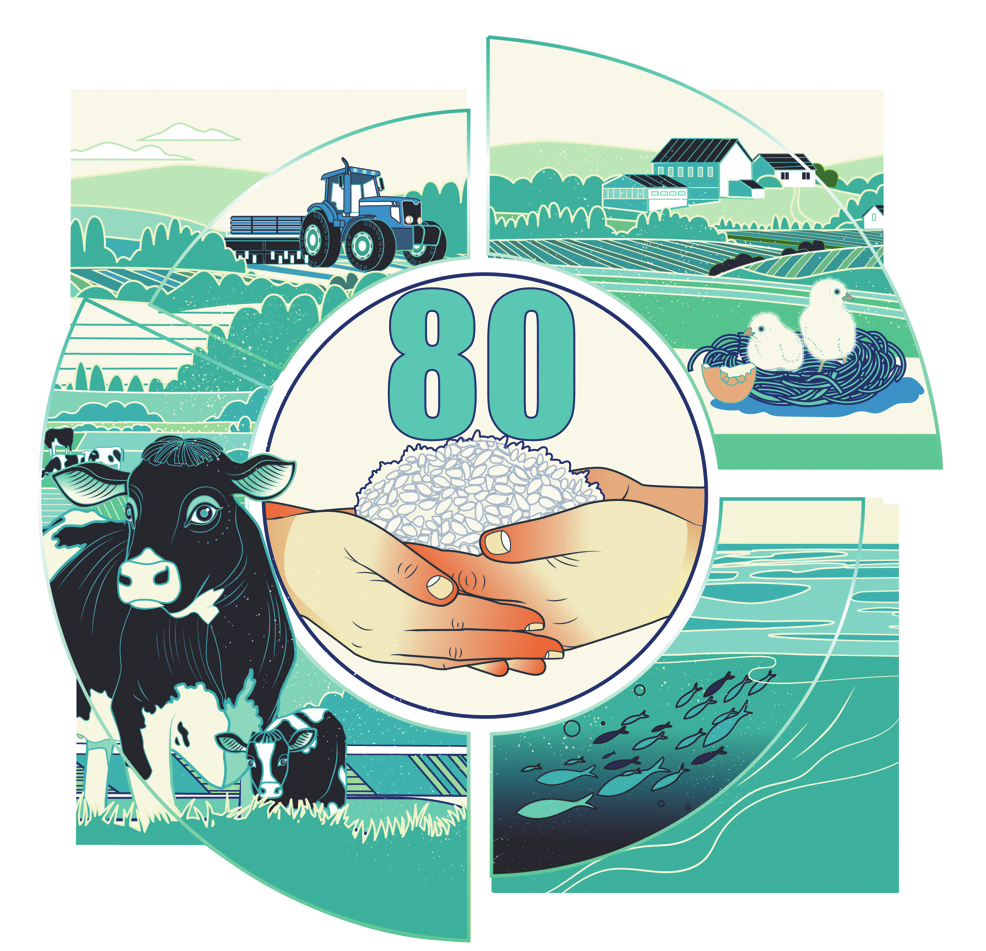
This year's World Food Day marks 80 years since the founding of the Food and Agriculture Organization of the United Nations, whose mandate from the outset has been to ensure humanity's freedom from hunger.
Today, around 8.2 percent of the people in the world face chronic undernourishment. That compares to roughly two-thirds of the global population living in areas with inadequate food supply in 1946, as revealed by the first World Food Survey conducted by FAO in its first months of existence. Moreover, in 2025, even with a population more than three times as large, the world produces more than enough calories to feed everyone.
As we mark this day and reflect on past, present and future challenges, I am reminded of one conclusion from that long-ago survey: "The choice is between going forward and going backward."
FAO and its member countries have achieved a lot: eliminating the rinderpest virus, establishing the Codex Alimentarius food safety standards, nearly tripling global rice yield since setting up the International Rice Commission in the late 1940s, negotiating international treaties on fisheries practices and genetic resources, setting up early-warning monitoring schemes to mitigate the risk of pests, and plant and animal diseases, establishing and hosting the Agricultural Market Information System to support trade, and the development of dietary guidelines to tackle not just stunting but also the world's growing overweight trend.
When desert locust outbreaks started in 2019 — coinciding with the hardest times of the COVID-19 — $231 million was mobilized to mitigate a crisis that ultimately saved $1.77 billion in losses and secured food for more than 40 million people across 10 countries.
Credit for such achievements goes rightly to our members who have been steadfast in their support of the idea that a world without hunger is a better one for everyone, rich or poor, North or South. These and other successes show what is possible when nations pool knowledge and resources, when there is political will, and when effective partnerships are forged.
Sustaining the spirit of cooperation that has existed for the past 80 years is increasingly urgent; the global agrifood system is more interconnected than ever with more than a fifth of all calories crossing international borders before being consumed. At the same time, threats to those agrifood systems from climate shocks, pests and diseases, economic downturns, or the fallout from conflict respect no borders and can unwind years of progress against hunger and malnutrition. As we see today with the spread of highly pathogenic avian influenza, more commonly known as bird flu, fall armyworm and locust, no single country can combat such transboundary threats.
We must ensure that the more than one billion people working in the agrifood systems that feed us all have the resilience to withstand and overcome the risks they constantly face.
We have the technologies, proven financial mechanisms, along with enabling policies, know-how and the capacity to rapidly achieve the goal of ending hunger. Enabling access to markets is key both to mitigating inequalities that erode resilience and to getting food to where it is needed. Full market participation means access to drought-resistant seeds, sustainable fishery and forestry norms, agreed phytosanitary standards, digital technologies, innovative resource-management tools and early-warning systems.
We have a framework in place to scale up and accelerate our task. The FAO Hand-in-Hand Initiative identifies and prioritizes investment opportunities in places where poverty and hunger are highest and agricultural potential is the greatest. The FAO One Country One Priority Product initiative promotes unique national agricultural products to drive sustainable agrifood systems and rural prosperity. The South-South and Triangular Cooperation programme recognizes that many developing countries have become major players in global development and economic governance and supports investment and partnership. The Digital Villages Initiative aims at enabling farmers around the world to use digital technologies, expanding access to e-commerce opportunities and reducing the digital gap. And the G20 Global Alliance against Hunger and Poverty unites countries and partners to mobilize action and investments for ending hunger and reducing poverty worldwide. These and many other tools work when they are deployed efficiently and effectively, and they work even better when consistently and coherently applied.
At FAO, we channel this vision through the "Four Betters": better production, so farmers can produce more with fewer resources; better nutrition, because quality matters as much as quantity; a better environment, to sustain healthy ecosystems and their multiple benefits; and a better life, so rural communities can build dignity and opportunity. Together, the "Four Betters" ensure that no one is left behind.
If we choose not to pursue these goals, we will go backwards. Eighty years on, hunger is still with us, but it is not inevitable. With shared purpose, we can — we must — move forward. With continued collaboration, we can finish the job of ending hunger for a better food-secure future for all.
The author is director-general of the Food and Agriculture Organization of the United Nations.
The views don't necessarily represent those of China Daily.
If you have a specific expertise, or would like to share your thought about our stories, then send us your writings at opinion@chinadaily.com.cn, and comment@chinadaily.com.cn.





