US' new visa fee a self-inflicted mistake









Recruiting and retention are just two of the reasons that the United States has enjoyed its paramount place in the science and technology sectors for decades. Businesses of all sizes operating in the country knew they would do well by bringing some of the most talented people from around the world to America and providing them with the resources needed to thrive.
In fact, both sides benefited: Employers hired talented people who saw no reason to abandon a position that offered stability and advancement.
As part of that arrangement, companies regularly sponsored these workers by paying the various fees associated with securing the necessary visas to remain legally eligible to work in the US.
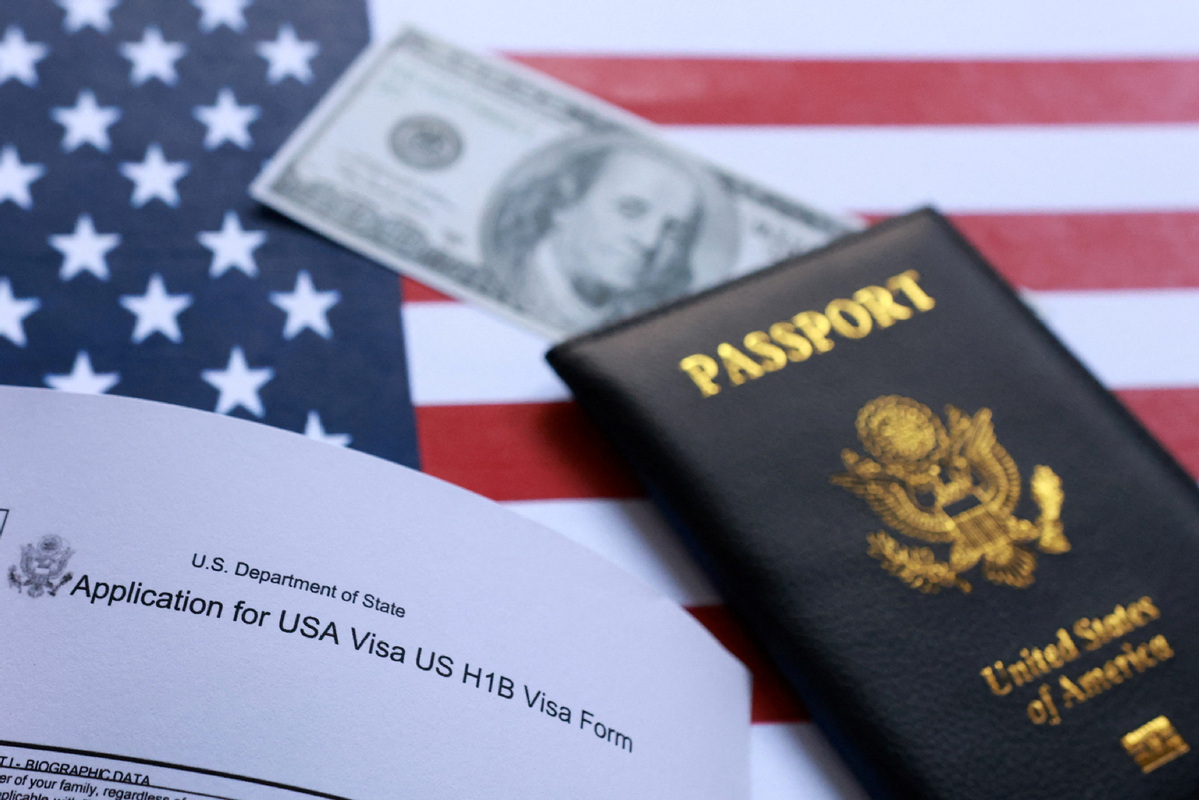
The current US administration wants to make that recruiting and retention process much harder. In what can be described only as another self-inflicted mistake, the White House announced last month that it will increase the fees for H-1B visas, which are given to highly skilled non-US citizens, allowing them to work in the country. The new fee is an astounding $100,000 per person for each new application.
Think of it this way: A group of one dozen new international employees would cost $1.2 million simply to get them in the door. Such costs, even in times when the US economy was humming along, would be challenging for many businesses. In the chaotic situation now, especially as tariff structures continue to be sorted out, companies seem likely to pull back on new international workers.
As has been the case with so many initiatives under this administration, confusion reigned once the new policy, which went into effect on Sept 21, was announced. Critical questions remained un-answered, while different officials made different claims. It appears the White House has settled on a message: The $100,000 fee would be paid only once, and it would not be applied to any visa holder already in the country.
Secretary of Commerce Howard Lutnick brusquely described the intent of the program after the new policy was announced, and the callous nature of his message was unmistakable: "If you're going to train somebody, you're going to train one of the recent graduates from one of the great universities across our land. Train Americans. Stop bringing in people to take our jobs."
"Stop bringing in people to take our jobs." Let's dissect that sentence and its validity. To begin with, let's examine data from the National Science Board for calendar year 2024.
The stability of his claim starts to fall apart when one realizes that testing scores in mathematics for US elementary and secondary students (roughly students ages 5 to 18) have shown a steady decline dating to the beginning of this decade. Lower scores correlate to a less likely chance of getting into a science, technology, engineering or math (STEM) major in college and, therefore, a STEM career.
The strength of Lutnick's words is undermined further when one notes that international students continue to make up more of the graduate student population in STEM programs throughout the US. This should come as no surprise, considering that high school-age students in almost three dozen countries score higher than their US counterparts in math test scores, according to the Program for International Student Assessment. Suffice it to say that students interested in and doing well in math gravitate toward STEM, and many of them are inclined to seek education beyond the undergraduate level.
Finally, the reality that this administration either will not or does not want to accept is that currently, roughly one in five employees working in STEM fields in the US were born in another country. There is every reason to believe that figure will increase in the years to come. They are trained for such jobs, and they want them. However, they are still in the minority.
Combine these three data points and a reasonable conclusion can be drawn: Companies are not bringing in people "to take our jobs", as Secretary Lutnick suggested. Rather, they are bringing in people because there is not a sufficient pipeline of American men and women to hold them.
The evidence is irrefutable: The US is not producing enough American-born STEM graduates. Average standardized test scores are just one cause. An aversion to taking on difficult majors might be another. Businesses could shrug off such problems in years past, because the federal government was an ally in ensuring that a strong supply of foreign-born, highly skilled workers could enter the country at a reasonable cost.
The White House appears to not care if it blows up this successful arrangement.
For a moment, flash back to when President Donald Trump was sworn in to office in January. Do you remember the number of high-profile technology and corporate executives who were seated behind him? The message the administration wanted to deliver that day was that the long-standing, cozy relationship between government and technology would become even closer. And yet some of those companies represented that day — notably Amazon, Apple, Google, Meta and Microsoft — are the ones who use the H-1B visa system most.
Will they fork over $100,000 per potential hire over the next 12 months? They likely can afford it. But the many smaller companies beneath them likely cannot.
And if either the president or his commerce secretary believes that US-born workers will show up to fill the gaps, they are terribly mistaken.
The author is an associate professor in the Communication and Organizational Leadership Department at Robert Morris University in Pennsylvania, the United States.
The views do not necessarily reflect those of China Daily or Robert Morris University.