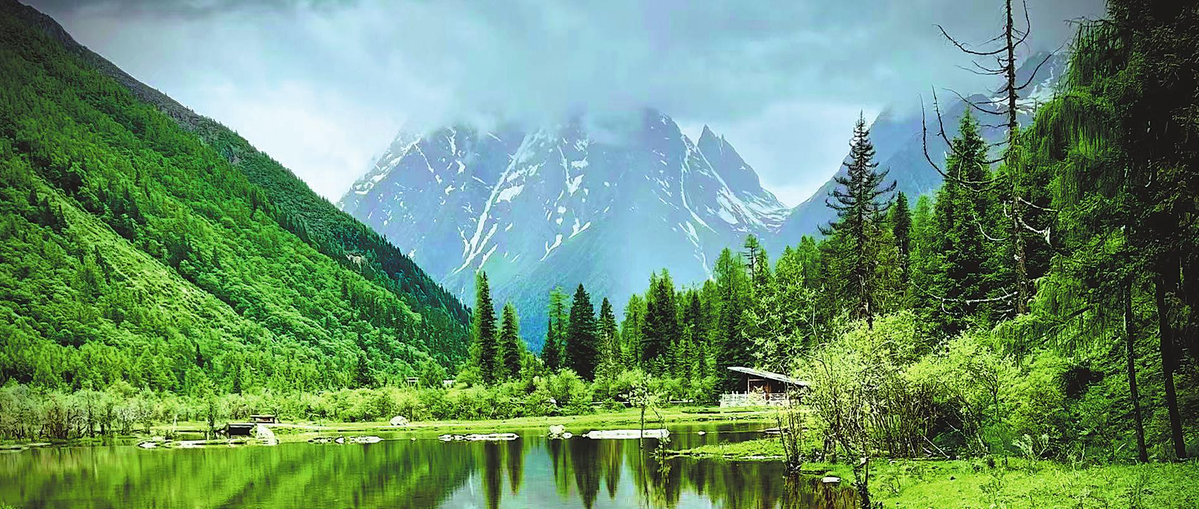
Pandas and poets. Adventurers and ape men. Soldiers and snow leopards. A mountain god reborn as four supernatural sisters. This cast of characters, literal and legendary, stars in the saga unfolding on the undulating stone stage of the Siguniang Mountains.
Planetary forces authored an extravagant geology that, in turn, scripted an epic spanning epochs in today's Aba Tibetan and Qiang prefecture, Sichuan province.
Every valley cradles a true tale. Every peak embraces a legend.
The range's very names reiterate the lore of this land. First is the ancient Gyalrong Tibetan name, Skula Rouda — which hails the god of life, birthdays and birthplace — and later, the lyrical transliteration to standard Chinese, Siguniang — which means "four sisters", a reference to its four premier peaks. This wasn't merely a reconsideration of names but a reincarnation of identity.
This penchant for personification extends across the vast range.
The highest peak, at 6,247.8 meters above sea level, Yaomei, is likened to the youngest sister of the quartet and "queen" of the superordinate Qionglai range, whereas the 5,033-meter-high Mount Abi merges with neighboring peaks to sculpt the natural effigy of a humble granny.
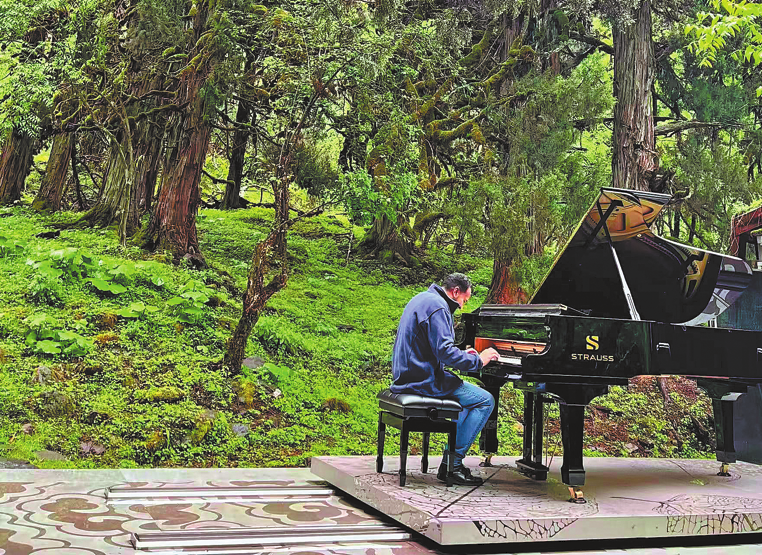
Another peak uncannily resembles the grim gaze of the yeren, an apelike cryptid often compared to Bigfoot's Chinese cousin, who is said to stalk the wilds of Shennongjia in Central China's Hubei province.
The 5,271-meter-tall Yueya Mountain's name is inspired by its crescent moon shape, while Potala Peak received its moniker from its resemblance to the palace that crowns Lhasa.
Geologists describe these snaggle-tooth serrations at the Sichuan Basin's edge as a "crocodile's jaw". Geographers venerate the range as the "Heavenly Gate of the Qinghai-Tibet Plateau". And climatologists compare Siguniang to a massive meteorological wall that seals out wetter westerly winds fromparching the plateau, high and dry.
It's an eave of the "roof of the world", a boundary delineating the domains of farmer and herder, and an intersection of Han and Tibetan culture.
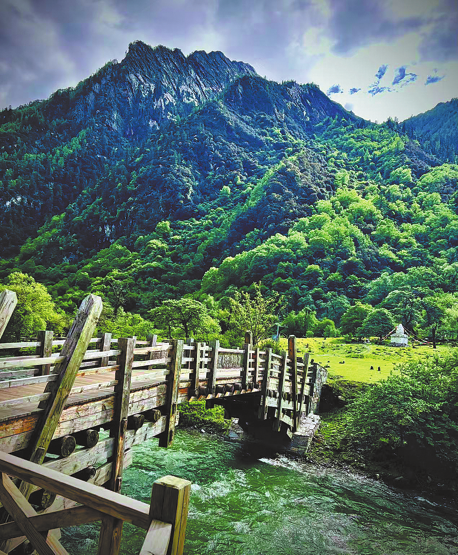
Luminary poet Du Fu penned prose exalting these eminences 1,300 years ago. Over a millennium later, in our time, novelist Alai, author of Red Poppies: A Novel of Tibet, elevated their stature to even greater heights. Countless other writers have profiled these giants' contours with their words, ensuring these mountains are as much a feature of literary imagination as physical reality.
This cultural landscape is inspired by one of the planet's most idiosyncratic geological terrains. Accordingly, Siguniang is vying for a UNESCO Geopark title to complement its World Heritage site designation.
Over a hundred of Siguniang's thousands of rock stilettos stab more than 5 kilometers into the diluted air, shredding the skyline and siring the world's mostcomprehensive vertical spectrum of biodiversity. A single spectacular view swoops from forest to shrub-land, from desert to snowcaps.
Over 2,000 higher plants — including the world's largest wild Chinese sea buckthorn forests — cling to these slopes that teem with more than 300 vertebrates.
These extreme precipices form a citadel safeguarding elusive yet iconic creatures.
Giant and red pandas waddle through bristling bamboo. Sichuan takins tiptoe up sheer cliff sides. Golden snub-nosed monkeys bounce through leafy canopies. Snow leopards slink across carpets of frost.
The Siguniang Mountains create a natural fortress that shelters these protected organisms. It towers over the limits of imagination, harboring a living paradox of fragility and strength.
This poetic geology is engraved in the stony scar tissue where Earth's crust fights itself from below, and erosive forces assault its surface from above. It's a lyrical diary of this land's grueling growing pains, as it comes of age over successive eras.
Its mutating anatomy is forged by fire and ice, magma and ocean. All conceivable expressions of stone and water have tormented its rocky flesh, which is wrinkled and disjointed by superlatively slow-motion collisions of tectonic plates that regularly rip through the globe's connective tissue.
Conflicting crustal forces shoved and yanked the land skyward hundreds of millions of years ago. Around 350 million years ago, these formations were washed over and partly dissolved by ancient oceans. A hundred million years later, the wounds where the crust was punctured bled magma when a super-scale outbreak of submarine volcanoes burst from its hide like blisters, leaving scabs and welts on the earth's skin.
Then, 65 million years ago, the Himalayan orogeny jolted the landscape upward with a new ferocity, as the Indian and Eurasian plates crashed together. Around 6.5 million years ago, this collision's skyward propulsion accelerated with even greater umph.
About 1.7 million years ago, an ice age scraped and sliced the landforms above 3,000 meters, gradually receding until the glacial sheaths were reduced to elevations exceeding 5,000 meters.
Bygone glacier bite marks linger as an unparalleled compendium of aretes, horns, U-valleys, cirques, ice kilns, hanging valleys, and moraines.
The Minjiang and Dadu Rivers originate and pour forth from the persevering snowcaps' chilly veins. Smaller streams and waterfalls wrap the landscape like ribbons, and glacial lakes bejewel the topography like sequins, shining as iridescent mirrors that reflect the clouds that swim through the air above.
These forces have also tattooed the rocks with a subdued palette. Gray-white sandstone, purple-red slate and light-green basalt streak the mountainsides with what has been nicknamed an "inverted rainbow".
Other colorful appellations include the Red Stone Array, where Changping Valley's mouth gulps scarlet boulders rendered by ruddy algae that daub the rocks, and the "Flaming Corridor", where Sichuan redwoods burn bright like the gods' torches in autumn.
They blaze vibrantly and stand in stark contrast to the bleached skeletons of trees whose dead branches stretch from watery graves, like bony fingers clawing at thin air, in Changping Valley's Withered Tree River Beach. Alluvial spills choked streams, drowning thickets of sea buckthorns and conifers, leaving their gnarled carcasses twisting and writhing in the rippling waves of newborn lakes.
A similar graveyard commemorating another bygone botanical dominion is hidden in Shuangqiao Valley, where trees mummified by calcification form a ghostly sculpture garden.
Ultimately, to ascend Siguniang is to feel time itself rising up from our world — the lethargic tempo of a tectonic pileup and the fleeting flash of a snow leopard's shadow. It reminds us that, beyond books, the most epic stories are engraved into the very body of the Earth.
And so, this stone saga continues to unfold. The sleepless terrestrial forces that have wrenched these peaks skyward also pull at our inner thoughts and push the outer bounds of our imaginations.
The Siguniang Mountains beckon us to tread with deliberation, to eavesdrop on the legends whispered by the winds, and to behold a part of our planet where earth, ice and fire inscribe a chronicle of life and lore.