China Focus: China achieves numerous breakthroughs in space exploration quest









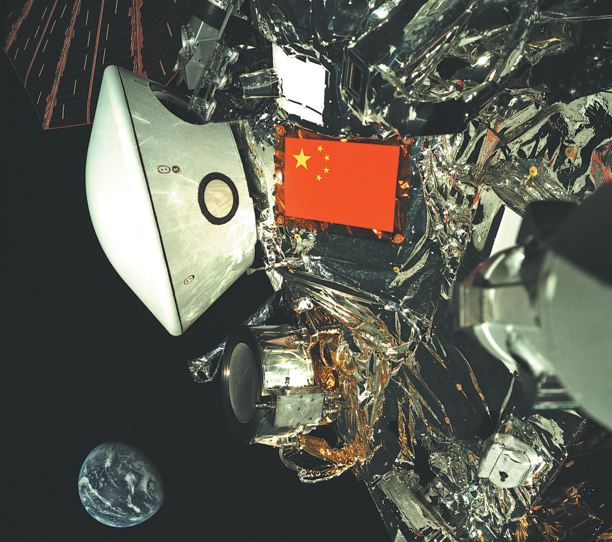
BEIJING -- It has been more than five months since the Shenzhou XX crew entered China's space station. The three astronauts have carried out various tasks in this period, including space science experiments, in-orbit emergency rescue training, and inspection and maintenance of the station's equipment.
Ranging from the construction of the space station to the first-ever sampling of soil from the far side of the moon by the Chang'e 6 mission and the exploration of Mars by the Tianwen 1 mission, China has achieved notable breakthroughs in space exploration during the 14th Five-Year Plan period (2021-2025) — making important contributions to humanity's exploration of space and sci-tech frontiers.
SPACE STATION CONSTRUCTION
China's space station was completed during the 14th Five-Year Plan period, becoming one of two space stations currently in orbit. In April 2021, the first module of the space station, the Tianhe core module, was launched into orbit. The two science lab modules, Wentian and Mengtian, were launched in July and October 2022, respectively, and successfully docked with the Tianhe core module.
In less than two years, China completed the assembly and construction of the space station, which is based on a configuration of the Tianhe core module and the Wentian and Mengtian lab modules.
Up to now, a total of nine astronaut crews, from the Shenzhou XII to the Shenzhou XX mission, have entered the space station and conducted about 20 extravehicular activities — including assembly and maintenance of space station equipment, and installation of space debris protection devices.
The space station also serves as a national-level space laboratory, where astronauts have conducted space science experiments and tests. By the end of 2024, some 181 science and application projects had been implemented in the space station, with nearly 2 tonnes of scientific materials sent up, almost 100 types of experimental samples brought back, and over 300 TB of scientific data obtained.
These experiments and tests have delivered breakthroughs such as the acquisition of new germplasm resources for rice and ratoon rice developed in space, and the differentiation of human embryonic stem cells into hematopoietic stem/progenitor cells in space. They have significantly advanced global research in space life and human studies, microgravity physical science, space astronomy and Earth science, and space technology and applications.
In February 2025, China and Pakistan signed an agreement to cooperate on the selection and training of Pakistani astronauts for participation in China's space station mission. With the space station now open to such foreign astronauts, China is showing a clear commitment to developing countries keen to engage in international crewed space cooperation.
MOON FAR SIDE SAMPLING
During the 14th Five-Year Plan period, China's space exploration quest also reached the far side of the moon. On June 25, 2024, after a 53-day space journey, Chang'e 6 brought back the first-ever samples collected from the far side of the moon. The Chang'e 6 mission team was therefore awarded the World Space Award in the team category by the International Astronautical Federation (IAF).
This mission serves as a model for space engineering endeavors. The Queqiao 2 relay satellite was launched on March 20, 2024, to provide relay communication support for activities on the far side of the moon. The Chang'e-6 probe, launched on May 3, 2024, entered lunar orbit after performing near-moon braking. The lander-ascender combination landed at the designated landing area in the South Pole-Aitken Basin on the far side of the moon on June 2.
After that, the combination completed sampling, and the ascender took off on June 4, carrying the samples and transferring them to the Chang'e 6 returner on June 6. The returner landed precisely in the designated area in North China's Inner Mongolia autonomous region on June 25, bringing back 1,935.3 grams of lunar samples.
Since then, Chinese scientists have conducted extensive research on these samples, making discoveries in areas such as magmatic activity on the far side of the moon, the ancient lunar magnetic field, water content in the lunar mantle, and the evolutionary characteristics of the lunar mantle.
The Chang'e 6 mission also featured four international payloads for lunar exploration and research. The lander carried the France-made radon isotopes detector, the European Space Agency's lunar surface negative ion analyzer, and the Italian laser retro-reflector, while the orbiter carried a small satellite from Pakistan.
DEEP SPACE EXPLORATION
During the 14th Five-Year Plan period, China also achieved significant breakthroughs in deep space exploration. The Tianwen 1 Mars probe was launched on July 23, 2020. After a 202-day, 475-million-km journey in deep space, the probe rendezvoused with Mars on Feb 10, 2021. Following a three-month survey of the landing area, the probe landed on Mars on May 15, 2021. On May 22, the Tianwen 1 rover drove onto the Martian surface and began its exploration.
The original data obtained by the 13 scientific payloads onboard the rover and the Tianwen 1 orbiter have been made available to scientists worldwide. For example, observational data from the rover helped scientists discover important evidence of an ancient ocean in the mid-low latitude region of Mars and revealed that the red planet once experienced a long period featuring a warm and humid climate.
During the Tianwen 1 mission, the China National Space Administration actively promoted cooperation with space agencies and global scientific communities, such as sharing orbital data from the Tianwen 1 orbiter with NASA and the European Space Agency (ESA) in collision warning cooperation.
The Tianwen 1 rover also conducted data relay communication tests, solar occultation observations and solar wind research with the ESA's Mars Express orbiter.
The Tianwen 1 mission team, notably, was awarded the World Space Award by the IAF in 2022.
On May 29, 2025, Tianwen 2 was successfully launched — marking the beginning of China's first asteroid exploration and sample return mission. The mission, with a design cycle of roughly 10 years, aims to explore and sample the asteroid 2016HO3 and return the samples to Earth, followed by exploration of the main-belt comet 311P.
This mission will help humanity understand the early solar system's material composition, formation processes and evolutionary history, as well as the material composition, structure and evolutionary mechanisms of small celestial bodies, thereby offering significant scientific value.
In the upcoming 15th Five-Year Plan period (2026-2030), China will continue its efforts in the field of space exploration. The Chang'e 7 and Chang'e 8 missions are scheduled for 2026 and 2028, respectively, while the Tianwen 3 mission is planned for launch around 2028 — aiming to return Mars samples to Earth.





- 10 dead and 84 injured in explosion at steel plant
- China unveils flexible urban planning rules to improve lives, foster new industries
- Ex–China Construction Bank executive gets 18 years for bribery, loan violations
- First batch of eco-friendly pioneer zones for construction of beautiful countryside unveiled
- Woodpeckers, finches captured in Jilin winter scenes
- Mainland reiterates 1992 Consensus as foundation for resuming cross-Strait dialogue