



Pharma sector transforms for growth
Drugmakers report rising R&D spending, revenue share from innovative products









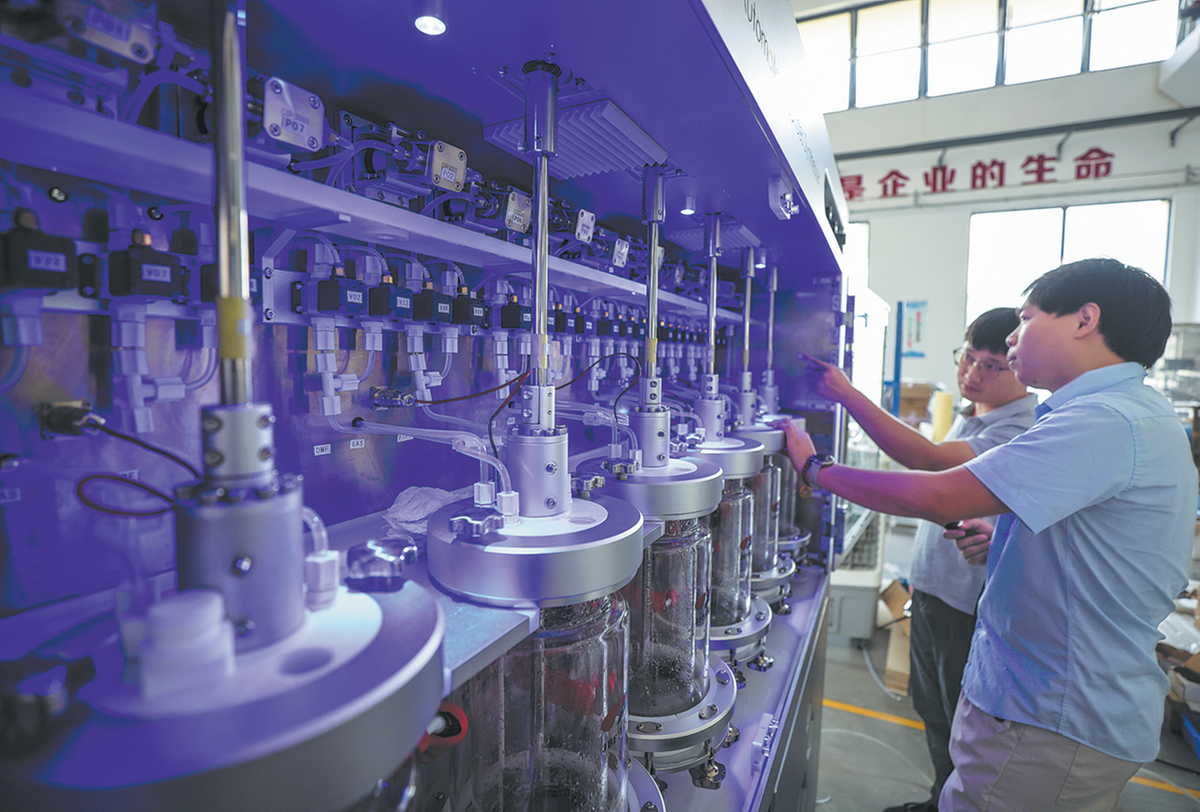
China's pharmaceutical sector, once driven largely by generic drug production, is now witnessing a steady rise in innovative drug development, cross-border partnerships, and record research and development spending, signaling a structural transformation toward high-quality growth, experts and industry insiders said.
In the first half, Jiangsu Hengrui Pharmaceuticals Co Ltd reported total revenue of 15.76 billion yuan ($2.21 billion), up nearly 16 percent year-on-year, with net profit rising around 30 percent to 4.45 billion yuan, according to its interim report.
For the first time, income from innovative drugs and licensing accounted for more than 60 percent of its total revenue. In 2018, the majority of the company's revenue was generated from generics, while only a small fraction came from innovative products.
The shift reflects more than just product mix. "Innovation and globalization have become the twin engines driving our growth," the company said in a statement to China Daily. "As one of the country's leading R&D-driven pharmaceutical enterprises, we have made continuous innovation our first development strategy."
Over the years, Hengrui has invested more than 48 billion yuan in research and development, with its R&D-to-revenue ratio climbing to 29.4 percent in 2024 — among the highest in the industry. The company operates 14 research centers worldwide, supported by a 5,600-strong global research team.
To date, Hengrui has secured domestic approvals for 24 Category 1 innovative drugs and four Category 2 new drugs.
Hengrui's transformation reflects not just the company's evolution, but the transformation of China's broader pharmaceutical industry.
Across China, a growing number of once traditional drugmakers, such as Jiangsu Hansoh Pharmaceutical Group Co Ltd, Jiangsu province-based Simcere Pharmaceutical Group Ltd and Hebei province-based CSPC Pharmaceutical Group Ltd, now are achieving similar transitions, reporting double-digit R&D growth and rising revenue shares from innovative products, according to their interim reports.
The shift is reconfirmed by hard figures.
China's pharmaceutical industry, now the world's second largest, accounts for around 30 percent of the global pipeline of innovative drugs in research, according to the National Medical Products Administration.
Jin Chunlin, director of the Shanghai institute of medical science and technology information, said China's pharmaceutical industry is entering a new developmental phase, underpinned by policy reform and accumulated industry expertise.
Jin explained that the generic-drug era was an essential foundation. It allowed firms to accumulate funds, master manufacturing techniques and establish a robust drug quality evaluation system. However, he said: "Companies cannot remain forever in the comfort zone of generics. Innovation is the only way forward."
The industry's transformation has been propelled by a decade of deep structural reforms. Beginning in 2015, the government overhauled drug review and approval mechanisms, accelerating the path to market for innovative therapies.
A landmark shift came in 2018 with the introduction of the national drug centralized procurement program, designed to pool public hospital demand and negotiate lower prices directly with drugmakers. By reducing inflated generic prices, the reform freed up funds for medical insurance coverage and redirected corporate focus toward innovation.
By 2020, a consensus had formed across the industry: the era of high-margin generics was over. China's pharmaceutical sector needed to evolve from imitation to innovation.
"The national drug centralized procurement reform has effectively reshaped China's pharmaceutical landscape," said Jiang Bin, deputy director of the Research Center of Public Policy at Peking University. "It has driven the industry away from a 'high-marketing, high-margin' model toward one defined by 'low cost and high innovation', improving efficiency and encouraging higher-quality growth."
Jiang added that the reform's impact "extends far beyond price reductions", helping establish a more transparent, competitive and sustainable market order.
The program continues to evolve. Its 11th round, currently underway, has shifted from "price suppression "to "value optimization", with new emphasis on both affordability and quality.
Complementing these efforts, the authorities have rolled out multiple measures to support the high-quality development of innovative drugs, providing full-chain support for R&D, clinical trials, approval, production and commercialization.
In 2025, for the first time, commercial health insurance was formally included in national drug reimbursement negotiations, paving the way for chimeric antigen receptor T-cell and gene therapies to enter the domestic payment system.
China's regulatory efficiency for new drugs has also improved dramatically. Over the past decade, the average review cycle for new medicines has been shortened from several years to just months, enabling companies to bring novel therapies to patients faster.
Since September, the National Medical Products Administration has implemented a 30-working-day fast-track review for key innovative drugs with clear clinical value. Eligible products include pediatric, oncology, and rare-disease treatments, specifically those supported by national R&D programs, or global multicenter trials led or co-led by Chinese principal investigators.
According to the administration, more than 200 innovative drugs and 260 medical devices have been approved in the past five years. In the first half of 2025 alone, 43 new innovative drugs were approved including 40 developed domestically, with an average review time of 11 months, a 62 percent reduction compared with 2018.
Zhao Heng, founder of consultancy Latitude Health, which specializes on the healthcare industry, said the acceleration allows Chinese patients to access global breakthroughs faster while helping domestic innovators reach commercialization sooner.
The shift is also evident in global markets.
Data from PharmCube, an industry intelligence firm showed that in 2024, Chinese pharmaceutical companies completed 94 out-licensing transactions with a total contract value of $51.9 billion, up 26 percent year-on-year. Upfront payments reached $4.1 billion, marking a 16 percent increase from 2023.
The momentum has only accelerated in 2025. In the first half alone, the total value of innovative drug out-licensing deals reached nearly $66 billion, already surpassing the full-year total for 2024, said Xu Jinghe, deputy commissioner of the National Medical Products Administration.
These collaborations show that Chinese innovation is gaining recognition from the global pharmaceutical community. Among the most prominent examples is that of Hengrui's $12.5 billion license-out collaboration with London-based GlaxoSmithKline, including a $500 million upfront payment and potential milestones worth $12 billion, one of the largest licensing deals ever signed by a Chinese drugmaker.
"Business development revenue has become a significant contributor to our performance," the company said. "Through out-licensing and co-development, we share R&D risks, learn from international partners, and bring Chinese innovation to global patients."
Across the industry, R&D intensity is climbing steadily. Major firms such as Simcere and Hansoh are deepening investment to sustain innovation. Simcere's R&D spending reached 28.7 percent of revenue in the first half, while Hansoh raised its R&D budget by 20.4 percent to 1.44 billion yuan.
These surges in spending have been underpinned by capital market reforms — notably the STAR Market in Shanghai and Hong Kong stock exchange's Chapter 18A list, which allows pre-revenue biotech firms to raise innovation funding.
Despite strong momentum, challenges persist. Developing a single innovative drug can take more than 10 years and cost upwards of $1 billion. Many smaller firms face financial strain as they await trial results, and competition in crowded fields such as oncology and diabetes has intensified.
Industry executives note that the hardest part of transformation lies in overcoming inertia, shifting from the predictable "recipe" of generics to the uncertainty of true innovation, which demands tolerance for failure and a culture that rewards experimentation.
Zhou Liyun, chairman of PharmCube, said fostering trial and error and enabling market-based selection help retain the global biopharmaceutical industry dynamics and China is now beginning to cultivate a similar innovation ecosystem.
For Hengrui, the next step lies in differentiation. "To stand out globally, innovation must address unmet clinical needs," the company said. "From target selection to indication expansion, we're pursuing diversified, patient-centered strategies across oncology, metabolic and cardiovascular diseases, immunological and respiratory diseases, and neuroscience."
From 2025 to 2027, the company expects dozens of major innovations to reach the market, including GLP-1 therapies for obesity and diabetes, and next-generation oncology drugs.


Today's Top News
- Xi sends congratulatory message to 39th African Union Summit
- Xi extends Chinese New Year greetings to ring in Year of Horse
- Country sees strong rebound in FDI
- Long March 10's booster retrieved from sea for 1st time
- China, US agree to strengthen dialogue, cooperation in various fields
- Fujian villages bear witness to changes







