Reshaping global climate and energy security









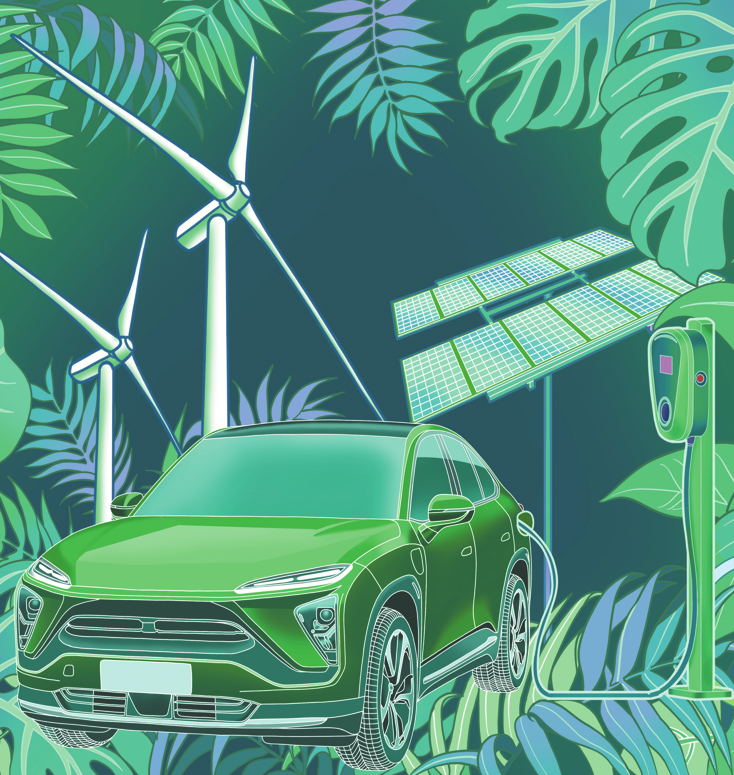
Whether the new era of green industrialization brings shared prosperity will depend not only on China's actions but also on how the Global South responds
As the world faces fragmented supply chains, trade tensions and climate shocks, China's domestic transformation under its 14th Five-Year Plan (2021-25) offers both stability and prosperity. Beyond geopolitics, China's achievements in renewable energy and electric mobility carry deep implications for the prosperity and resilience of the Global South.
China's energy transition has been remarkable. In 2024 alone, the country added 278 gigawatts of utility-scale solar power, bringing its total solar capacity to more than 880 GW. Wind power grew by another 79.8 GW, further strengthening China's leadership in clean energy. By the end of 2024, renewables accounted for 56 percent of China's total installed capacity, surpassing coal for the first time. This milestone reflects years of deliberate coordination to promote industrial upgrading, the dual climate goals and energy security.
According to the International Energy Agency, China invested $625 billion in renewables in 2024, more than double the amount of a decade earlier. This surge helped drive global prices down. Battery pack prices dropped to a record low of $115 per kilowatt-hour in 2024. China's domestic transition has therefore made global decarbonization both cheaper and faster.
China's green agenda is as much about industrial leadership as environmental reform. The country now produces more than 80 percent of the world's solar modules, 60 percent of its wind turbines, and nearly 70 percent of its battery cells. What began as an environmental necessity has become one cornerstone of China's export and diplomatic strategy. Through the green Belt and Road Initiative, China has shifted overseas financing from coal toward low-carbon infrastructure. Its companies now build solar farms in Kenya, hydropower plants in Laos and modernized grids in Pakistan, extending the benefits of China's experience to nations that lack capital and technology.
China's green transformation also extends to the transport sector. In 2024, Chinese automakers exported more than 6 million vehicles, over 30 percent of which were electric or hybrid. Companies such as BYD and Geely have become global players, selling competitively priced electric vehicles across Asia, Europe and Latin America. China's cost advantage is decisive. This allows Chinese companies to compete effectively with Western automakers while maintaining profitability through economies of scale.
For some Global South countries, affordable Chinese electric vehicles and two-wheelers could accelerate the transition toward cleaner transport. Cities in Indonesia, Nigeria and Brazil could reduce oil imports, cut pollution and modernize their mobility systems. Companies such as BYD in Thailand and Chery in Indonesia already assemble vehicles locally, creating jobs and enabling technology transfer.
Yet the risks remain significant. The United States' wanton tariffs and anti-subsidy measures disrupt global markets, especially developing markets. Association of Southeast Asian Nations countries must therefore design clear policies on localization, sustainability and fair competition to secure long-term value rather than short-term supply.
China's 14th Five-Year Plan demonstrates that industrial policy aligned with green objectives can be both growth-enhancing and stabilizing. For developing economies that are long advised to let markets decide, China's coordinated approach, which combines State planning with market incentives, offers a pragmatic alternative.
This model provides three important lessons for the Global South. First, it enables affordable decarbonization. The sharp decline in renewable and battery prices, driven largely by China's production scale, has made clean energy more accessible for developing nations. This allows low-income countries to leapfrog fossil-fuel dependence and move directly toward sustainable power systems. By reducing reliance on imported oil and gas, they can protect themselves from volatile global prices, improve trade balances and ease fiscal pressures.
Second, it creates opportunities for technology transfer and industrial learning. As Chinese companies expand their overseas investments, they bring capital, equipment and technical expertise. When host governments negotiate effectively, these partnerships can lead to joint ventures, training centers and research hubs that build long-term industrial capabilities instead of short-term assembly operations.
Third, it contributes to resilience and a more balanced global economy. A cleaner and more diversified Global South, powered in part by Chinese technology, can gradually narrow the North-South energy divide. This will promote a fairer and more inclusive world economy where developing nations play an active role in shaping sustainable growth rather than remaining passive recipients of investment.
At the same time, the host countries should also strengthen their own industrial and technological foundations with pragmatic governance rooted in transparency, environmental accountability and fair competition. Clear regulations, competitive procurement and effective oversight are essential to ensure that cooperation with China is a win-win partnership.
China's decarbonization efforts also reshape global climate and energy security. If current progress continues, its emissions could peak before 2030, accelerating global efforts toward net-zero targets. For developing nations, often the most affected by climate disasters, this would mean less exposure to extreme weather and supply disruptions.
Geopolitical tensions, however, remain. The US and the European Union have intensified tariffs and technology restrictions to limit China's influence in green supply chains. This may lead to fragmentation in global green progress. Actually, the whole Global South can work together to make sure that the next decade's green transition can become a shared effort for humanity. For the Global South, the lesson is not to copy China's model entirely but to adapt its pragmatic approach, to plan, learn and scale what works.
China's success is not only its national story. It is also a reflection of the choices facing the developing world. Whether this new era of green industrialization brings shared prosperity will depend not only on China's actions but also on how the whole Global South responds with vision, vigilance and a sense of urgency.
The author is an assistant professor at the Faculty of Economics and Business at the Indonesian International Islamic University, and a member of the advisory board at the Reform Initiatives, Indonesia. The author contributed this article to China Watch, a think tank powered by China Daily.
The views do not necessarily reflect those of China Daily.
Contact the editor at editor@chinawatch.cn.