New tariff proposal a repeated misjudgment









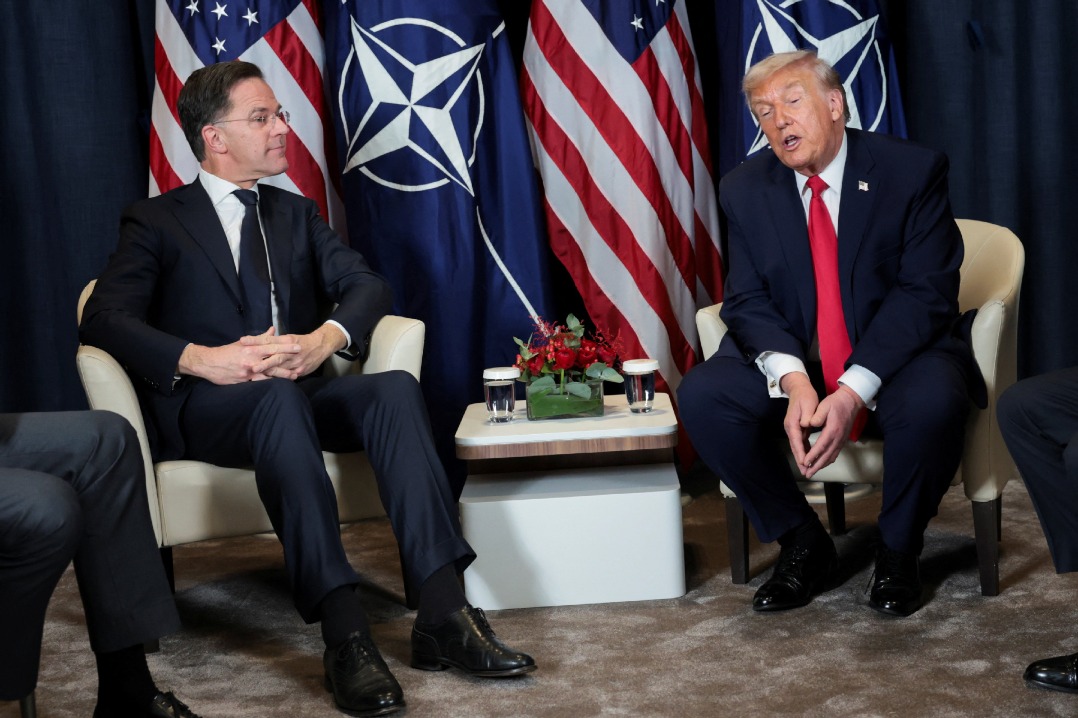
The renewed proposal by United States President Donald Trump to impose a 100-percent tariff on Chinese goods reflects a repeated misjudgment of global economics. It assumes that unilateral measures can weaken China's technology development and economic strength. Yet each trade or tech restriction directed at China has functioned as a catalyst for technological renewal.
Instead of suppressing innovation, these restrictive measures have accelerated it. The attempt to curb China's technology development has paradoxically reinforced its self-reliance in science and technology, propelling a transformation deeper and stronger.
Industrial history unfolds through four significant transitions — mechanization, electrification, automation and intelligent transformation.
The first substitution of physical labor with steam-powered machinery occurred during mechanization. The second introduced electricity, bringing mass production and urban illumination. The third created automated systems that replaced repetitive work with mechanical precision. The fourth, now led by artificial intelligence, integrates cognition with production, enabling systems that learn and adapt.
China's rise belongs squarely to this latest transformation. Confronted with foreign restrictions, the Chinese economy has drawn strength from the challenge. Obstruction has become stimulus, shaping a new era of innovation.
The American pursuit of AI reflects a distinctly different philosophy. Silicon Valley focuses much of its energy on creating artificial general intelligence, a theoretical construct intended to mirror the human mind. This aspiration, though intellectually ambitious, often drifts away from tangible application. The effort seeks to reproduce consciousness rather than to extend the capability of industry. It reflects a fascination with the idea of a "digital self "more than a vision for social advancement. Such innovation dazzles in imagination but stands detached from the material conditions of productive life.
By contrast, China's approach treats AI as an instrument to serve and improve reality rather than to imitate it.
Chinese technology centers on embedding learning algorithms in manufacturing, logistics, agriculture and healthcare. AI operates as a utility that strengthens systems rather than competes with them. Factories use AI-based inspection lines that refine precision through continuous data feedback. Transport networks adjust in real time to environmental changes. Medical diagnostics combine clinical expertise with algorithmic interpretation. Through these applications, China transforms technological imagination into infrastructure, aligning cognitive power with practical outcomes.
This pattern of pragmatic development also explains China's composure in the face of US economic provocation. When the suggestion of a 100-percent tariff triggered volatility in global financial markets, China responded calmly and moderately. The logic is consistent: Every external pressure sharpens internal capacity. The experience of past curbs or "sanctions" proved this principle. When the US blockaded high-end chips from reaching Chinese tech giant Huawei, the result was the birth of the Kirin processor and the Harmony operating system. Each constraint produced an invention or a tech breakthrough. A tariff meant to damage trade would quicken the domestication of supply chains and the localization of high-technology industries.
China's open attitude toward intellectual collaboration further deepens this contrast. In the American model, technology often remains enclosed within patents and licenses, monetized through exclusivity. China instead chooses transparency through open source publication. Companies disseminate their foundational code and models for global participation. Alibaba's release of Tongyi Qianwen and similar initiatives exemplify this expansive philosophy. By encouraging shared development, Chinese innovation attracts contributions from programmers across continents, weaving an international network of collective intelligence. The spreading of knowledge, rather than its restriction, becomes the trustworthy source of influence.
The statistical evidence of this evolution is remarkable. China now installs more industrial robots each year than the rest of the world combined, indicating a decisive move from mechanical automation to intelligent integration. Domestic providers have surpassed foreign brands for the first time, demonstrating a comprehensive command over both software and hardware. These achievements are not the result of isolation but the consequence of systematic investment in essential technologies under external pressure. Trade barriers that once appeared threatening have become incentives for China to innovate, reinforcing industrial confidence and policy continuity.
Hence, the US' tariff and tech-curb strategies misunderstand the present reality of industrial and technological competition. It attempts to govern technological advancement through economic coercion, ignoring the fact that intelligence flows freely across borders of policy. Ideas cannot be taxed. Knowledge resists containment. The moment one nation attempts to deny access, another develops an alternative that expands the field altogether. The resulting innovation is not only sustainable but autonomous. As the US authorities indulge in protectionism, China continues to reconfigure production through its broad intelligence strategy, thereby transcending the restrictions placed upon it.
The more profound significance of this transformation lies in its philosophical coherence. China's development model is directed toward mutual benefit, collective advancement and balanced growth. By strengthening open collaboration and applied research, China cultivates an atmosphere where invention becomes both a national and a human achievement.
If the global community observes this dynamic without prejudice, it will recognize that China's technological progression offers a constructive alternative to the zero-sum thinking dominating Western political discourse. Genuine global leadership in the new age of intelligence will belong not to those who threaten others with tariffs, but to those who channel creativity into shared prosperity. The ultimate irony of the American approach is that every attempt to hinder China's progress confirms the strength it seeks to diminish. Each "sanction" becomes a lesson in self-reliance, each tariff a mark of unintended encouragement.
Through determination, openness and pragmatic wisdom, China continues to convert adversity into opportunities, demonstrating that innovation, once rooted in purpose and community, is the most resilient force in modern civilization.
The author is a solicitor, a Guangdong-Hong Kong-Macao Greater Bay Area lawyer, and a China-appointed attesting officer.
The views do not necessarily reflect those of China Daily.