New endoscopic tech for complex spine surgery attracts global experts









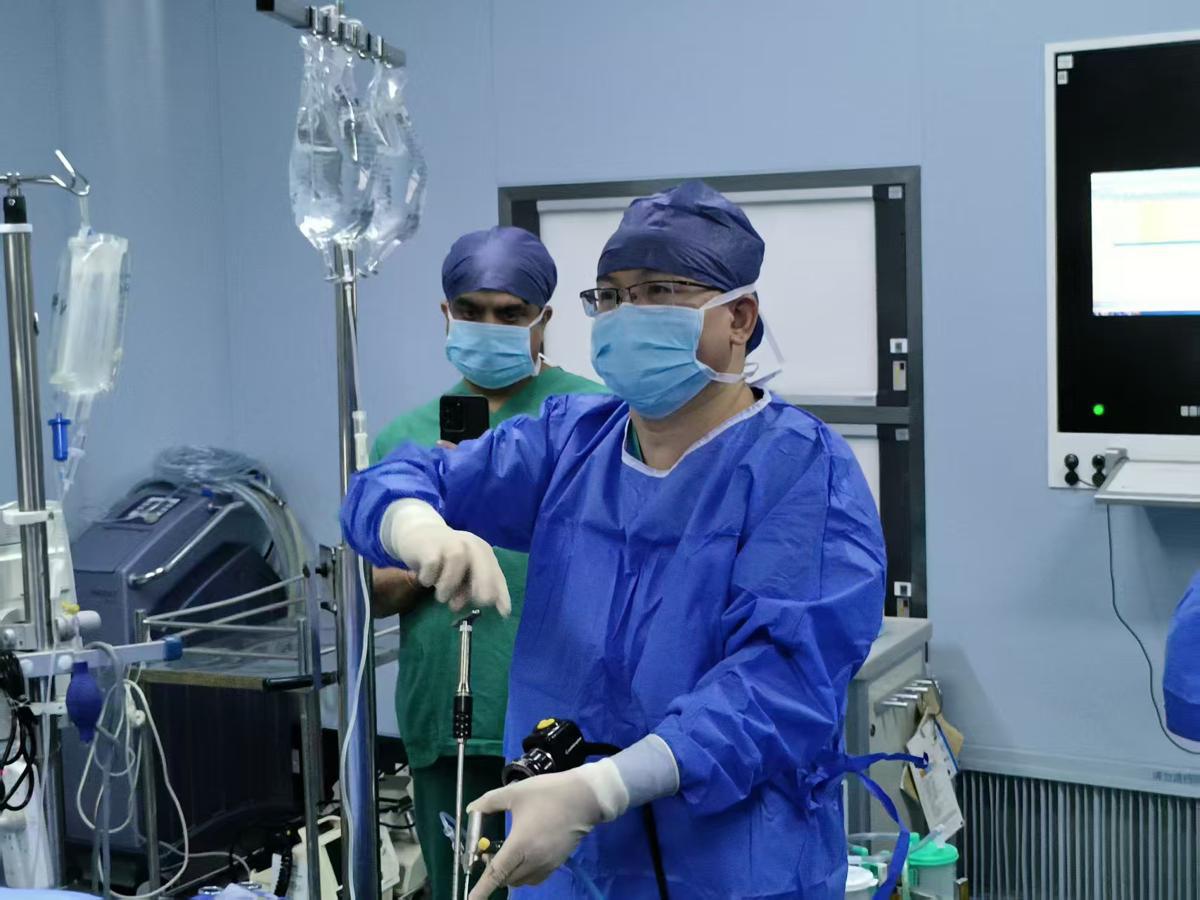
Attracted by a Chinese-developed spinal endoscopic technology known as uni-port bi-channel dual-media, or UBD, which reduces incisions from around 20 centimeters to just 1 cm, nearly 100 experts from home and abroad gathered in Shanghai recently for an industry conference.
These foreign experts in spine surgery are from countries including Japan, India, Thailand, Vietnam, Indonesia, Singapore, Russia and Ecuador. Many of them were eager to connect with the Shanghai specialists, expressing keen interest in the technology that significantly enhances surgical safety and patient outcomes.
The three-day event, the inaugural International Conference of UBD Spinal Endoscopy and Innovative MISS (minimally invasive spine surgery) Techniques, focused on the latest advancements in the professional field, aiming to deepen global understanding of this Chinese innovation and foster international collaborations.
Among the attending experts was Santosh Tripathi from India, who operates his own hospital.
"I'm truly impressed by the potential of UBD technology," he said. "Its bi-channel feature is a global first, providing full visibility during surgery and boosting the surgeon's confidence while performing the operation."
"Overall, considering the technology's advantages in controlling bleeding, managing the surgical field, and offering greater instrument freedom, I believe it will have a strong appeal for treating complex spinal cases in India and the neighboring regions," said Tripathi.
Changes in modern lifestyle are leading to a rise in spinal disorders, which are increasingly affecting younger populations, and resulting in a growing demand for surgical solutions.
Based on decades of clinical experience, professor He Shisheng at Shanghai East Hospital's minimally invasive spine center and his team identified significant limitations in traditional endoscopic spine surgeries, such as restricted operating space and high technical demands.
To address these challenges, He and his team developed the UBD spine endoscopy system, pioneering the concept of a uni-port bi-channel endoscope compatible with both air and water media. This system expands the indications for endoscopic surgery, and enhances efficiency in treating complex spinal conditions.
UBD achieved technological maturity in 2021 following a decade of experimentation and refinement, said He. "Our goal is to bring more complex cases into the realm of minimally invasive treatment, offering patients less trauma, greater efficiency, and safer surgical experiences," he said.
"Unlike other common spine endoscopy technologies, UBD allows for bi-channel operations through a 1-cm incision. In a surgical space measured in millimeters, doctors can avoid critical nerves and blood vessels while removing calcified disc tissue," He said.
The UBD surgical demonstrations during the conference received widespread acclaim from international experts, many of whom expressed interest in introducing the technology to their countries.
Experts also called for more long-term clinical follow-up data, multicenter comparative studies, and internationally registered papers to better assess its safety and potential for broader applications.
He said the UBD technology has already been adopted in many regions of China, with more than 2,000 surgeries using the technology completed domestically. Also, overseas UBD training centers have been established in Japan and Thailand.
Looking ahead, He noted that future optimizations will focus on integrating robotics and artificial intelligence into surgeries, including real-time data collection during operations to enhance precision.