Progress made holding back desert
Revised master plan ushers in next phase in long-running battle









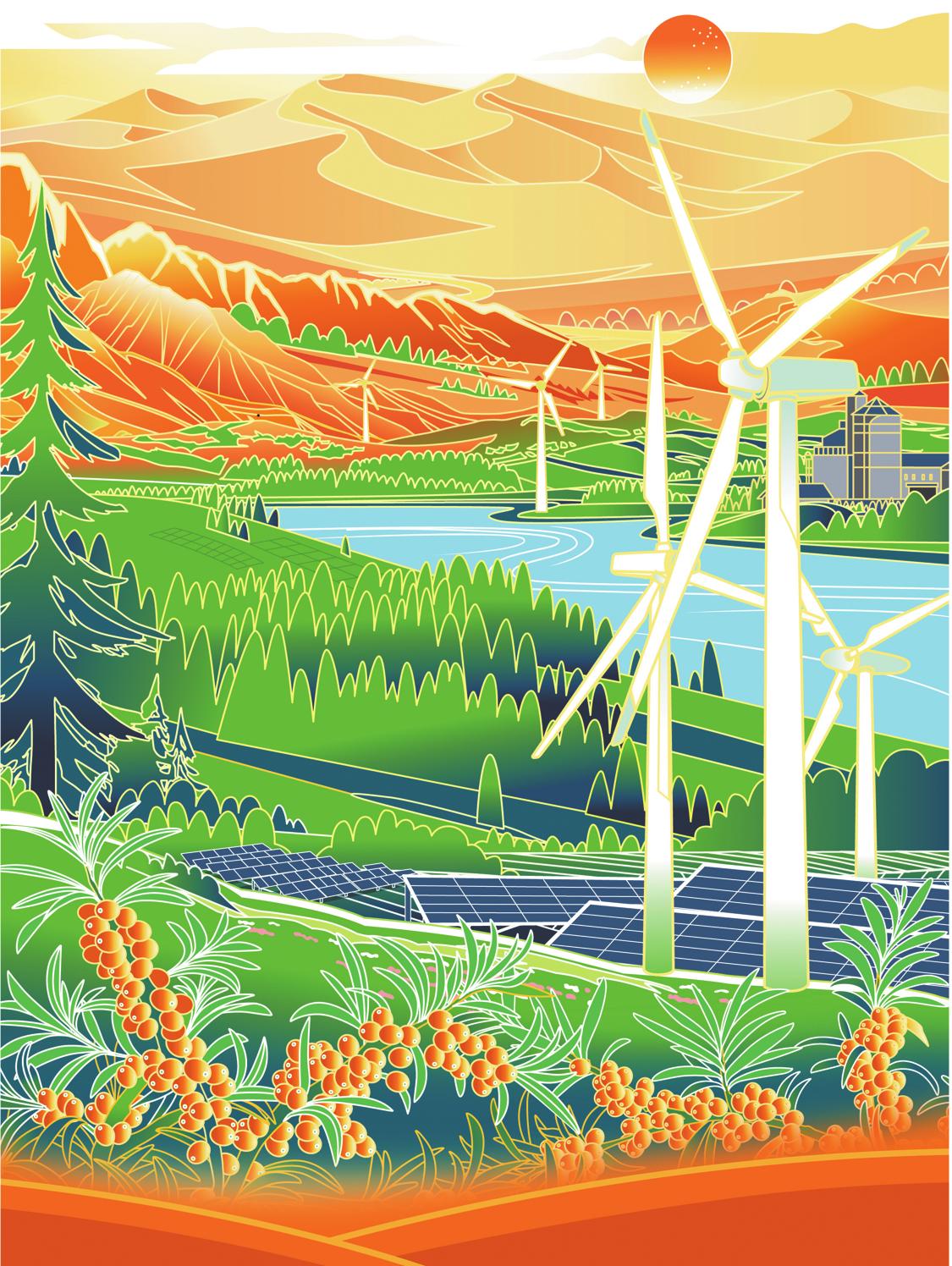
After years of cumulative effort, the Alshaa League on the western edge of the Inner Mongolia autonomous region treated its 100 millionth mu (6.67 million hectares) of desertified land earlier this month.
The milestone comes on the back of the sustained hard work of many across China's northern reaches to hold back the spread of the desert.
"This breakthrough represents both a quantitative leap and a qualitative transformation in our ecological conservation efforts," said Tuvshin, head of Alshaa's forestry and grassland bureau.
"The green barriers we've built along the fringes of three major deserts have solidified a crucial ecological shield for northern China," he said.
This hard-won progress coincides with a significant strategic evolution at the national level. In September, the State Council, China's Cabinet, unveiled a revised master plan for the Three-North Shelterbelt Forest Program, stretching across the north, northwest and northeast of the country.
This updated blueprint refocuses efforts from sheer scale toward scientific precision and synergistic benefits, aiming to secure past gains and accelerate future progress.
The convergence of Alshaa's tangible success and the plan's strategic refinement marks a new chapter in China's long-term commitment to ecological civilization, offering insights for desertification control globally.
Strategic evolution
Launched in 1978, the Three-North Shelterbelt Forest Program is a large-scale, multiphase afforestation project aimed at protecting northern China from desertification and sandstorms.
After the initial phase of the project, in 1989 China unveiled a comprehensive plan that outlined the scale, objectives and stages, guiding the project through to its 2050 completion.
The project, spanning 13 provincial-level regions, including Inner Mongolia, Xinjiang Uygur and Ningxia Hui autonomous regions, and Shanxi and Shaanxi provinces, focused overwhelmingly on planting trees and shrubs at a massive scale to stabilize soil and block the advancing sands. This approach has yielded significant results, increasing the region's forest coverage from 5.05 percent in 1977 to 13.84 percent today.
Zhang Jingbo, office director of the Three-North program research institute, said that as a pivotal national strategy, the program is fundamental to China's ecological security, sustainable development and people's wellbeing.
By combating desertification it safeguards food security, fosters green industries and demonstrates China's commitment to global ecological governance, earning international recognition as a successful model, Zhang said.
Cheng Xiaoqin, a professor of forest ecology at Beijing Forestry University, said the decision to revise the master plan has been driven by both urgency and strategic foresight.
She pointed out three challenges that necessitated the update.
The degradation of ecosystems revealed the need for more targeted governance, as some plantations faced water scarcity and vulnerability to pests. A changing climate, bringing more frequent droughts, underscored the need for a more resilient, water-conscious approach. Additionally, the focus on pure ecological defense often overlooked potential economic opportunities for local communities.
The revised plan tackles these challenges by adopting a holistic philosophy focused on expanding, revitalizing and safeguarding green spaces. Central to this approach is the reimagining of forests as synergistic assets that fulfill the essential roles of acting as water reservoirs, providing economic resources, ensuring food security, and serving as carbon sinks.
This strategic upgrade aligns with national goals for ecosystem security and high-quality development, as well as global efforts in ecosystem governance, Cheng said.
Fight on front lines
The success in Alshaa provides a case study of this evolving strategy in action. The league, grappling with the Badain Jaran, Tengger and Ulan Buh deserts, was once a primary source of sandstorms affecting northern China. Decades of persistence, employing methods such as aerial seeding, enclosure conservation and afforestation, have culminated in the creation of a 1,856-kilometer network of protective forest and grasslands.
The greenbelts have effectively halted the expansion of the three deserts, protecting not only local communities but also vital natural landscapes like the Yellow River, Hexi Corridor and Hetao Plain. In addition, they safeguard critical infrastructure, including highways, railways and gas transmission pipelines.
During the 14th Five-Year Plan (2021-25), Inner Mongolia expanded the Three-North Shelterbelt Forest Program by an additional 6.67 million hectares, as part of a broader national effort to combat desertification, improve ecological stability and enhance environmental protection.
During this period, the region completed the afforestation of 9.87 million hectares, improved 24.47 million hectares of land by planting grass, and reclaimed 12.33 million hectares of desertified and sandy land. These efforts are unparalleled in scale, ranking first in the country, and demonstrate the region's commitment to large-scale ecological management and restoration.
The revised master plan sets out clear goals for the Three-North Shelterbelt Forest Program by 2050. Those goals include increasing the forest coverage rate by another 1.9 percentage points to bring the forest and grass coverage rate to 43 percent.
It also outlines tasks for the last three stages of the shelterbelt program. For the current stage, to run until 2030, the priorities are the fight against desertification in the Great Bend of the Yellow River, the two sandy lands of Horqin and Hunshandake, and the outskirts of the Taklimakan Desert.
The plan designates the Great Bend of the Yellow River area as a core zone for the decisive battle. The urgency and strategic importance of the plan are sharply focused in places like Dengkou county at the strategic apex of the Great Bend.
Dengkou's location makes it a crucial barrier preventing the merging of the Ulan Buh and Kubuqi deserts, and protecting the vital Yellow River and the Hetao Plain, a key grain-producing region.
Decades of efforts have raised the county's forest and grass coverage from a mere 0.04 percent in the 1950s to 39.1 percent today — a monumental achievement, according to He Wenqiang, deputy head of Dengkou's desertification control bureau. Yet, degradation pressures persist, with over half of the county's forestland and a third of its grassland still considered degraded.
Dengkou's response to this illustrates the new, integrated philosophy. The county is championing the "Dengkou Model", which combines engineering, industrial development and water-saving techniques, He said.
This multifaceted approach aims to achieve full coverage of desertification control within the county within a decade, further raising the forest and grass coverage rate to over 50 percent, he added.
Cheng said China's efforts can help other nations that are grappling with land degradation and climate change.
"China's Three-North Shelterbelt Forest Program offers a global model for desertification control through long-term scientific planning, ecological-industrial synergy and technological innovation. It transforms environmental gains into economic benefits by developing specialty industries, raising local incomes and encouraging public participation," Cheng said.
Future global collaboration can be strengthened by establishing technology-sharing platforms, launching joint research projects and strengthening capacity building by offering training programs, she added.
Contact the writers at jihaisheng@chinadaily.com.cn






- 10 dead and 84 injured in explosion at steel plant
- China unveils flexible urban planning rules to improve lives, foster new industries
- Ex–China Construction Bank executive gets 18 years for bribery, loan violations
- First batch of eco-friendly pioneer zones for construction of beautiful countryside unveiled
- Woodpeckers, finches captured in Jilin winter scenes
- Mainland reiterates 1992 Consensus as foundation for resuming cross-Strait dialogue