



Looking way beyond electric: potential of hydrogen set out
Engineers and government ministry release road map on alternative fuel









The hydrogen fuel cell vehicle market is poised to expand from the current 10,000-unit scale to over 4 million units by 2040, according to China's Technology Roadmap 3.0 for Energy-Saving and New Energy Vehicles which was released on Wednesday.
The road map, which was compiled by the China Society of Automotive Engineers with guidance from the Ministry of Industry and Information Technology, sets China's long-term targets for electrification, low-carbon development and intelligent connected vehicle technologies.
Zhang Jinhua, president of the China-SAE, said: "We have identified the specific development goals and pathways for fuel cells in the decarbonization of commercial vehicles in the future. It is preliminarily estimated that by 2040, new products will also reach the million-unit level, with total ownership to reach 4-5 million units."
The sector has benefited from favorable policies recently. The industry's stable growth plan released by the central government in September promotes fuel cell vehicle demonstrations, expands heavy-duty fuel cell vehicle use, and develops hydrogen infrastructure.
The Beijing city government has launched a demonstration project for fuel cell vehicle applications, while Guangzhou has issued a notice for operating subsidy applications.
Data from the China Association of Automobile Manufacturers show that the production and sales of fuel cell vehicles reached 441 and 408 units in September, growing by 173.9 percent and 94.3 percent year-on-year respectively.
As of September, there are 25,700 fuel cell vehicles and 560 hydrogen refueling stations in the country.
The CAAM noted that hydrogen energy transportation is still in its early stages of development. However, with continued policy support and the diversification of application scenarios, the fuel cell vehicle market has growth potential.
Wan Gang, president of the China Association for Science and Technology, called for coordinating and advancing the development of hydrogen energy and fuel cell vehicles through demonstration policy innovation at the World New Energy Vehicle Congress in late September in Haikou, Hainan province.
He urged policies to extend from key technology breakthroughs to large-scale promotion and infrastructure construction, so as to improve the development environment for the entire industry chain.
Both domestic and international automakers are ramping up investments in hydrogen fuel cell vehicle development and operation.
Haima Automobile, one of the first automakers in China to engage in hydrogen-powered vehicles, has been conducting a demonstration operation of hydrogen fuel cell vehicles in Haikou since March 2024. It involves 50 vehicles offering ride-hailing and rental services.
These vehicles have collectively run for more than 2 million kilometers without failure and can reduce carbon dioxide emissions by approximately 1,000 metric tons annually, according to the automaker.
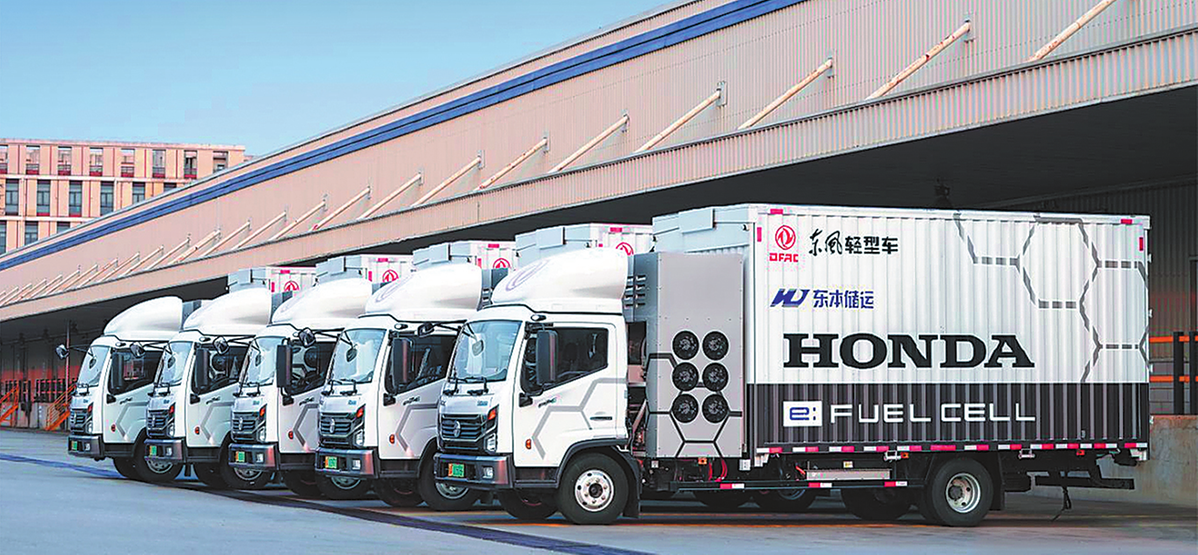
On Wednesday, Honda and Dongfeng launched the demonstration of hydrogen fuel cell commercial vehicles on Wuhan's logistics routes, with plans to expand to Guangzhou, Shanghai and other regions.
Since 2023, the two parties have been testing the integration of Honda's fuel cell system with Dongfeng's light commercial vehicles, focusing on environmental adaptability, power efficiency, and durability. Over two years, tests in various real-world scenarios have shown that the performance meets market demands.
The new demonstration project aims to verify the technology's applicability in China's transport environment, assess real-world usage and costs, evaluate market competitiveness and acceptance, and analyze operational efficiency, according to the automakers.
BMW is focusing on fuel cell passenger vehicles. In September, the German luxury automaker announced the launch of its third-generation hydrogen fuel cell system. The first prototypes are in trial production, with plans for mass production by 2028 and to be first featured in the next-generation X5.
The system, developed by BMW and Toyota, features improved power density, reducing space requirements by 25 percent compared with last generation, while enhancing efficiency. These advancements translate to longer driving range, higher power output, and lower energy consumption for vehicles.
However, the United States' automaker General Motors announced earlier in October that it would end its R&D plan for next-generation fuel cells and cancel its first hydrogen factory, citing policy changes and insufficient infrastructure.
While hydrogen holds promise for specific high-demand industrial applications like backup power, mining, and heavy trucking, the path to reaching a sustainable business in fuel cells is long and uncertain, GM said in a statement.
According to the US Department of Energy, only 61 hydrogen refueling stations are operational in the country.
Stellantis also suspended related investment, believing that hydrogen-powered light commercial vehicles will gain little market recognition before 2030.
But, industry experts pointed out that hydrogen fuel cell vehicles have unique advantages in commercial applications: their 5-10 minute refueling time, around 600-km range, and reliable cold-weather performance make them ideal for logistics and long-distance transportation.
While such vehicles face challenges like limited refueling infrastructure and high costs, experts predict these costs will fall by 2035.
The global fuel cell vehicles market is projected to reach $35.2 billion in 2025, growing to about $62.09 billion in 2026. It is anticipated to achieve nearly $502.5 billion by 2034, progressing at a compound annual growth rate of 76.7 percent during 2025-34, according to Business Research Insights.



















