Faithful adherent
China has become a linchpin of the UN system, providing support and proposals to bolster the centrality and authority of the organization










As the most universal, representative and authoritative intergovernmental organization, the United Nations plays an irreplaceable role in international affairs. And since the restoration of its seat in 1971, China has continuously deepened its cooperation with the UN, contributing Chinese wisdom to global development in areas such as peace, security, development, civilization and governance.
China has always regarded the maintenance of world peace as an important responsibility. As the country that dispatches the largest number of peacekeepers among the five permanent members of the UN Security Council and the second-largest financial contributor to UN peacekeeping operations, China has sent more than 50,000 peacekeepers to participate in 26 UN peacekeeping missions across over 20 countries and regions. At present, about 1,800 Chinese troops are carrying out peacekeeping tasks. The Chinese military has also trained peacekeeping personnel for over 70 countries and established an 8,000-strong peacekeeping standby force to enhance rapid response and professional support capabilities.
Since 2010, the Chinese Navy's hospital ship Peace Ark has carried out 10 Mission Harmony operations, visiting 52 countries and regions and providing over 370,000 medical consultations. Through this multi-level participation, China has become an important force within the UN peacekeeping system.
In the field of security, China advocates the vision of common, comprehensive, cooperative and sustainable security and calls for resolving differences through dialogue and cooperation. China has promoted diplomatic efforts on the Ukraine crisis and the Israeli-Palestinian conflict, and proposed the Outlook on Peace and Development in the Horn of Africa. China also played a major role in the resumption of diplomatic relations between Saudi Arabia and Iran.
China actively participates in arms control and disarmament processes. It has ratified the Firearms Protocol, and promotes international humanitarian assistance in demining endeavors. It has strengthened cooperation with developing countries in fields such as counterterrorism, disaster prevention and mitigation, climate change responses and public health. In recent years, China has launched a series of global initiatives, including the Global Initiative on Data Security and the Global AI Governance Initiative, to help improve international rules in emerging domains such as the deep sea, polar regions and outer space, thereby enhancing the world's capacity for security governance.
In the field of common development, China has shared its own experience with the world for the benefit of all. In the early years of reform and opening-up, China was a recipient of assistance from the UN Development Programme; today, it promotes common prosperity through development cooperation. China's experience in targeted poverty alleviation has been included in a database of cases of the UNDP for global poverty reduction. To date, China has lifted about 800 million people out of abject poverty, achieving the UN's 2030 poverty reduction goals ahead of schedule and contributing more than 70 percent of the global poverty reduction.
Through South-South cooperation and participation in international poverty alleviation programs, China has also translated its domestic poverty reduction practices into development solutions shared by the world. From the promotion of hybrid rice technology to the construction of infrastructure in countries participating in the Belt and Road Initiative, China has helped many impoverished people overseas improve their lives.
As of November 2023, China had also established 24 agricultural technology demonstration centers in Africa, introducing more than 300 advanced and applicable technologies such as maize planting and vegetable cultivation, which have increased local crop yields by 30 to 60 percent. Meanwhile, through cooperation with the UN Food and Agriculture Organization, China has provided agricultural technical assistance to multiple countries, helping them significantly enhance their food production capacity. The FAO also plans to share China's innovative poverty reduction models — such as the SDG Pilot Village — with other developing countries through South-South and tripartite cooperation.
At the G20 platform, China announced its participation in the Global Alliance Against Hunger and Poverty and has promoted the transformation of its poverty reduction experience into global public goods.
In the field of climate governance, China submitted its first Nationally Determined Contributions document in 2015, setting the goal of reducing carbon dioxide emissions per unit of GDP by 60 to 65 percent from 2005 levels by 2030. It has also established the China South-South Climate Cooperation Fund to support developing countries.
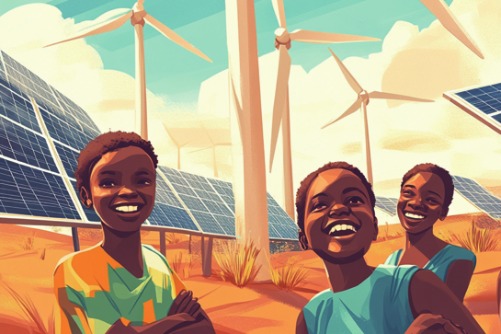
In his speech at the UN Climate Summit 2025, President Xi Jinping announced China's new Nationally Determined Contributions: "China will, by 2035, reduce economy-wide net greenhouse gas emissions by 7 percent to 10 percent from peak levels, striving to do better; increase the share of non-fossil fuels in total energy consumption to over 30 percent; expand the installed capacity of wind and solar power to over six times the 2020 levels, striving to bring the total to 3,600 gigawatts; scale up the total forest stock volume to over 24 billion cubic meters; make new energy vehicles the mainstream in the sales of new vehicles; expand the National Carbon Emissions Trading Market to cover major high-emission sectors; and basically establish a climate adaptive society." This move demonstrates China's heightened emissions-reduction commitment under the Paris Agreement framework.
In addition, China's Global Development Initiative has received support from more than 100 countries and international organizations, creating synergy with the BRI. China promotes regional economic growth through agricultural technology, infrastructure, and connectivity projects, such as the Mombasa-Nairobi Standard Gauge Railway and Addis Ababa-Djibouti Railway in Africa and the China-Laos Railway in Southeast Asia, all of which foster mutual benefit and win-win outcomes. According to World Bank estimates, the BRI will help lift 7.6 million people worldwide out of poverty by 2030.
In the field of cross-cultural exchanges, China has proposed the Global Civilization Initiative, which calls for respecting the diversity of civilizations and advocates mutual learning and exchanges among civilizations as a means to transcend conflict and estrangement. China actively participates in UNESCO affairs and supports the protection of cultural and natural heritage. It currently ranks among the top countries in the number of World Heritage sites. China promotes dialogue among civilizations and cooperation in the humanities.
In the field of global governance, China upholds multilateralism with the UN at its core and calls for greater representation of developing countries in the international governance system. China pays its UN dues and peacekeeping assessments on time, and has put forward the Global Governance Initiative based on five key principles: sovereign equality, international rule of law, multilateralism, the people-centered approach and real results. These principles are consistent with the purposes of the UN Charter and respond to the common concerns of most countries.
With the expansion of BRICS and the growth of the Shanghai Cooperation Organization entering new stages, institutional platforms for the Global South have become more robust. Developing countries now enjoy significantly enhanced representation and organization in global affairs.
Meanwhile, China continues to expand its institutional opening-up. To date, China has signed visa exemption agreements of various types with 157 countries and regions, applied zero-tariff treatment to 100 percent of taxable products originating from the least developed countries having diplomatic relations with China, and steadily advanced trade and investment liberalization and facilitation — injecting new momentum into global economic recovery.
Over more than half a century, China has evolved from a newcomer to the UN into an active leader in global governance. Standing at the milestone of the UN's 80th anniversary, the international community increasingly recognizes that global challenges require unity and cooperation among all nations.
China advocates building a community with a shared future for humanity, emphasizing interdependence and win-win cooperation, and offering direction for the creation of a world of lasting peace, universal security and common prosperity. Looking ahead, China will continue to work hand in hand with the UN, contributing to world peace and sustainable development through cooperation and action.

The author is the president of China Foreign Affairs University. The author contributed this article to China Watch, a think tank powered by China Daily.
The views do not necessarily reflect those of China Daily.
Contact the editor at editor@chinawatch.cn.