China's new quality productive forces gather steam to turbocharge future growth









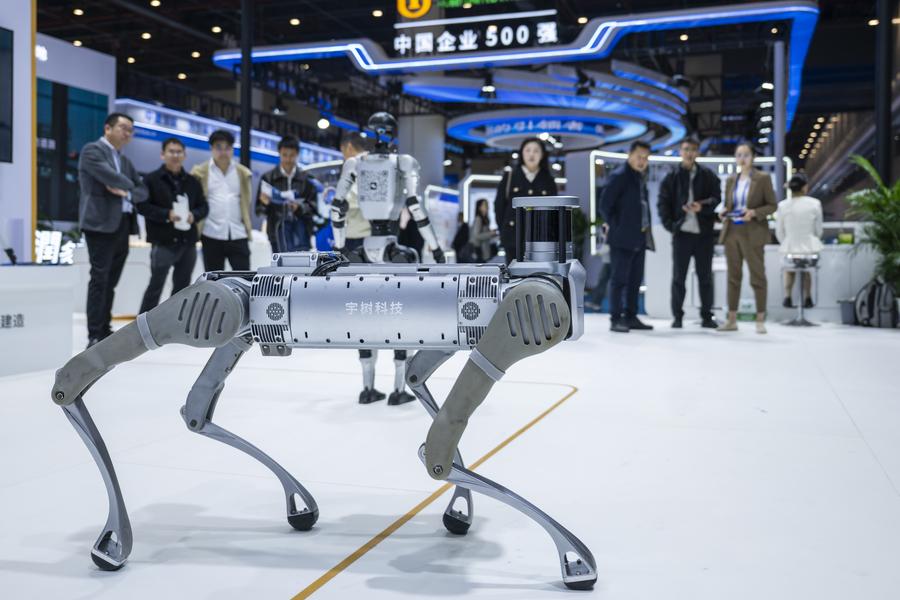
BEIJING -- Shifting from the "world factory" to a tech innovation hub, China is accelerating the development of new quality productive forces to forge a new growth path amid a more complex global landscape.
The world's second-largest economy has recently unveiled a pivotal document outlining priorities for its 15th Five-Year Plan (2026-2030), which emphasizes "achieving greater self-reliance and strength in science and technology" and "steering the development of new quality productive forces" as key objectives for the coming five years.
As a pillar of China's high-quality development, the cultivation of new quality productive forces tailored to local conditions has made notable strides in recent years and is expected to play an even more pivotal role in supporting growth in the near future.
Tech-powered upgrades
Under bright white lights, an automated production line hums softly as robotic arms lift, pivot and place miniature components with precision. Autonomous carts glide seamlessly between workstations, transporting trays of parts without pause. In an adjacent control room, a small team of technicians monitors dashboards that integrate real-time data.
This scene plays out daily at Dongguan Moldbao Smart Technology Co, a mold manufacturer in Dongguan, South China's Guangdong province. Founded in 2016, the company has been an early pioneer in China's smart-manufacturing drive, launching multiple automated mold production lines capable of running around the clock.
"Molds are known as the 'mother of industry' and are used across many sectors, but producing them demands high consistency and precision," said Wang Sheng, vice president of the company. "To ensure that, we rely on data, which is more stable than humans."
Doubling down on technology upgrades, the company has digitized and automated every step of production, Wang said, from design and programming to manufacturing and logistics. With the resulting efficiency gains, the company has shortened its mold production cycle by about 30 percent.
Across China, traditional industries are undergoing a technology-driven transformation to raise productivity and open new paths for growth.
In Northeast China's Liaoning province, a traditional heavy-industry base, intelligent and green upgrades are transforming legacy sectors, offering a clear path to shed its rust-belt image. For example, Ansteel, a major provincial steelmaker, has deployed an intelligent system to optimize molten steel handling, reducing production costs by 15 percent and cutting wastewater discharge by 21 percent.
Speaking about this national trend, Lyu Peng, a researcher with the Chinese Academy of Social Sciences, said it exemplifies the development of new quality productive forces, which span both cutting-edge and traditional industries. "New quality productive forces are not limited to strategic emerging or future industries," Lyu added. "With transformation and upgrading, traditional sectors can become them as well."
Numerous companies across the country are accelerating their digital transformation efforts. According to the China Internet Development Report 2024, the country now has nearly 10,000 digitalized workshops and intelligent factories. Of these, more than 400 have been recognized as national-level benchmark factories in smart manufacturing, utilizing technologies such as AI and digital twins.
Using advanced technologies such as information technology, artificial intelligence, big data and the Internet of Things, new quality productive forces reorganize and optimize traditional factors of production, reshaping how manufacturing is run and managed, said Zhu Qigui, deputy director of the China Academy of Financial Research.
Zhu noted that these forces will influence technological renewal, production efficiency and industrial structure. "Chinese manufacturers must strengthen innovation, optimize industrial structure, and improve product quality and added value to achieve high-quality development and stand out in global competition," he said.
Innovation as core
According to the recommendations from the Central Committee of the Communist Party of China for the new five-year blueprint, the country will strengthen self-reliance in science and technology and guide the development of new quality productive forces. "Innovation" is a recurring theme, with priorities including raising innovation capacity across the board and advancing original innovation.
To this end, Shenzhen, China's leading science and technology hub, has provided an exemplary solution. In Nanshan District, a sci-tech innovation cluster is taking shape, bringing together a diverse range of innovators and enterprises.
"Here, it is easy for us to work with universities and research institutes, keeping us connected to cutting-edge technologies and talent," said Zhou Qi, president of Dimension Technology Co, Ltd, an optical measurement solutions provider. The cluster now hosts multiple industry leaders and nearly 10 universities, showcasing an industry-academia-research collaboration model that efficiently translates research outcomes into real-world productivity.
One of Nanshan's key talent pools is Shenzhen Polytechnic University, a state-funded vocational undergraduate institution that produces graduates tailored to the pressing needs of industry and technology firms. "We develop specialized courses around industrial chains, extend classrooms into industrial parks, and integrate talent training with production lines," said Xu Jianling, the university's president. "Building on these efforts, we have advanced education reforms that adapt to industrial development."
On a broader national scale, China has fostered more than 500,000 high-tech enterprises over the past five years and now claims the largest global share of sci-tech innovation clusters.
The China Innovation Index, a barometer of the country's innovation capability, rose 5.3 percent from the 2023 level to 174.2 last year, according to the National Bureau of Statistics (NBS). The innovation environment has continued to improve, with higher investment, faster growth in outputs and stronger drivers of economic activity, the bureau said.
The country's sci-tech innovation efforts are delivering an effective boost to growth, with the innovation effectiveness index reaching 132.4 last year, up 1.9 percent from a year earlier, according to the NBS. Specifically, the sub-index measuring the proportion of added value from new technologies, new industries and new business models in total GDP increased by 4.3 percent year-on-year.
As a contributor of about 30 percent to global growth, China's shift toward innovation-driven development is drawing global investors. Last month, AstraZeneca officially opened a new global R&D center in Beijing. It is the British pharmaceutical company's sixth global strategic R&D center and its second in China, following the first in Shanghai.
Looking ahead, Xiong Hongru, a researcher at the Development Research Center of the State Council, said that as China pursues greater science and technology self-reliance, it will bolster large-scale strategic basic research projects focused on key frontiers.
Additionally, efforts will be made to deepen industry-academia-research integration in talent cultivation to build a competitive human-capital advantage, while accelerating the transformation and application of major scientific and technological achievements, Xiong added.



- Mainland denounces Taiwan-US trade deal as 'sellout pact'
- Beijing becomes China's second 5-trillion-yuan economy in 2025
- Strengthening trade bonds benefits people across Taiwan Strait: spokesperson
- Chinese researchers develop eye surgery robot
- High-speed train staff members in Beijing busy preparing for Spring Festival travel rush
- Mainland says DPP's so-called trade deal with US sells out Taiwan's interests