


Gilded in gold
New exhibition displays seldom-seen artifacts, telling the Chinese history of this revered yellow metal, Wang Ru reports.










Zhao mentions that the style of this plaque recalls imperial hunting scenes found on gold and silver wares from the Sassanid Empire (224-651) in West Asia, but the rider's attire and facial features are distinctly Tubo, and display a blend of exotic artistic traditions with Tubo elements.
Benefiting from the convenient transportation network of the ancient Silk Road, Tubo adopted multicultural elements from China's Central Plains, and South, Central, and West Asia, says Wang, who adds that the Silk Road also brought opportunities for the Tang to absorb foreign cultures.
This section also features cultural exchanges between the Tang and Tubo.
"Tang and Tubo coexisted for a long time, during which gold played an important role in their close relationship. It was recorded that gold objects were among the gifts from Tubo to Tang rulers, and gold pieces from Tang also arrived in Tubo through marriage alliances.
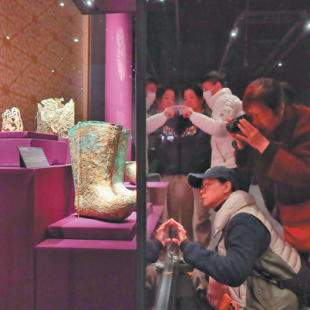
"We show some of the objects from Tang, and some from Tubo. You can see they are similar, but also very different. Together, they show an exchange of techniques and aesthetics at that time. That's why we say Chinese civilization is integrated, yet pluralistic," says Wang.
The last section highlights gold ornaments from China's 10th to 17th centuries, developed by different ruling ethnic groups, including Khitan, Mongolian and Tangut.
Guo Jingning, director of the Capital Museum, explains that gold has three peaks of development in Chinese history. The exhibition's three sections basically correspond with the three stages.
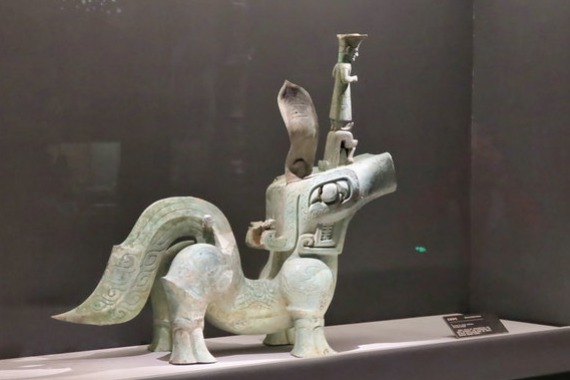
"The first peak appeared during the Shang (c. 16th century-11th century BC) and Zhou dynasties, exemplified by gold artifacts from the Sanxingdui site. The second was from the Tang and Song (960-1279) dynasties, during which gold wares from the Hejiacun hoard in Xi'an, Shaanxi province, serve as outstanding examples. The final one was the Ming and Qing (1644-1911) dynasties, represented by gold artifacts from the mausoleum of Emperor Wanli of the Ming period," says Guo.

Two exhibitions featuring similar groups of objects were held in Hong Kong in 2013 and 2023. This time, although the exhibits remain mostly unchanged, researchers from the Capital Museum conducted extensive research on the artifacts. They delved into historical literature and compared the items with similar findings from archaeological excavations, and were, therefore, able to provide more detailed information, according to Wang.
This display marks another cooperation between Chinese mainland and Chinese Hong Kong museums, a partnership that has become increasingly frequent in recent years.
The Hong Kong Palace Museum has signed more than 10 memoranda of understanding with mainland museums and universities, and co-organized over 10 exhibitions and academic activities with the Palace Museum in Beijing.
In partnership with museums in Sichuan, the Hong Kong museum organized an exhibition to showcase the newest archaeological discoveries from the Sanxingdui site in 2023 and 2024, which became one of the most popular exhibitions in its history.
"The Hong Kong Palace Museum was established as a collaborative project between Hong Kong's West Kowloon Cultural District Authority and the Palace Museum in Beijing. Therefore, we have the responsibility to tell wonderful stories of Chinese culture through our collaboration with museums on the Chinese mainland," says Wang.
Contact the writer at wangru1@chinadaily.com.cn