


Sharing wisdom of traditional Chinese medicine with the world










"We live in an era of rapid technological advancements, but we humans are more than ever conflicted by anxiety." This is how Meng Liang, chairman of the Mencius Foundation, began his keynote speech to the 22nd World Congress of Chinese Medicine.
"It may boil down to our tendency to solve problems with a confrontational mindset, which can result in the separation of mind and body, the opposition between man and nature, and the divide among civilizations."
At the congress, which was held in Sydney from Oct 30 to Nov 1, Meng, a 79th-generation descendant of the ancient Chinese philosopher Mencius (372-289 BC) and a champion of traditional Chinese medicine (TCM), argued that the ancient wisdom of TCM offers timely solutions to modern anxieties and divisions.
He highlighted "diversity and symbiosis", two values central to TCM philosophy, arguing that these principles offer an answer to major contemporary challenges.
"TCM is the concentrated manifestation of China's excellent traditional culture, such as I-Ching and Confucianism," he said.
"All things are nurtured together without harming one another; all paths run in parallel without conflicting," citing a quote from the Confucian classic Zhongyong, or Doctrine of the Mean, he added, "Such is the ideal form of celebrating diversity and symbiosis."
Meng pointed out that TCM is an ancient art of honoring diversity and balance. TCM sees the human organs as having equal importance, it does not emphasize the supremacy of the heart or the brain. Instead, it focuses on how the various functional systems, especially the wu zang, or five viscera (liver, heart, spleen, lung and kidney), achieve a high degree of coordination guided by xin, or the heart-mind, to help qi, or vital energy, flow smoothly through the body's meridians.
"Health, thus, is the state of dynamic balance of various systems," he said.

In diagnosing a patient, an outstanding TCM specialist does not merely rely on a lab report. They would use the millennia-old four diagnostic methods called observation, listening and smelling, questioning, and pulse-taking. By piecing together the patient's pathological data from various perspectives, the doctor can make a sound diagnosis.
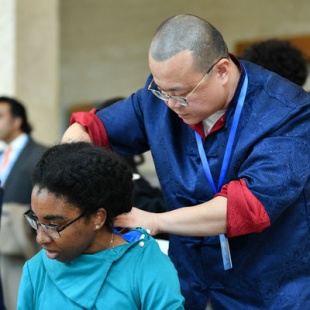
In terms of treatment, TCM also adopts a holistic approach through a wide range of therapies, including herbal medicine, acupuncture, massage and exercise. Every herbal medicine formulation, tailored to each patient, adheres to the "principal, assistant, adjuvant and guide" principle, which emphasizes the roles and percentage of different medicinal herbs.
"The combination of herbal medicine, acupuncture, massage and exercise provides a library of treatment options," Meng explained.
Stressing that TCM is also a fine art of achieving harmony, Meng argued that learning about TCM can reshape our view of health and our relationship with nature.
He noted that, for decades, people have been accustomed to using "war" as a metaphor for treating illnesses, such as "declaring war" on cancer and "fighting" against viruses.
"This is a powerful metaphor, but also a dangerous one, because it implies that we must eliminate an enemy to achieve health," he said.
TCM, however, offers a different metaphor, viewing the human body as a landscape that needs favorable weather and care. Disease is not an enemy to be eliminated, but a signal of an imbalance in the ecosystem. A doctor is not a warrior, but a gardener whose job is to fertilize (replenish deficiencies), weed (reduce excesses) and dredge the channels (promote blood circulation and remove blood stasis), so that the garden of life can regain its ability to flourish.

By embracing the metaphor of TCM, health is no longer seen as the outcome of "winning a war", but rather the result of "nurturing an ecosystem", he argued.
More importantly, TCM encourages us to reconsider our relationship with nature, Meng said. He emphasized that TCM's focus on daodi yaocai — or authentic, region-specific medicinal materials — embodies a deep ecological philosophy that remains highly relevant today.
TCM posits that the best medicinal materials can only be produced from the healthiest and most harmonious ecosystems. Hence, developing TCM is intrinsically aligned with protecting biodiversity, addressing climate change and practicing sustainable development, he added.
"Mr Meng's keynote speech deeply resonated with me," said Allie Xu, a Brisbane-based TCM practitioner and acupuncturist who attended the congress in Sydney.
"It prompted me to rethink the philosophy behind TCM — the relationship between humanity and nature, body and mind, and civilizations. The concept of 'diversity and symbiosis' showed me that TCM is not merely a historical legacy, but a living wisdom capable of responding to contemporary anxieties and divisions.
"It reminds us that TCM not only treats the body but also explores the path to harmony between people, and between humanity and the world," Xu added.