



Calls for China to consume better, rather than more









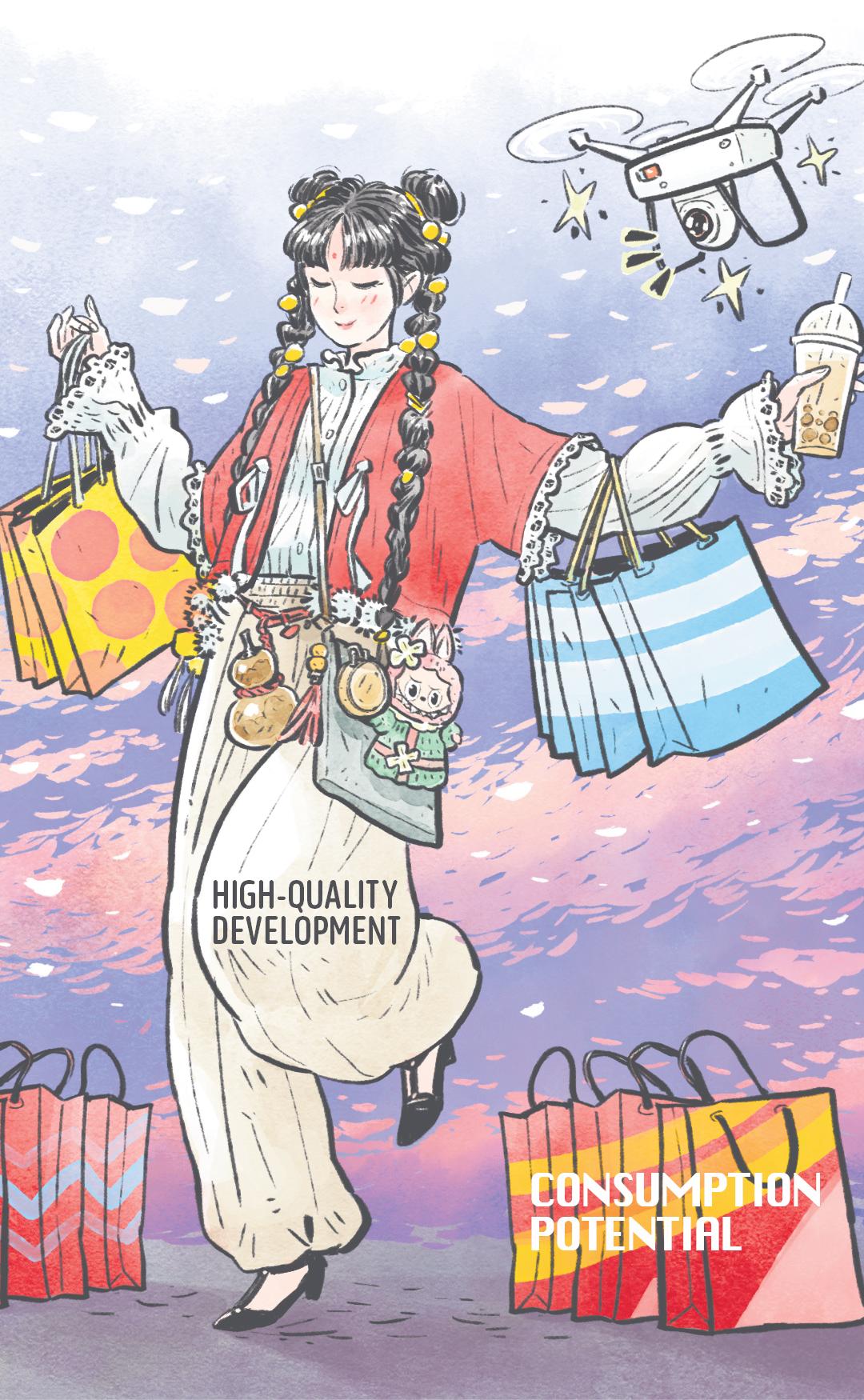
As China advances high-quality development and cultivates new quality productive forces, some Western commentators and policymakers have urged the nation to rely more on domestic consumption to sustain growth rather than over-dependence on exports. Yet the general call for more consumption is inadequate. The challenge before China is not simply to consume more, but to consume better.
Good consumption promotes sustainability and well-being, while bad consumption leads to waste and social and environmental harm. Understanding this distinction is essential for policymakers, businesses and households alike.
In the United States, household consumption accounts for about 68 percent of GDP. Many Western economists treat this as a benchmark of success and urge China to follow suit. Yet a lot of US consumption is financed by easy credit and driven by marketing rather than real income growth. Consumers are encouraged to "trade up", replace what still works and equate happiness with accumulation.
The result is wasteful overconsumption — rising debt, emissions and inequality. Total US household debt now exceeds $18 trillion, suggesting consumption without restraint breeds dependency, not prosperity. When Western officials urge China to "consume more", they are effectively inviting it to repeat their mistakes.
For four decades, China's rapid growth was powered by infrastructure and manufacturing — industries led by engineers rather than marketers. As the country's railways, roads and ports near completion, doubling down on such investment inevitably yields diminishing returns.
China's manufacturing sector remains among the world's most efficient, serving increasingly diverse markets beyond the US. But sustaining growth now requires rebalancing — from heavy investment and export-reliance toward a more service-oriented, experience-driven economy.
In fact, the tertiary (services) sector already accounts for roughly 56-57 percent of China's GDP.Meanwhile, culture-related industries contributed 4.59 percent and tourism and related industries 4.24 percent of GDP in 2023. These figures underscore that the shift toward services is well underway.
Most Chinese families live in apartments already equipped with enough furniture and appliances. Pushing more consumption in rural areas is not as useful as encouraging spending on travel, education, culture, entertainment and care services, which create jobs and enhance well-being. This is "better consumption", it enriches lives without exhausting resources.
Moreover, the government should actively support the build-out of domestic industries in tourism, entertainment, media and sports for young people to consume — rather than encouraging more resource-depleting material-goods purchases. Imagine a China where young consumers choose music festivals, sporting events, interactive media, creative content or domestic travel experiences, rather than buying a second or third car or upgrading every gadget. That is a model of consumption aligned with sustainability, emotion-rich human interaction and social vitality.
In parallel, the government should prioritize the expansion of healthcare and eldercare services, cradle-to-grave care, retirement-community development and intergenerational well-being. For a rapidly aging society, this is the sector in which China should "sell care, not cars". In such service areas, the empathy of human labor interactions with customers cannot be substituted by artificial intelligence alone. The human touch still matters. A vibrant domestic eldercare services sector not only meets social needs, but also offers high-quality employment and durable demand.
Services consumption — notably hospitality, tourism, arts, media and healthcare — creates employment while leaving a lighter environmental footprint than many traditional goods-related industries. By contrast, bad consumption often includes impulse buying, over-use of cheap, low-quality products and dependence on goods that damage both people and the planet.
Fast fashion, junk food and excessive packaging may boost short-term GDP, but they undermine long-term welfare. Policymakers should therefore evaluate goods and services not only by sales, but by their net contribution to sustainable prosperity, taking into account their carbon footprint.
Encouraging better consumption also requires addressing why many Chinese families save rather than spend. A stronger social safety net — in healthcare, pensions, education and eldercare — would reduce precautionary savings and allow households to consume with more self assurance.
An important priority should be to lift consumption among rural and lower-income households, where spending is limited not by lack of aspiration, but by insecurity. Expanding social protection and improving income distribution will foster balanced, inclusive and human-centric consumption — the kind that supports stable domestic growth.
Markets alone do not ensure good consumption. Many so-called free-market economies impose "sin taxes" on alcohol, cigarettes and other harmful products to discourage damaging behavior without eliminating choice. China could similarly use incentives and disincentives to guide healthier and more sustainable consumption patterns.
For businesses, this transition also demands a new mindset. Engineers built China's manufacturing strength; marketers will shape its next phase by designing experiences and services that elevate well-being rather than promote excess. Innovation should focus not just on making products faster or cheaper, but on making lives better. The government should support innovations that result in products associated with "good consumption" — ecologically friendly design, intuitive service platforms, aging-friendly care technologies, and immersive cultural and sports experiences.
A quiet revolution in consumer values is already underway. Around the world, a growing consumer segment is seeking simplicity over abundance, authenticity over ostentation. These "simplifiers "value minimalism, sharing and sustainability.
In China, young consumers are leading this shift — embracing second-hand goods, renting rather than owning, and supporting ecologically friendly brands. They represent the future of responsible consumption and a powerful driver of sustainable prosperity.
Consumption will always play a role in growth, but it should serve higher goals — human development, social harmony and environmental balance. As China transitions toward high-income status, its focus must shift from quantity to quality, from products to purpose, and from material accumulation to experiential enrichment.
China has an opportunity to redefine modernity. Modernization does not necessarily mean copying the Western consumption model. It means redefining prosperity for an era of constraint, where balance, moderation and foresight become the hallmarks of progress.
If the 20th century belonged to economies that consumed, the 21st will belong to those that conserve. China's path of "high-quality consumption "can yield not only stronger growth, but also a more sustainable and humane civilization — or in other words, an example the world urgently needs.
The writer is executive vice-chancellor, American president, and distinguished professor of social science at Duke Kunshan University.
The views do not necessarily reflect those of China Daily.


Today's Top News
- Chinese leaders extend Spring Festival greetings to retired senior officials
- China successfully recovers first-stage booster of Long March 10 rocket from sea
- Longer Spring Festival break fuels travel boom
- Whatever the season, China will keep tourists busy
- Is Spring Festival without fireworks applaudable?
- Vital role of family virtues in governance







