



Traditional treatments soothe patients' pains
Ethnically diverse Guizhou makes most of unique medicine systems









Southwest China's Guizhou province has for centuries been a melting pot for as many as 48 of the country's 56 ethnic groups, creating a diverse mix of culture, tradition and systems of medicine.
In a small clinic in the Guizhou city of Tongren, Bai Yutao uses traditional techniques of the Qiang ethnic group to treat his patients.
The acupuncturist immerses polished white stones into a bubbling broth of medicinal herbs before wrapping them in cloth and rolling them across a patient's back. The warmth seeps deep into the muscles, releasing tension with each slow stroke.
This "white-stone therapy" blends traditional Qiang techniques with modern medical care.
Guizhou's ethnic diversity has become a valuable asset, and by preserving these cultural practices and integrating them with elements of the modern world, the province has made a name for itself in the TCM industry.
At Jiangkou County Hospital of Traditional Chinese Medicine, Bai, who is also a rehabilitation physician, said field research among Qiang communities in Sichuan province and elsewhere has helped his team adapt manual techniques so as to comply with clinical regulations and drug use standards.
"The Qiang have long been skilled at treating trauma and contusions," he said.
"We have taken proven methods from those communities and used them as extra help to relieve joint pain and similar conditions."
Like many ethnic healing systems, Miao and Qiang medicine historically included shamanistic elements and were passed down orally. Traditional healers remain common in Guizhou, but their numbers are shrinking as younger generations pursue formal education and urban jobs.
For many like Bai, traditional medicine is more of a cultural inheritance. "We need to protect the cultural roots of these medicines," he said. "At the same time we must make them safe, effective and accessible to more people."
In China, practitioners of alternative medicine must receive a modern medical education, pass professional exams and hold a license to practice. Some experienced herbal practitioners have received licenses under a separate system in recognition of many years of effective practice.
Last year, Tongren was approved to establish a national pilot zone for the inheritance and innovative development of TCM.
The pilot has focused on standardizing treatment and on regulating medicinal materials used in hospitals.
As part of that effort, authorities have established 13 municipal TCM quality control centers, drafted quality standards and codified 17 external-treatment procedures derived from Tujia ethnic medicine. Working with the market supervision bureau, they have issued management rules and tightened in-hospital controls on medicinal materials.
Beyond clinical oversight, the region is turning its unique plant resources into economic opportunity. Smallholders and cooperatives are building supply chains that reach national and international markets.
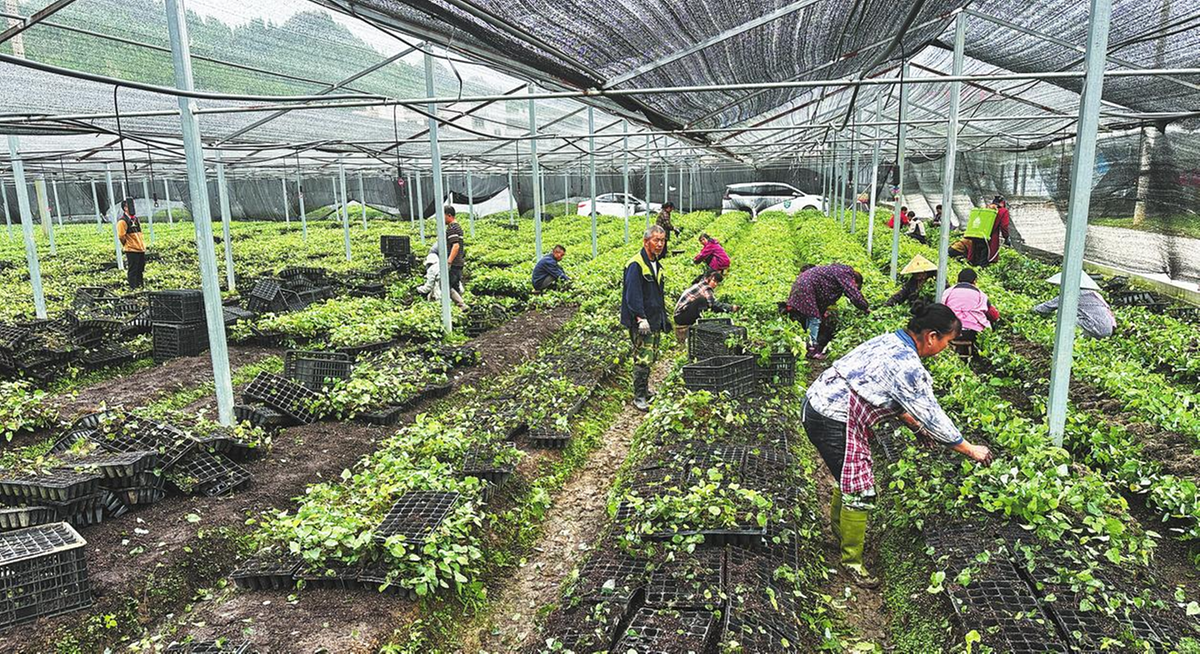
At a barrenwort nursery in Jiangkou county, workers tend seedlings inside greenhouses. Known in Chinese medicine for strengthening tendons and bones, barrenwort is listed in the Chinese Pharmacopoeia and has become a staple of medicines and supplements.
The Party secretary of Minhe township, where the nursery is located, said Jiangkou's mountainous, humid climate is well-suited for the plant.
In 2020, State-owned China National Pharmaceutical Group partnered with local cooperatives and farmers to build the country's largest barrenwort breeding and seedling base, covering some 62.7 hectares.
The project provides technical guidance and purchase guarantees to participating villagers.
For many local families, the change has been visible. "My family used to grow corn and rice and barely made any money," said villager Xiao Shuqun, who works at the nursery. "I leased out my 6 mu (15 mu is equal to one hectare) of land to grow barrenwort. I can earn more than 80 yuan ($11.23) a day working here."
At 55, she said she no longer has to farm herself and enjoys a steadier income.
Companies in Guizhou are also exporting the region's aromatic and medicinal raw materials.
Guizhou Miaoyao Biotech Co, which focuses on essential oils and plant extract, said more than half of its ingredients are exported to the United States for use in wellness products.
Founder Lu Guilin said valerian oil is one of its major export items, supported by a planting base of more than 2,000 hectares, which supplies essential oil internationally. Lu said the company's network includes more than 3,000 cooperative households and provides an estimated more than 200,000 work opportunities a year.
He added that the company plans to expand the promotion of its own branded products, including post-exercise soothing formulas developed with modern extraction techniques based on ancient recipes.
Contact the writers at liuboqian@chinadaily.com.cn


- Macao establishes 4 state key laboratories: national political adviser
- Metronome and navigator: How China's five-year plans steer unprecedented modernization
- China's new five-year plan charts world's largest modernization by population
- China's top political adviser visits press representatives
- China Coast Guard vessel Sandu conducts patrols in South China Sea
- Tree planting activities held across China





