'Bricks' for lunar base clear tough first test









China has taken a concrete step toward realizing its ambition of building a permanent outpost on the moon by successfully exposing a batch of experimental "lunar bricks" to the harsh conditions in space for about a year and bringing them back almost intact.
The 34 sample bricks, weighing about 100 grams in total and made from materials that mimic lunar soil composition, were returned to Earth recently aboard the Shenzhou XXI spacecraft. Their survival outside the Tiangong space station for such a long duration marks a critical milestone in engineering and advances China's plan to build the International Lunar Research Station by 2035.
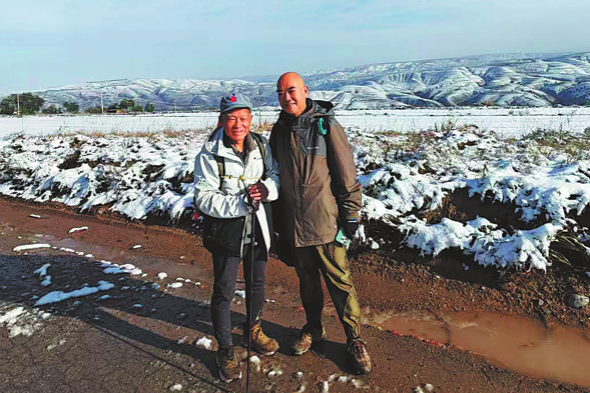
"At first glance, the bricks seem to be in good condition," said Zhou Yan, a scientist at Huazhong University of Science and Technology, the institute responsible for making the "lunar bricks", which are said to be more than three times stronger than standard bricks.
While the "lunar bricks" show no signs of cracks or pits, typically caused by the impact of space debris and meteoroids, they have become slightly pale in color, a change scientists are now investigating, Zhou added.
Scientists will then analyze how the space environment has altered the internal structure of these bricks, providing the data needed to ensure lunar bases are able to stand the test of time.
The experiment aims to address the biggest hurdle in lunar construction: the exorbitant cost of transporting building materials from Earth. Scientists are in the process of perfecting a technology to build on the moon using local resources.
"Due to the high costs of interplanetary transportation, we need to use lunar soil, solar energy and minerals to produce the bricks for construction," said Zhou Cheng, a professor at the National Center of Technology Innovation for Digital Construction.
The experimental bricks were made using volcanic ash from the Changbai Mountains in Northeast China, which has a chemical makeup very similar to lunar soil. To make the bricks, researchers used a process called hot-press sintering, which is essentially baking and pressing soil under high heat until it fuses into a solid.
The project was led by Ding Lieyun, an academician of the Chinese Academy of Engineering and chief scientist at the National Center of Technology Innovation for Digital Construction.
In November 2024, the Tianzhou 8 cargo ship transported these bricks to the Tiangong space station, which were then mounted outside the orbital outpost to weather space conditions that are difficult to simulate in a lab on Earth. The conditions included an environment of vacuum, punishing cosmic radiations, and extreme temperature changes ranging from -190 C to 180 C.
According to the researchers, the whole experiment is designed to last three years. While the first batch of "lunar bricks" has returned, other samples remain in space and will be retrieved annually to test how the material holds up over longer periods.
"After three years, we might be able to reveal patterns in the performance of these bricks and speculate on their service life trends over five, 10 or 20 years," Zhou Yan said.
Ding, from the Chinese Academy of Engineering, emphasized that understanding how these materials age is vital for future construction, because lunar buildings cannot be temporary structures. "When constructing a building, we don't expect it to last just a few years. This principle holds even greater significance when building on the moon," he said.
The brick experiment is part of a broader timeline laid out by Wu Weiren, chief designer of China's lunar exploration program.
China aims to land astronauts on the moon by 2030 and build a basic version of the International Lunar Research Station on the lunar south pole by 2035. An expanded version is planned by 2045, potentially serving as a launchpad for crewed missions to Mars.
Contact the writers at limenghan@chinadaily.com.cn





- Global gathering of Cantonese people opens in Guangdong
- China's draft airline rules represent progress for wheelchair users
- China steps up efforts to tackle wage-withholding employers
- Taicang factory builds inclusivity
- Scientists discover important Early Jurassic dinosaur tracks
- China's Shenzhou XXII spaceship docks with space station combination