Ancient DNA reveals kinship, social structure of China's prehistoric Shimao city









BEIJING -- Scientists have harnessed ancient DNA to reconstruct the intricate social structure of one of China's earliest cities, revealing a genetically diverse society anchored in the authority of patrilineal clans.
The research published on Thursday in Nature presents the first direct genetic evidence regarding the origins of the Shimao population -- the builders of Shimao, a massive Neolithic walled settlement in northern China that thrived around 4,300 years ago and was abandoned about 500 years later.
The findings, based on genetic analysis of ancient individuals, offer a glimpse into the kinship practices, including sex-specific sacrificial rituals, of an early state-level society in East Asia.
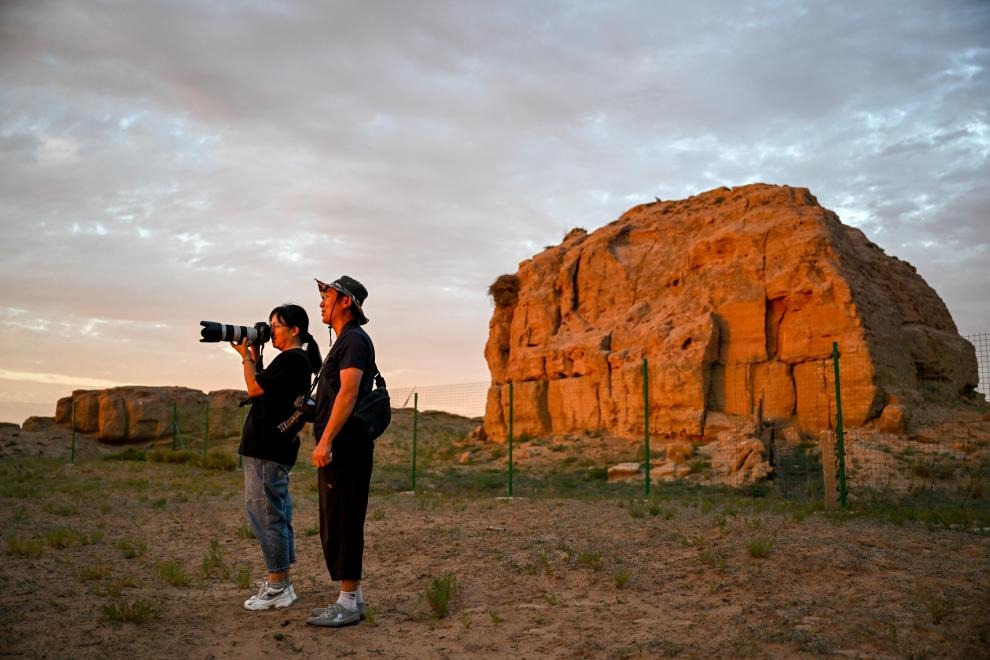
The 4-million-square-meter Shimao city is the largest known prehistoric settlement in China. Its sophisticated fortifications, including pyramid-like platform, cyclopean stone walls, palatial complexes and stone carving, along with high-status artifacts like exquisite jades, point to a highly complex, stratified society.
Yet anthropologists have long argued over the Shimao population's genetic roots, its relationship to Yellow River farmers and northern steppe pastoralists, and the social order that raised this vast stone metropolis.
ANCESTRY
A team led by Fu Qiaomei from the Institute of Vertebrate Paleontology and Paleoanthropology (IVPP) under the Chinese Academy of Sciences analyzed DNA extracted from the remains of 144 individuals excavated from Shimao's core areas and its surrounding satellite settlements.
Globally, only a tiny number of prehistoric sites have produced genomic data for more than a hundred individuals. Shimao, with its immense scale and a social order built on elaborate human sacrifice, is the first such complex society to be decoded by ancient DNA.
Genetic analysis shows that the Shimao people can trace the bulk of their ancestry to local Yangshao culture farmers who tilled the Loess Plateau more than a millennium earlier, underscoring an unbroken chain of regional genetic continuity.
However, the study also uncovered interactions across vast distances. Some individuals carried genetic components linked to the populations from the northern steppes, and ancestry from southern Chinese rice-farming populations was also detected in a few individuals, suggesting broader contacts than previously recognized.
This confirms Shimao's long-term interaction with farmers and herders across China, providing pivotal proof of the early "pluralistic-yet-unified" trajectory of Chinese civilization.
STRUCTURED KINSHIP
A key breakthrough of the research was the reconstruction of extensive family pedigrees within the Shimao society, some spanning up to four generations.
The analysis of tombs from elite burial areas revealed a society organized primarily along patrilineal lines. High-status male tomb owners were central to the kinship networks, with their wives genetically traced to different, external biological families.
The study also shed light on the cruel practice of human sacrifice, a hallmark of Shimao's social hierarchy. Sacrificial victims found in ritual pits and as attendants in high-status tombs showed distinct patterns.
Victims from a skull pit were predominantly male, while those sacrificed to accompany elite individuals in tombs were almost exclusively female.
Also, the sacrificed individuals showed no close biological kinship to the tomb owners, but some sacrificed females were found to be biologically related to each other, suggesting that specific families or communities might have been selected for sacrificial rites, according to the study.
The highly structured sacrificial rituals and the lack of kinship between elites and victims highlighted a rigid social stratification.
The findings also indicate that high-status Shimao lineages appear to have deliberately shunned, or at least rarely practiced, close-kin marriage.
These results have helped uncover fine details about the regional population and social structure during the early establishment of states, said the researchers.





- Former Hainan official sentenced in bribery case
- Hangzhou residents enjoy rare snowfall
- Artificial reefs part of successful marine conservation efforts in Guangdong
- Zigong lantern festival combines cultural heritage with advanced technology
- Woman executed for abusing and killing stepdaughter
- Zhangjiakou academy students hit Olympic ski slopes as winter break begins