



Behind diplomatic crisis, Japan's economic slide









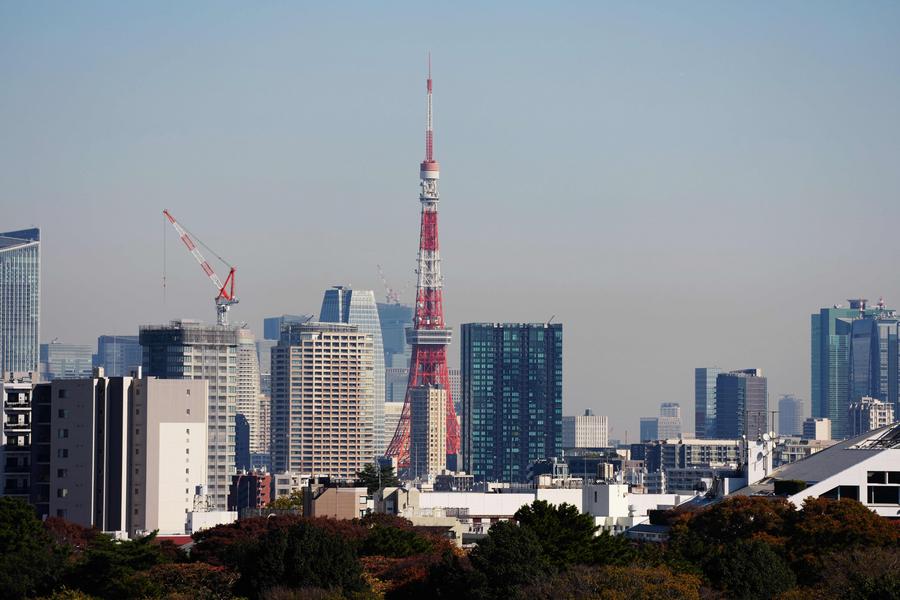
When Japan's new prime minister Sanae Takaichi took office, she pledged to focus on economic improvement. After her Taiwan comments, new missteps could prove costly to Japan, the region, even the world.
On October 21, Sanae Takaichi, the president of the ruling Liberal Democratic Party (LDP), was voted in as the 104th prime minister of Japan; the first woman selected for the nation's highest post.
Barely a month later, in her first parliamentary address, Takaichi, 64, stated that the Chinese mainland's "use of force on Taiwan" could constitute a "survival-threatening situation" for Japan, implying the possibility of Japan's armed intervention in the Taiwan Strait. That sparked a diplomatic crisis as Japan's relations with China plunged to lowest in years.
Yet, this crisis has been long in coming. Takaichi needs a geopolitical spat to steer attention away from Japan's secular economic challenges.
Political slide to hard right
Instead of a continued partnership with the centrist Komeito party, Takaichi launched her coalition with the center-right Nippon Ishin party. With the end of the 26-year coalition with Komeito, the LDP took a turn to hard right.
Initially, Takaichi's cabinet enjoyed some of the highest approval ratings (65 percent -85 percent) of any Japanese government in the last two decades, with strong support among young and middle-aged respondents. The Japanese see as the administration's national priority in tackling inflation (84 percent), economic stimulus (64 percent), social security (53 percent) and security (47 percent). Bread and butter issues supersede military issues by far.
Only a minority of Japanese (17 percent) approved of Hagiuda Koichi, who had previously been involved in a slush fund scandal, being appointed as executive acting secretary general. After Abe's assassination, ties between the LDP and Unification Church came under scrutiny and Hagiuda had intimate ties with the controversial Church.
Moreover, both Takaichi and Hagiuda are members of the Nippon Kaigi, Japan's largest far-right and ultranationalist non-governmental organization. It seeks to change the postwar Tokyo Tribunal's view of Japanese history, restore the divine status of Japan's emperor and undermine gender equality. It champions official visits to Japanese war criminals' Yasukuni Shrine and denies the forced prostitution of the "comfort women" in World War II.
Nippon Kaigi has a significant presence in the Japanese parliament and six prime ministers have been its members. The effective goal of Takachi is to mainstream Nippon Kaigi and cement a deeper military partnership with the US.
Structural economic woes
Last week, Japan's cabinet approved a $135 billion stimulus package to address rising living costs and boost economic growth by strategic investments in semiconductors and artificial intelligence.
For months, Takaichi had called for "responsible proactive fiscal policy." However, it is not clear how she plans to balance fiscal prudence with still more spending. In both absolute and relative terms, Japan holds the largest debt burden globally amounting close to $10 trillion; more than double the size of its economy.
The high debt-to-GDP ratio has not caused a collapse because much of the debt is held by domestic investors and interest rates remain low. While the ratio has been decreasing since the Covid-19 pandemic, Takaichi's stimulus policies could reverse the trend.
Furthermore, years of fiscal stimulus, social welfare spending, an aging and shrinking population, coupled with stagnation compound the debt burden.
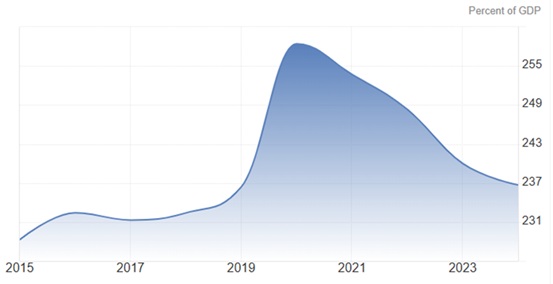
By increasing national debt, Takaichi's stimulus could lead to higher interest rates and a weaker yen. That would trigger inflation, which could erode the effectiveness of the stimulus, a loss of investor confidence, even capital flight, with negative global spillover effects.
The LDP's lingering contradiction
Early signs reflect rising unease in the Japanese markets. These worries are mirrored by rising Japanese government bond yields. Recently, the yield on benchmark 10-year JGBs hit 1.835 percent, the highest since summer 2008. Similarly, the yen briefly softened to 157.90 against the dollar amid fiscal fears and receding expectations for an imminent BOJ rate hike.
In the Japanese markets, these worries are mirrored by rising Japanese government bond yields. Recently, the yield on benchmark 10-year JGBs hit 1.835 percent, the highest since summer 2008. Similarly, the yen briefly softened to 157.90 against the dollar amid fiscal fears and receding expectations for an imminent BOJ rate hike.
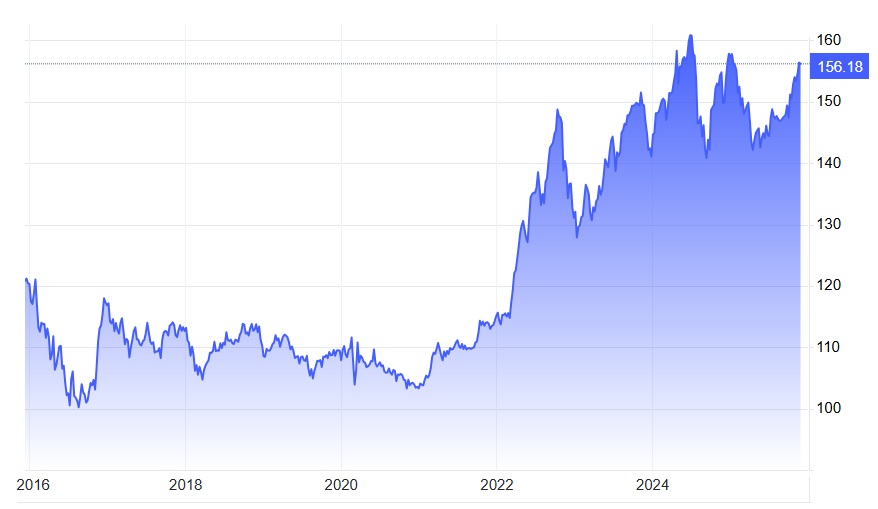
Assuming erosion in fiscal and monetary credibility, yen depreciation is likely to foster rising prices. In that case, the effectiveness of the stimulus package could be undermined, which would compel Takaichi cabinet to demand more stimulus – which, in turn, would further penalize medium- to long-term economic and financial market stability.
This is the basic contradiction that the Abe cabinets managed to contain: the stated effort to achieve sound economic fundamentals versus the nagging need for continuous stimulus packages to revive the stagnant economy. Worse, Takaichi cabinet's starting point is more fragile, as evidenced by the weakening yen.
As the Takaichi cabinet has stressed the importance for policy coordination with the Bank of Japan (BOJ), the central bank may find it challenging to raise interest rates in December, even despite inflation at 3 percent in October. The "coordination" between the two could contribute to adverse pent-up effects in the coming months.
Rising inflation is the last thing Takaichi needs. It is the greatest concern of those who elected her.
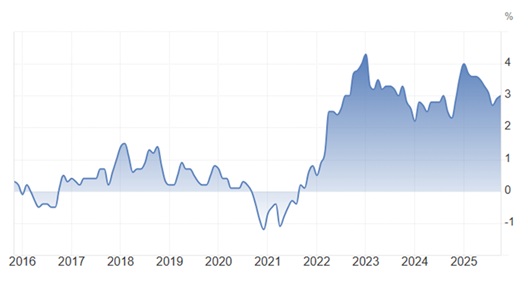
Source: Ministry of Internal Affairs & Communications, Japan; author
Takaichi's ultraconservative profile
Born into a dual-income middle-class family, Takaichi grew of age in a very conservative home. Independent and enterprising, she studied in the university and worked in the US as a congressional fellow for Democratic congresswoman Pat Schroeder.
Upon return to Japan, she created a career and visibility as a presenter for TV Asahi starting her political career in the early 1990s. Though running as a liberal, she switched to the LDP after election.
By the early 2010s, Takaichi was championed by the LDP leader Shinzo Abe. To profile her patriotism, she often visited the war criminals' Yasukuni shrine. As a cabinet minister in 2011, she even allowed herself to be photographed with Kazunari Yamada, the leader of Japan's small neo-Nazi party.
By the mid-decade, she was seen as a promising new LDP leader. But it was only her third leadership bid that made her Japan's first female prime minister.
To Takaichi, American deterrence is vital to Japan's hard right. That's why she used her recent visit at the US Yokosuka Naval Base to vow to bring the US–Japan alliance into a "golden age."
Three scenarios
Today, Takaichi faces three major scenarios.
Measured de-escalation. In this scenario, she will seek to ease tensions through diplomatic dialogue. Japan is not just heavily reliant on Chinese tourism, seafood exports, and rare earth minerals. Beijing is Tokyo's largest trading partner. In 2024, China's share of Japan's total trade exceeded 20 percent, with 17.6 percent of Japan's exports and 22.5 percent of its imports going to or coming from China. De-escalation would help mitigate the current economic pain. This would likely be supported by the US, which advocates regional stability. Yet, de-escalation is not motivated by Takaichi's ideology, but by Japanese voters' bread-and-butter priorities.
Protracted instability. The current status quo will linger, marked by underlying tensions and occasional flare-ups, without a full resolution. China would continue its economic pressure, while Takaichi would seize the opportunity to legitimize increased defense spending and closer alignment with the US thus sparking the odds for further escalation in regional confrontation. As the spat broadens, Japan's GDP will take a prolonged hit while adverse spillover concerns surge in the markets.
Full-blown escalation. A more volatile scenario would mean a further breakdown of diplomatic ties and increased military posturing. Takaichi would take an even more decisive position on Taiwan and commit to military coordination with the US, thus crossing one redline after another. But as Ukraine and Gaza suggest, the Trump White House prefers to regionalize conflicts. Nonetheless, heightened risk of confrontation would cause Japan's GDP to plunge drastically, which would undermine the fiscal stimulus, alienate her voter constituencies, penalize business and investor confidence risking capital flight.
The next weeks are critical. China's decision to take the spat to the UN forces Takaichi on a diplomatic defense. But new missteps could accelerate both the geopolitical and economic slide.
Dr Dan Steinbock, an expert of the multipolar world, is the founder of Difference Group and has served at the India, China and America Institute (US), Shanghai Institute for International Studies (China) and the EU Center (Singapore).
This is an abbreviated version of the original commentary published by China-US Focus on Nov 28, 2025.
The views don't necessarily reflect those of China Daily.
If you have a specific expertise, or would like to share your thought about our stories, then send us your writings at opinion@chinadaily.com.cn, and comment@chinadaily.com.cn.





