Mind-machine tech leaps from lab to life, powering up future industry









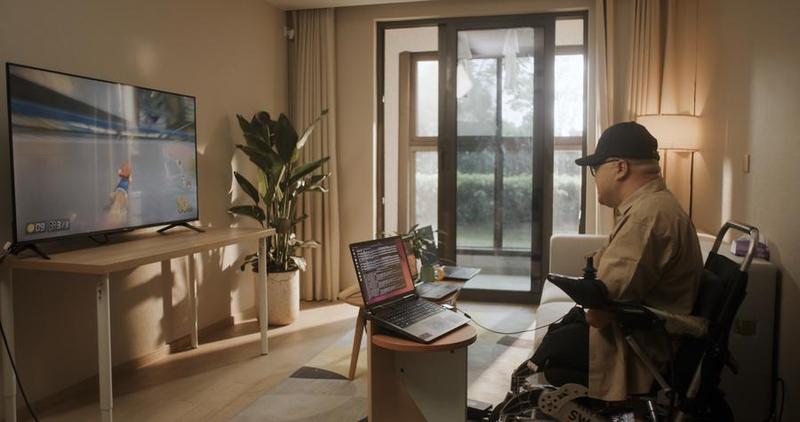
SHANGHAI - In a quiet ward at Shanghai's Huashan Hospital, a 28-year-old who has been paralyzed for eight years was playing Mario Kart using only his mind. Thanks to a robotic glove, he has gained precise, independent control over each finger.
Made possible by a home-grown brain-computer interface (BCI), this accomplishment underscores China's fast-growing capabilities in a technology that melds neuroscience, AI and advanced engineering, and holds promise to deliver life-changing benefits to patients worldwide.
The patient, who received the implant in late October, was able to control a computer cursor just five days after starting initial training. By day 17, his performance had matched Neuralink's benchmark in tests, having extended that control to smart-home systems and humanoid robots.
At a recent BCI forum, neurosurgeon Mao Ying from Huashan shared this landmark clinical update: "We implanted China's first fully implanted, wireless, battery-powered BCI system," a gadget designed by Shanghai-based startup NeuroXess.
CLINICAL BREAKTHROUGHS
China's BCI clinical pipeline is expanding at a remarkable pace, exploring multiple technological pathways.
In March, the collaborative team from Huashan Hospital and the Chinese Academy of Sciences kicked off the nation's first invasive BCI trial.
The system's coin-shaped implants, equipped with ultra-flexible electrodes, are inserted into a precisely thinned recess in the skull above the brain's motor cortex via a minimally invasive procedure. External wireless power and signal receivers are integrated into a wearable cap, making it easy to use in daily life.
Nine months later, the man who lost all four limbs in an accident, using a system with electrodes implanted directly into the brain's motor cortex, can perform digital tasks like messaging and gaming.
This work has positioned China as the second country, following the United States, to advance invasive BCI technology to the clinical trial stage. The BCI device is projected to gain regulatory approval by 2028, offering improved quality of life for patients with complete spinal cord injury or amyotrophic lateral sclerosis (ALS).
China is systematically validating BCI's potential. Over the past year, Chinese brain-tech firms have launched clinical trials of multiple BCI products in hospitals across Beijing, Shanghai, and other cities.
A semi-invasive, epidural BCI trial, which is considered safer, is also underway. After Beijing's Xuanwu Hospital performed the first implantation in October 2023, 32 cervical spinal cord injury patients have now received the device in a multi-center trial launched this May.
All participants have successfully performed brain-controlled home rehabilitation, with over 4,951 cumulative safe-implantation days, supporting the safety and long-term viability of this approach.
They averaged more points on hand grasp tests, and even without the device, their manual function improved, hinting that the technology may enable neural remodeling.
"We hypothesize that the formation of a 'top-down feedback loop' between brain signals and the glove's response may have reactivated neural pathways below the site of spinal cord injury," explained Zhao Guoguang from Xuanwu Hospital.
The trial represents a "zero-to-one" pioneering milestone for China in the BCI field, added Zhao.
MED-TECH ECOSYSTEM
China is building a new innovation ecosystem to accelerate this emerging sector -- a model that integrates fundamental research, engineering and clinical adoption, creating a streamlined pathway from lab breakthroughs to real-world solutions.
The total number of BCI enterprises in China has already surpassed 200, according to data from the China Academy of Information and Communications Technology.
Shanghai, which has designated mind-machine technology as a key industry of focus, has launched a BCI technology incubator within walking distance of Huashan Hospital.
Over the past year, Huashan Hospital has partnered with nearly ten leading Chinese BCI firms, performing dozens of clinical-trial surgeries. Its self-developed brain-mapping navigation system can reduce the time to locate implant sites from hours to just three minutes.
All partner companies in the network can train their models using a shared cross-hospital EEG dataset called iBrain.
INSIDE is one of the partners in this med-tech ecosystem. The Shanghai-based startup collaborated with Huashan Hospital to develop a ChatGPT-like model for EEG data. The model achieved over 83 percent accuracy in recognizing Mandarin phonemes, a significant challenge considering that Mandarin has more than 400 phonemes, compared to about 50 in English.
"The large EEG model will show exceptional capabilities across language decoding, image interpretation, motion analysis and smart-device integration," said Mao from Huashan Hospital.
In the central Chinese city of Wuhan, BCI company Neuracom has co-established a laboratory with Union Hospital of Tongji Medical College, one of the region's top medical centers, to ensure their products precisely address clinical needs from the earliest stages of development.
Recognizing that the field is still constrained by a limited understanding of the brain, China launched its national project for brain research in 2021, positioning BCI and brain-inspired intelligence as two pivotal research directions to build a stronger foundational knowledge base.
This July, multiple Chinese authorities have jointly issued a set of guidelines aimed at promoting the innovative development of the BCI industry, seeking to achieve key technological breakthroughs in the industry by 2027.
MARKET MOMENTUM
An industry report projects that the global BCI market will surpass $10 billion by 2030. Beyond therapeutic applications, a variety of non-invasive BCI technology are expanding into China's consumer market, signaling vast growth potential ahead.
"Put on this earpiece, and AI can detect your emotional shifts," said Yi Haoxiang, founder of EnterTech, holding a 3 gram BCI device in his office in Hangzhou, a tech hub in eastern China. "It captures EEG signals from the skin to assess your mental stress."
With China's growing elderly population and the nationwide promotion of the silver economy, the BCI industry is facing significant unmet demand.
The country plans to turn next-generation industries, including brain-computer interfaces into new engines of economic growth in the coming five years.
During a roundtable discussion, Han Bicheng, founder of Hangzhou-based brain tech firm BrainCo, shared that his team once visited over a hundred households of individuals with physical disabilities to map their daily lives.
"In the end, we only charted 100 stationary points, because their world rarely extends beyond their front door," said Han. In the future, technologies like BCIs, exoskeletons and robotic hands can expand mobility for these disadvantaged individuals, thus broadening their social horizons and unlocking new possibilities for consumption.
"The next generation of BCI technology not only promises to help groups like those with obesity, insomnia or autism," Han envisioned, "but may also allow the blind to see in darkness or even see ten kilometers away."