



RMB's trending dollar ratio reflects rising confidence in country's assets









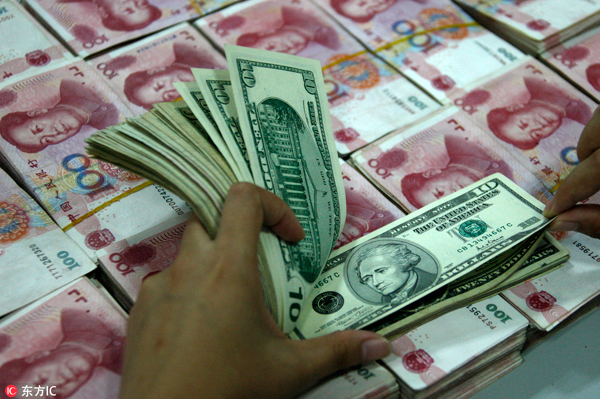
The central parity rate of the Chinese currency weakened 17 pips to 7.0348 against the US dollar on Tuesday, according to the China Foreign Exchange Trade System. The renminbi's recent rise above the psychologically important exchange rate threshold of 7 to a dollar is more than a symbolic milestone — it highlights a pivotal shift in how global investors are viewing renminbi-denominated assets as 2026 approaches.
On Thursday, the offshore renminbi strengthened past the 7.0 level against the dollar for the first time since September 2024. As of Monday, the offshore renminbi had appreciated by about 4.5 percent against the dollar this year, the biggest gain since 2020.
These gains, however, should not be overstated. The CFETS RMB Index — which tracks the renminbi exchange rate against a basket of currencies of China's trade partners — has actually weakened by about 3.8 percent so far this year, underscoring that the renminbi's strength is largely a dollar-side story as the dollar weakened, rather than a unilateral surge.
Looking ahead, two-way fluctuations — not a one-way rise — are still the most likely path, especially as short-term appreciation pressure linked to year-end concentrated foreign exchange settlements is expected to ease once the seasonal settlement window passes.
The People's Bank of China, the country's central bank, in a statement released on Dec 24, reiterated that its focus is on keeping the renminbi exchange rate generally stable at a reasonable and equilibrium level.
That said, even overall renminbi stability with moderate strengthening potential carries meaningful implications for global asset allocation. A firming currency — or expectations of one — systematically enhances the investment case for Chinese financial and real assets.
For foreign investors, total returns from renminbi assets consist of both asset performance, such as equity price gains or bond yields, and currency effects. If the renminbi is on a mild appreciation path, even stagnant asset prices can deliver attractive returns once converted back into dollars or other currencies — elevating the expected payoff from Chinese equities, bonds and other financial instruments.
This dynamic has been reshaping cross-border capital flows. While December data are still incomplete, overseas long-term investors posted net inflows of about $10 billion into China's A-share and H-share markets during the January-November period, compared with outflows of $17 billion for 2024, according to Morgan Stanley.
The Chinese equity and debt markets are poised to benefit. Foreign investors may become more inclined to expand allocations in Chinese equities amid a renminbi appreciation cycle, supporting their valuation expansion. In the bond market, a firmer renminbi augments the allure of Chinese government bonds at a time of globally declining interest rates, encouraging overseas investments and further anchoring yields at lower levels.
Beyond short-term portfolio flows, a stable or slowly appreciating Chinese currency fosters confidence among long-term investors, such as central banks, sovereign wealth funds, pension funds and insurers, which prioritize currency stability as a key determinant of long-term return predictability.
The same logic applies to multinational corporations weighing foreign direct investment, as what anchors FDI decisions is confidence in macroeconomic stability and future purchasing power — areas where a steady renminbi can reinforce confidence.
Crucially, this currency-asset interaction is unfolding against a broader, multiyear repricing of Chinese assets. Capital inflows are not merely chasing exchange rate moves; they are responding to deeper fundamentals — China's rapid technological advances, a vast and increasingly resilient domestic market, and a manufacturing system that remains both robust and adaptive.
In that sense, the generally stable Chinese currency with upward potential is a reflection of rising confidence that Chinese financial and real assets, priced in renminbi, are being reassessed in light of their fundamental strength.





