China offers an anchor as global economy fragments









The year 2025 marked a decisive shift in the tone and structure of the global economy. The United States' decision in April to impose sweeping "reciprocal tariffs", followed by additional or threatened duties on automobiles, steel, aluminum, semiconductors and other strategic products, pushed global trade relations into their most confrontational phase in decades.
These measures have driven the US' effective tariff levels to heights not seen in nearly a century, accelerating fragmentation across markets, supply chains and institutions that once underpinned globalization.
As uncertainty deepens, the central question facing the world economy is no longer whether fragmentation is happening, but whether stability can still be preserved within it.
For the US, the consequences of this policy became increasingly visible over the course of the year. Higher tariffs translated into higher production costs for domestic manufacturers and elevated prices for consumers, while companies dependent on imported intermediate goods faced shrinking margins and disrupted planning cycles. Investment decisions were postponed as companies struggled to assess regulatory risk, and financial markets repeatedly reacted to tariff announcements with volatility.
Rather than insulating the US economy, protectionism has complicated inflation management and weakened confidence, key pillars essential for sustained growth.
The global repercussions have been broader and more structural. Trade volumes have softened, cross-border investment has become more cautious, and global supply chains have shifted from efficiency-driven networks to risk-averse configurations. Throughout 2025, multinational corporations increasingly prioritized redundancy over optimization, relocating or duplicating production to hedge against sudden policy shocks. While this may have reduced exposure to unilateral tariffs, it also raised costs, lowered productivity and slowed the diffusion of technology, effects that weighed most heavily on developing economies seeking to integrate into global manufacturing and services networks.
These dynamics have intensified concerns about the outlook for global growth in 2026. The momentum that once came from deepening trade integration has weakened, and the world economy now relies more heavily on domestic demand, regional cooperation and selective industrial upgrading.
At the same time, risks have multiplied. Financial conditions remain tight, geopolitical tensions persist, and confidence in the rules-based trading system has been eroded by repeated unilateral actions.
Against this backdrop, the likelihood of heightened trade friction in 2026 remains high, particularly if major economies continue to treat tariffs as tools of routine policy rather than measures of last resort.
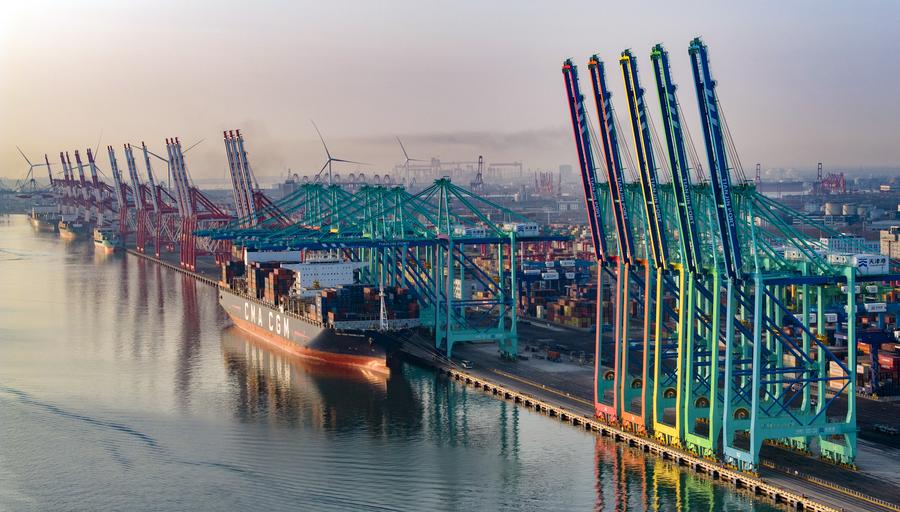
It is within this increasingly fragmented environment that China's role has taken on heightened importance. Over the past year, China has continued to emphasize development and external cooperation as core policy priorities, projecting a degree of continuity that contrasts sharply with the volatility elsewhere. While global demand has softened, China has sustained its position as a major engine of trade, investment and industrial activity, providing a degree of predictability that many partners, especially in the Global South, have come to rely on.
Throughout 2025, China advanced policies aimed at high-standard opening-up, including further easing market access, strengthening protections for foreign investors, and expanding institutional openness in trade and finance. These measures reinforced China's role as a key hub within global and regional value chains at a time when companies were actively seeking stable and diversified markets. For developing economies facing reduced access to traditional Western markets, China has continued to offer demand, investment and opportunities for industrial upgrading.
Equally significant has been China's approach to globalization itself. As debates over "decoupling" and "de-risking" intensified last year, China consistently articulated support for inclusive economic globalization and the multilateral trading system. This stance has resonated with many Global South countries, which have little to gain from a world divided into competing economic blocs. By advocating openness, connectivity and development-oriented cooperation, China has positioned itself as a defender of a more balanced and participatory global economic order.
The evolution of China's own economy has further reinforced this role. Over the past year, China has continued shifting toward higher value-added growth, with progress in green technologies, digital industries and advanced manufacturing. This transition has implications well beyond China's borders. As Chinese enterprises move up the value chain, they create space for developing economies to integrate into supporting industries, regional supply networks and downstream markets. Rather than displacing partners, this transformation has the potential to deepen South-South cooperation and strengthen shared growth prospects.
At the same time, the tariff disputes initiated by the US have accelerated a broader reconfiguration of the global economic order. Many countries have responded by diversifying trade and investment relationships, strengthening regional trade agreements, and expanding cooperation among emerging markets. This trend, evident throughout 2025, points to a more multipolar global economy in which resilience is built through diversification rather than dependence on any single market. In this emerging landscape, China has become an increasingly important node, linking regions, facilitating investment flows and supporting development across continents.
The role of the Global South also evolved markedly over the past year. Developing economies contributed an increasing share of global growth, even as advanced economies slowed. Their collective weight in global trade, investment and consumption increased, as did their demand for a greater voice in global economic governance. Through platforms for South-South cooperation and engagement with emerging institutions, Global South countries began to shape the global agenda more assertively. China's engagement with these economies through trade, infrastructure and development partnerships reinforced this shift, helping translate demographic and market potential into tangible economic outcomes.
In 2026, growth will depend on whether major economies choose confrontation or coordination, exclusion or inclusion. In this context, China's emphasis on development, openness and cooperation offers a stabilizing counterweight to rising protectionism.
As fragmentation continues to reshape the world, such stabilizing forces will be essential to ensuring that global growth remains possible, shared and sustainable.
The author is executive director of South-South Dialogues, a Nairobi-based communications development think tank.
The views do not necessarily reflect those of China Daily.