Standoff between Iran and West to continue after turbulent year









For the just-passed year, developments over Iran could serve as the starting point for a new round of confrontation, as the trust deficit between Iran and the West, combined with the spillover effects of regional conflicts, creates a complex and dangerous limbo that experts warn is set to continue into 2026.
In late December, familiar yet alarming news surfaced: Israeli Prime Minister Benjamin Netanyahu once again reportedly sought US President Donald Trump's nod for more military actions against Iran. According to media reports, Israel's focus is now squarely on Iran's ballistic missile program, moving beyond the nuclear project.
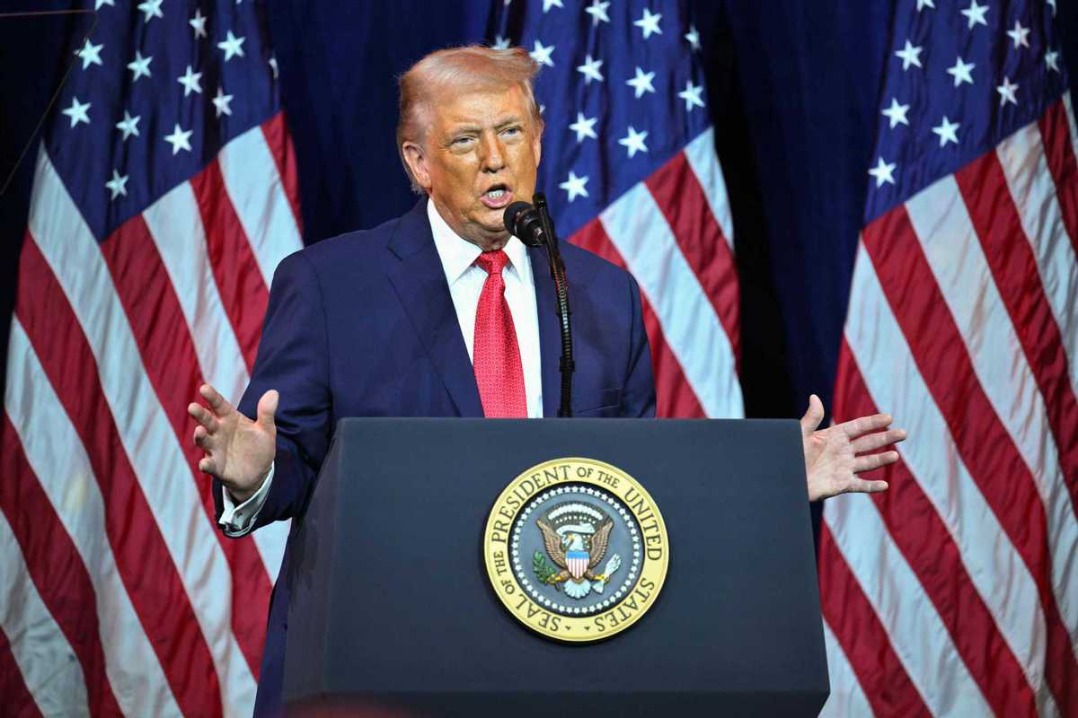
On Dec 29, Trump threatened to "eradicate" any attempt by Tehran to rebuild its nuclear program or ballistic missile arsenal. "Now I hear that Iran is trying to build up again, and if they are, we're going to have to knock them down," he said at a news conference with Netanyahu in Florida.
In response, Ali Shamkhani, top political adviser to Iran's supreme leader, said "Iran's missile capability and defense are not containable or permission-based" and any aggression against his country would be met with an "immediate harsh response".
The region is still absorbing the impact of the 12-day conflict in June, which analysts say has resulted in a tense mutual deterrence — a situation intolerable for Netanyahu.
"Israel's objective is not security in the conventional sense, but rather absolute dominance," said Trita Parsi, executive vice-president of the Quincy Institute. "The Israelis will constantly shift the goalposts in order to make sure that they can make the confrontation with Iran an endless, forever war."
Iran has always maintained that its nuclear program is peaceful and its missile program has been developed to defend the country's sovereignty and is "nonnegotiable".
On June 13, Israel launched major surprise airstrikes across Iran, hitting nuclear and military sites. The US joined on June 22, bombing key nuclear facilities. Iran then retaliated with a strike on the US base Al-Udeid in Qatar.
It was a watershed moment, shattering long-held taboos on direct confrontation. Experts said that all parties, save possibly Israel, soon realized that further hostilities would come at the cost of regional chaos.
A subsequent US-brokered ceasefire brought a pause. Describing it as "incredibly weak", Hussein Ibish, a senior resident scholar at the Arab Gulf States Institute, said, "The Israelis are itching to resume their bombing campaign against Iran, and they may attempt to do that quite soon, perhaps in the first half of 2026."
Gokhan Ereli, a researcher at ORSAM, a Turkish think tank, concurred, noting the Israel-Iran conflict is merely "frozen" and will continue "economically, politically, and perhaps militarily throughout 2026".
Against this backdrop of simmering threats, the end of the 2015 Iran nuclear deal, officially known as the Joint Comprehensive Plan of Action, or JCPOA, appeared even more consequential.
Iran said in October that it was no longer bound by the deal, under which international sanctions were lifted in exchange for limitations on its nuclear program.
Calling it a "helpless end", Qin Tian, deputy director of the Institute of Middle East Studies of China Institutes of Contemporary International Relations, said the failure underscores a fundamental trust deficit between Iran and the West.
"The US strategy of combining maximum pressure with engagement was derailed by the 12-day conflict, leaving it in a policy deadlock — unable to force submission or reach a compromise," he said. Another worrisome trend is that the nuclear issue has slipped down the priority list for both, he said. "Washington sees the bombings as a tactical success, diminishing the issue's urgency. Tehran, in response, has doubled down on national security as its paramount concern."
This view was echoed by Xiao Yang, a researcher at the International Studies Center of Beijing International Studies University, who noted the core clash: For Iran, it's an integral part of national security strategy; but for the US, it's a serious challenge to its regional hegemony.
"Both sides treat the nuclear issue as a matter of broad national interest. Israel's military intimidation will complicate nuclear negotiations, as any miscalculations or accidental skirmishes between Israel and Iran could lead to renewed deadlock. And it will further erode trust between the US and Iran," he said.
Iranian President Masoud Pezeshkian said on Dec 27 that the US, Israel and Europe were waging a "total war" against his country.
It came as JCPOA signatories, the United Kingdom, Germany and France, known as the E3, pushed for the so-called snapback process, reimposing all UN and EU sanctions on Iran.
Sina Toossi, a senior fellow at the Center for International Policy, a Washington-based organization, said the snapback was included in the JCPOA to ensure that all sides abide by the deal, but the E3 are using it to further pressure Iran. "The overall US and European approach to Iran has been just brute power — like might is right," he said.
Ellie Geranmayeh, a senior policy fellow at the European Council on Foreign Relations, warned that this locks all sides into perpetual confrontation. "With snapback leverage spent, the E3 should seek a soft landing. The priority must be returning to the diplomatic drawing board," she said, suggesting "small reciprocal steps" as a pragmatic way to limit risks.
China has consistently opposed such unilateral coercive measures, seeing such a move as gravely undermining diplomatic efforts and calling for the resumption of negotiations.
Amid the looming uncertainty, returning to dialogue and multilateral diplomacy is expected to offer the only viable path to prevent a deeper crisis in 2026.