Shipping rates diverge sharply









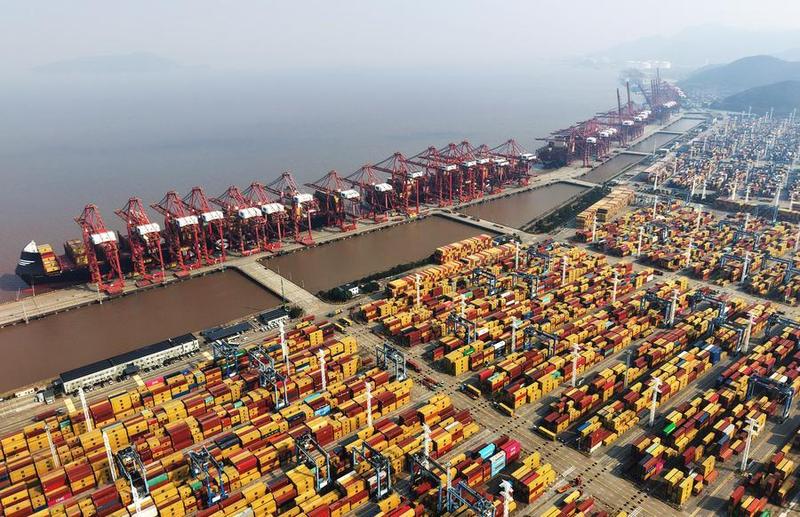
Shipping rates between China and its major trading partners have diverged sharply in recent weeks, with short-haul routes to Southeast Asia recording sustained price increases, while long-haul services to the West Coast of the United States have faced downward pressure.
Freight forwarders and market watchers said that the contrasting movements underscore structural differences in demand and capacity across key global trade lanes.
Jin Er, senior manager overseeing Asia route operations at Southeast Logistics Group in Ningbo, Zhejiang province, said that since mid-October, freight rates on Southeast Asia routes have continued to rise, with customer inquiries and bookings becoming more frequent.
As a result, his workload has increased, prompting him to arrive at the office early each day to handle emails.
Prices for a forty-foot equivalent unit (FEU) climbed from about $600 in late September to nearly $1,000 on services from Ningbo to Thailand last week, while rates from Ningbo to Myanmar increased from roughly $1,200 to around $1,500 over the same period, data from Ningbo Customs showed.
"Faster services operated by carriers such as Maersk Line and SITC International Holdings Co can cost up to $2,000, while rates to Ho Chi Minh City in Vietnam tend to be slightly lower," said Jin.
In the same office, however, US route manager Liang Ying has been dealing with a different situation. She said that since November, freight rates on US West Coast routes have moved lower, at times falling below those on some short-haul regional services.
Freight rates from Ningbo-Zhoushan Port to the Port of Los Angeles have fallen from about $3,100 per FEU in November to around $2,800 per FEU this week, after briefly touching lows of $1,600 in December — a level rarely seen on US trade lanes, she said.
Qian Hanglu, an analyst at Ningbo Shipping Exchange, said with demand in the US remaining relatively weak, excess capacity on US routes has put downward pressure on freight rates.
As the run-up to the Chinese New Year is a busy period for container shipping, several carriers have announced plans to lift rates on US West Coast routes by about $1,000 per FEU from January 2026.
"Whether such increases will ultimately hold will depend on how supply and demand evolve in the coming weeks," said Qian.
Since October, freight rates on Thailand and Vietnam routes have shown a strong upward trend. Although prices have eased in recent weeks, they remain at relatively elevated levels, she added.
The rise reflects strong trade flows between China and Southeast Asia, underpinned by complementary industrial structures and policy tailwinds from the Regional Comprehensive Economic Partnership, said Chen Jianwei, a researcher at the University of International Business and Economics' Academy of China Open Economy Studies in Beijing.
ASEAN remained China's largest trading partner between January and November of 2025, with total bilateral trade surging 8.5 percent year-on-year to 6.82 trillion yuan ($976.78 billion), statistics from the General Administration of Customs showed.
"Although many new container vessels have been delivered over the past two years, most are large ships with capacities of more than 10,000 twenty-foot equivalent units. Some Southeast Asian ports, constrained by water depth, navigational capacity and infrastructure, are unable to accommodate such vessels," said Chen.
By contrast, these mega container ships have been deployed mainly on routes to the US, resulting in ample overall capacity on those lanes, he added.
zhongnan@chinadaily.com.cn