



City eyes eVTOL dominance positioning









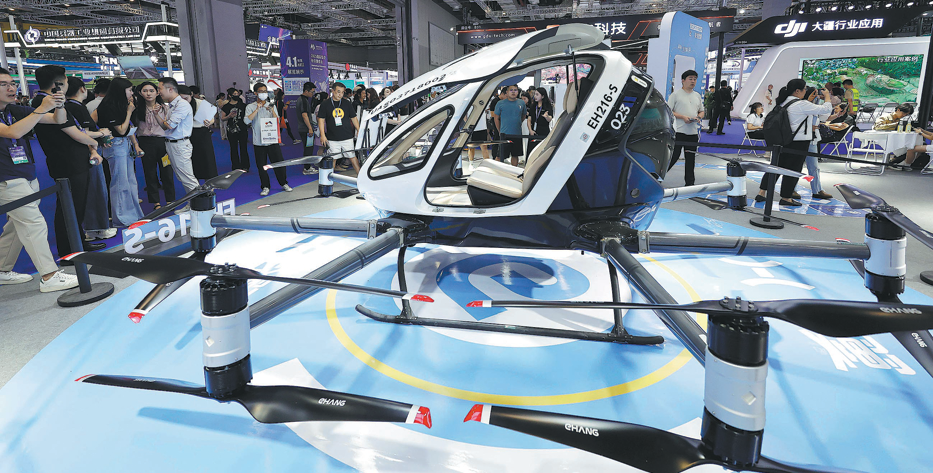
With favorable policies, abundant capital and unique airspace, Shanghai is expected to develop into a "world capital of the electric vertical takeoff and landing sector", industry experts said.
On Jan 4, the Shanghai Municipal Commission of Economy and Informatization, together with five other departments, issued measures to link the Yangtze River Delta to accelerate the construction of advanced manufacturing clusters in the low-altitude economy. The measures are effective till Dec 31, 2028.
According to the measures, by 2028, the core industry of Shanghai's low-altitude economy should reach a scale of approximately 80 billion yuan ($11.5 billion), forming a complete industrial chain for new low-altitude aircraft and marching toward "world capital of eVTOL"status, with prominent comparative advantages.
Targeting mainstream technological directions, Shanghai should cultivate and attract 10 leading enterprises in complete aircraft — such as eVTOL, industrial drones and new energy general aviation aircraft — forming a mass production capacity of over 500 new aircraft, and driving the industrial chain to achieve additional investment of over 20 billion yuan.
The measures also raised the requirements to strengthen urban-rural collaboration and Yangtze River Delta integration, and basically establish one national-level low-altitude new aircraft pilot-scale experiment verification platform.
Gao Chengyuan, a consultant at the low-altitude economy branch of the China International Association for Promotion of Science and Technology, said: "Shanghai has three core advantages. One is the Yangtze River Delta super supply chain, where batteries, motors and composite materials required for eVTOL aircraft can be fully equipped within 200 kilometers, naturally minimizing logistics costs. Second is its unique one-stop airworthiness resources, which can reduce the certification cycle by more than 30 percent. Third, with a vast array of scenarios — including logistics, emergency response and business travel — the order is sufficient enough to feed the first mass production line. More importantly, the 80-billion-yuan target has united the government, capital and central enterprises with funds, airspace and policies all being given the green light simultaneously. This level of synchronization is not something other cities can learn in the short term."
Specifically, the measures provide support of up to 100 million yuan to complete aircraft manufacturing projects with high technological innovation and outstanding contributions to industrialization, such as eVTOLs and ton-scale industrial drones.
Ma Liqi, co-founder and CEO of drone maker McLean (Shanghai)Intelligent Technology Co Ltd, said:"The support of up to 100 million yuan for complete machine enterprises is exemplary. For enterprises like us, which invest heavily in research and development and have long cycles, this not only alleviates financial pressure, but also strengthens our strategic determination to base ourselves in Shanghai and participate in global competition."
Lin Xianping, secretary-general of the institute of culture and creation at Hangzhou City University, said: "To realize high-quality development, Shanghai should deepen the innovation of its aviation system, build a cross-provincial low-altitude digital corridor through the integration of the Yangtze River Delta and improve resource utilization of digital airspace. In addition, it should strengthen industrial collaboration, bind core enterprises with project subsidies of up to 100 million yuan and orders, and tackle key technologies such as solid-state batteries and lightweight materials."
zhengyiran@chinadaily.com.cn



















