What EU can learn from China, and where it can go next









To be successful in the next 50 years, the EU must change its industrial, foreign and security policies, and above all, its outlook on itself and the world
As the European Union and China mark 50 years of diplomatic relations, China has achieved a level of development that few in the EU — or elsewhere in the world — expected. In several important areas, including renewable energy, large-scale infrastructure, advanced manufacturing and artificial intelligence, China has planned better, moved faster and achieved outcomes comparable to, and often exceeding, those of Europe.
This is not because the EU lacked talent or resources. It is because China mobilized its productive forces with long-term purpose, while the EU, in recent decades, gradually lost its way.
China treats economic transformation as a system-wide endeavor. Therefore, when developing a sector, it invests not just in one part of the chain but in all of it: workers, research, supply chains, energy and logistics.
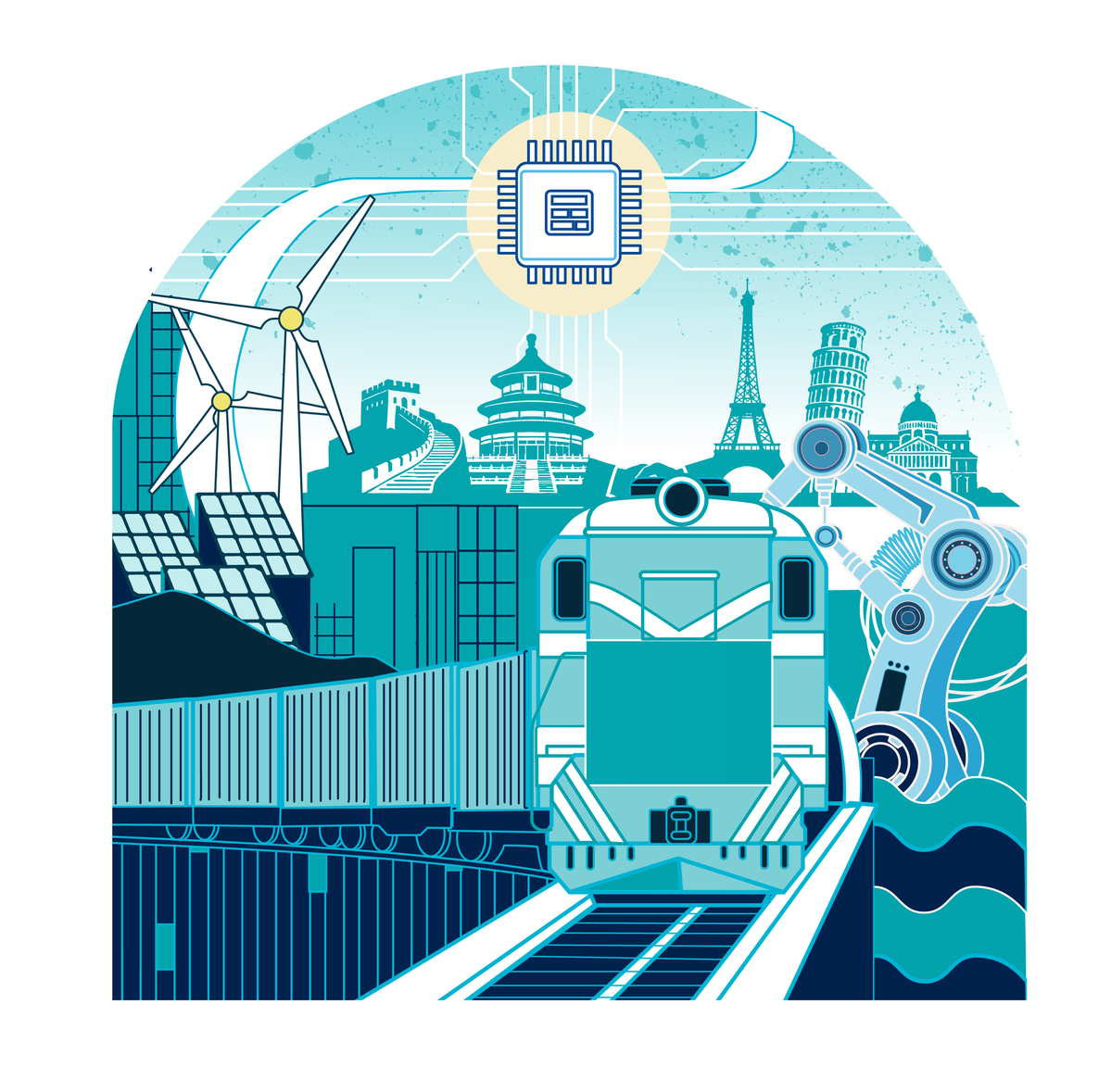
The green transition, for example, needs not only wind turbines and solar panels, but also cheap energy, rare earth processing capacity and engineering schools. AI requires not just algorithms, but also microchips, data centers and thousands of trained specialists. If one link falls behind, the entire transition slows down, generating exorbitant costs, or does not happen at all.
China understood this early and acted accordingly. Under policies such as new-type industrialization and the development of new quality productive forces, it emphasizes innovation, breakthrough technologies, efficient allocation of production factors and deep industrial transformation, with the clear ambition of becoming a manufacturing superpower.
The results speak for themselves. Since 2000, industrial production in China has grown by over 8 percent on average, compared to around 0.6 percent in the EU. In 2023 alone, China accounted for more than 60 percent of global new solar capacity and nearly two-thirds of new wind installations. Every day appears to bring new milestones, from the AI system Deep-Seek and the world's first fourth-generation nuclear reactor Shidaowan to lunar exploration with Chang'e 6 — achievements that inspire both admiration and a sense of urgency across the West.
The EU's challenge is not a lack of ideas, human capital or programs with fancy names. It is the continued dominance of a financial-capitalist mindset centered on monthly or quarterly shareholder gains and executive bonuses.
This logic discourages long-term investment in skills and workers, coordinated planning across sectors, strategic public investment and patience for projects that take 10 to 20 years to mature. Even when public money is used, losses are socialized, and profits privatized, turning public investment into a short-term subsidy rather than a foundation for lasting innovation.
During the 1990s and 2000s, the EU convinced itself that it could afford to outsource most manufacturing while focusing on services and finance, chasing quick profits. But productivity and innovation happen in factories, labs, workshops and research centers — not stock exchanges or consulting companies.
By moving production abroad, it also moved the entire innovation ecosystem — which had previously generated world-leading projects such as Concorde, the TGV high-speed rail and Olivetti's Programma 101 — abroad. Now, when the EU is outcompeted in sectors such as solar energy, batteries and electronics, it is because the industrial base behind these innovations no longer exists at sufficient scale.
As the EU faces this reality, there is a growing temptation to blame China.
But China is not responsible for the EU's weakened productive forces. China did not force the EU to outsource its manufacturing. China invested where the EU chose not to, planned where the EU opted for short-term gains, and is now reaping the benefits.
Trying to compensate for the EU's decisions by building up trade barriers, banning or imposing tariffs on Chinese imports, and following other countries into disastrous trade wars does not solve the EU's underlying problems. While hurting both sides and the entire world economy, it is likely that the EU, with its smaller market, weaker industrial base and fewer linkages with the Global South, would suffer more.
Some in the West go further, arguing that China's rise should be halted through geopolitical pressure, or even military escalation. This is the most dangerous illusion, and must be opposed at any cost, for at least two reasons.
First, it is immoral, much like colonialism was. Every country has an inalienable right to develop, and no country has the right to prevent others from doing so.
Second, beyond ethics, this view misreads reality. Modern wars are decided by productive capacity and technology. China's military modernization, including through the Sept 3 military parade commemorating the 80th anniversary of the victory in the Chinese People's War of Resistance Against Japanese Aggression (1931-45) and the World Anti-Fascist War, delivers the message that although China is not seeking aggression, it is no longer a country that can be intimidated into unequal treaties.
Instead of embracing the flawed logic of hegemonism, the EU should approach the emerging multipolar world with respect, pragmatism and optimism, and seize the opportunity to work with the Global South to build a world that is more peaceful, just and prosperous.
China's initiatives for improving global development, security, civilization and governance, offer a realistic way to navigate a multipolar world.
Also, concrete examples already exist for the EU industry. The 2026 Renault Twingo will be the first Western car engineered in China and manufactured in Europe: a complete reversal of traditional patterns. To make this possible, the French company opened a Shanghai R&D center, and, in the words of their lead engineer, "humbly came to learn".
In truth, that humility may contribute more to the EU's industrial future than hundreds of think tank reports in Brussels or billions of euros in funds promised by European Commission President Ursula von der Leyen. It should become a common mindset of the EU: to learn, to adapt and to cooperate.
Fifty years of EU-China relations show something important: China's rise was driven not by shortcuts, but by long-term planning, coordinated investment and the mobilization of its society's productive forces. The EU can learn from this — not by copying China, but by recognizing where it abandoned its own strengths.
To be successful in the coming 50 years, the EU must change its industrial policies, its foreign and security policies, and above all, its outlook on itself and the world.
The author is a member of the European Parliament. The author contributed this article to China Watch, a think tank powered by China Daily.
The views do not necessarily reflect those of China Daily.
Contact the editor at editor@chinawatch.cn.