Innovative architecture gives rise to schools of the future
Creative thinking solves conundrum of limited space, urgent need for student places










Gateway opened
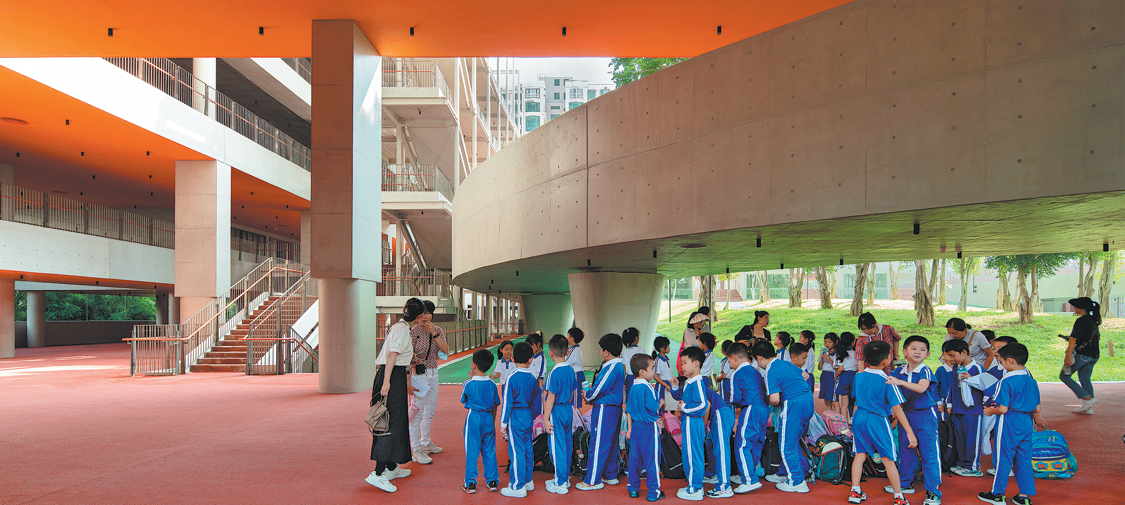
Hongling school was the first tangible success of a radical urban experiment.
"It was the first to truly crack the 'high-density school' puzzle," said Zhou Hongmei, the mastermind of the campus action plan.
In 2017, Zhou faced immense pressure as deputy director of the Futian district planning bureau. The district's school shortage was so severe that parents' complaints were overwhelming.
At the time, the high-density campus was "uncharted territory" in architecture, devoid of precedents, theory, or management experience, Zhou recalled.
From her position in the approval process, she decided to step into the front line, initiating a "quasi-utopian" experiment. In just 10 days, she organized a design plan with three architecture firms.
He's team was invited and its scheme stood out for satisfying both the high-density demand and children's need for a campus that is both functional and beautiful.
Zhou admitted that the endeavor was, at first, an "illegal experiment". Her model did not fully comply with standard public bidding procedures. Yet, when Hongling was successfully completed, a gateway to a "brave new world" was opened.
The constraints unleashed a torrent of creativity among ingenious architects who had been previously shut out of bidding on projects. They have since placed running tracks on rooftops, created rooftop farms, and weaved sky bridges and courtyards between buildings, overcoming the rigid, outdated aesthetics of the past.
"It was precisely because we used institutional innovation to attract the 'Olympiad-level contestants', the high-density equation was solved," Zhou explained.