



Saint Deem debuts vein-recognition production line









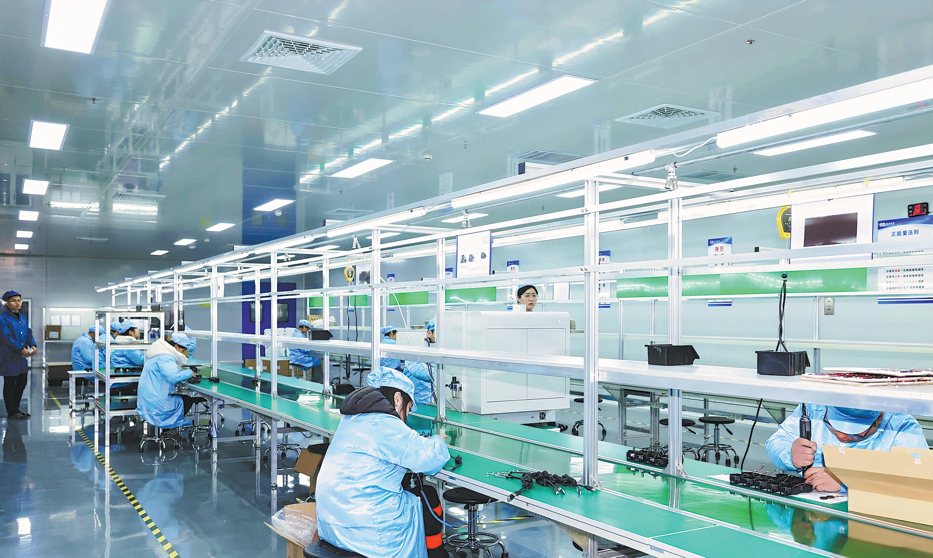
Chinese biometric technology firm Saint Deem has launched its first dedicated vein-recognition manufacturing line, marking a step toward large-scale commercialization of a technology that industry experts said could reshape the digital identity verification industry.
The production line, located in Huainan in East China's Anhui province, is designed to produce up to 2 million vein-recognition modules and authentication devices annually, targeting applications ranging from consumer electronics and payments to vehicles and smart infrastructure, the company said.
The new factory spans more than 10,000 square meters and includes clean-room SMT (surface mount technology) production, assembly and packaging lines. It is the first specialized manufacturing line in China dedicated solely to vein-recognition products, filling a gap in the country's biometric supply chain, the company said.
Vein recognition — which identifies individuals by analyzing patterns of veins beneath the skin — is gaining attention as governments and companies seek more secure alternatives to passwords, fingerprints and facial recognition, which have become increasingly vulnerable to spoofing and AI-generated forgeries.
"Vein recognition offers what other biometric technologies struggle to guarantee: it is internal, live and extremely difficult to replicate," said Qian Haomin, co-CEO of Saint Deem. "With this production line, the company is shifting from an R&D-driven model to a new stage driven by the dual engines of R&D and manufacturing."
For Saint Deem, which has spent 15 years developing vein-recognition algorithms, hardware and software platforms, the Huainan plant is intended as a springboard for wider global adoption.
He emphasized: "Our goal is not just to sell devices. It is to make vein recognition a trusted, universal key — connecting people securely to both the digital and physical worlds."
Zhang Zhiqiang, mayor of Huainan, said that vein recognition is not just another biometric tool, it is a strategic technology for future digital infrastructure that will help develop emerging industries while helping traditional sectors upgrade through secure digitalization.
At a parallel industry forum on standards and applications, Zheng Zhiming, an academician of the Chinese Academy of Sciences and a leading expert on AI and data systems, said that conventional identity systems are struggling to keep pace with increasingly sophisticated attacks.
"Passwords are one-dimensional, QR codes are two-dimensional,"Zheng said. "Vein recognition operates in three dimensions. Higher dimensionality means greater randomness and fundamentally stronger security."
He added that as AI-generated deepfakes and synthetic identities proliferate, vein-based authentication could become a critical security anchor in complex digital systems.
Saint Deem's technology has already been deployed in palm-vein payment systems, smart locks, public transport and high-security environments, according to the company and its partners.
In one example, Chengde Public Transport Group in Hebei province has rolled out palm-vein payments for bus passengers, reducing reliance on cards and QR codes.
Industry experts said that consumer markets could provide the next growth engine. China sold about 17.5 million smart locks in 2024, but penetration remains relatively low, leaving room for higher-security solutions.
As the technology moves toward mass adoption, experts stressed the need for unified technical and security standards to prevent fragmentation and ensure trust.
Zheng Yinfei, a professor at Zhejiang University and an expert on IT standardization, said, "Establishing evaluation and security benchmarks is essential to protect users and unlock the industry's full value."


Today's Top News
- Intl brands see strong rebound in China
- Japan urged to adhere to a peaceful path
- Jimmy Lai sentenced to 20 years in prison
- Xi stresses sci-tech self-reliance in building modern socialist country
- Takaichi's election 'victory' calls for vigilance: China Daily editorial
- Jimmy Lai verdict shows Hong Kong's rule of law tolerates no foreign meddling







