Bridging futures










The China-Africa partnership is displaying fresh dynamism as it celebrates its 70th anniversary
Chinese Foreign Minister Wang Yi’s visit to Ethiopia, Tanzania and Lesotho in January came at a time when countries of the Global South are forging closer bonds and new pathways of cooperation. Reflecting on China-Africa relations last year, the minister described the two as “good brothers who fight side by side and share a common future”. His words speak to more than the practice of diplomacy. They evoke a shared historical experience, a record of mutual support and a continuing partnership in the search for development pathways.
This year marks the 70th anniversary of China-Africa diplomatic relations and the fifth anniversary of the Global Development Initiative China has put forward, a framework that has furthered cooperation between China and Africa. Since President Xi Jinping proposed the initiative in September 2021, it has emerged as a practical mechanism for advancing the United Nations’ 2030 Agenda for Sustainable Development. The initiative’s focus on poverty alleviation, food security, climate change, industrialization and digital connectivity has resonated deeply across African nations. As President Xi said: “Given the new opportunities and challenges we face, closer cooperation between China and Africa is needed, more than ever.”
The numbers already tell a compelling tale. The Global Development Initiative has mobilized nearly $20 billion in development funds and carried out over 1,100 cooperation programs that benefited people in different countries. In agricultural cooperation, for example, China has helped establish more than 24 agricultural technology demonstration centers across the continent by 2023. These centers have increased crop yields by an average of 30-60 percent, benefiting over 1 million smallholder farmers.
Infrastructure development under the Global Development Initiative framework has also been transformative. During this year’s visit to Africa, Wang cited the Tanzania-Zambia Railway as an example. Beyond this existing infrastructure, China has also committed to supporting what the China International Development Cooperation Agency refers to as 1,000 “small and beautiful” livelihood projects that focus on community-level impacts, from solar power installations in rural areas to mushroom farming through Juncao technology.
As comprehensive strategic partners and fellow BRICS members, China and South Africa have deepened cooperation across multiple sectors. According to the Institute for Security Studies in Africa, since 2000, South Africa’s total bilateral trade with China has grown significantly, rising from $1.34 billion to $34.18 billion in 2023. This makes China South Africa’s largest trading partner and South Africa China’s largest market in Africa.
China provides an important developmental blueprint for other nations in the Global South. To borrow the words of former South African president Nelson Mandela, this represents an “African rebirth”. This has already been manifested in many ways in South Africa.
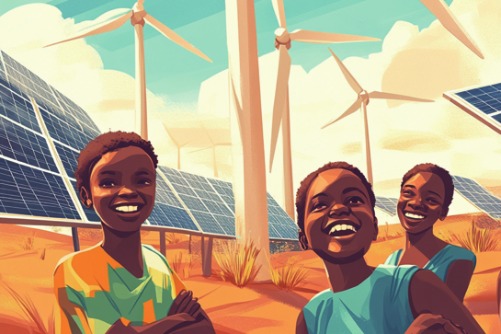
China has invested heavily in South Africa’s renewable energy sector, with numerous solar and wind projects supporting South Africa’s goal of generating 18.2 gigawatts of renewable energy by 2030.
In digital development, Chinese telecommunications companies have helped expand 4G and 5G coverage to underserved rural areas, enabling mobile banking, distance learning and telemedicine services that are transforming lives in remote communities.
The human capital dimension is equally important. Through scholarships and vocational training programs, thousands of South Africans have gained skills in manufacturing, technology and engineering. Confucius Institutes across the country, including the one at the University of Johannesburg, encourage people-to-people understanding through language and cultural education.
More broadly for the continent, the Forum on China-Africa Cooperation remains the cornerstone of multilateral engagement. At the 2024 Beijing Summit, China announced “10 partnership actions” to support African modernization, with commitments totaling more than $50 billion over three years. The implementation of zero-tariff treatment for 100 percent of products from African countries with diplomatic ties represents a game-changing market access opportunity.
Within the African Union framework, China’s partnership has strengthened continental integration. Support for the African Continental Free Trade Area through infrastructure investments is helping realize the dream of a unified African market of 1.3 billion people with a combined GDP exceeding $3 trillion.
The BRICS mechanism, which expanded in recent years with the inclusion of six more countries, including Egypt and Ethiopia, offers another avenue for South-South cooperation. The New Development Bank has approved over $30 billion in infrastructure and sustainable development loans for member countries by 2023.
Now, as we commemorate 70 years of China-Africa diplomatic ties, the relationship must continue to evolve. From a Global South perspective, development partnerships succeed only when they enable countries to move up the economic ladder on their own terms.
The measure of success, therefore, lies in African ownership of development priorities, transparent and accountable project implementation, environmental sustainability and genuine skills transfer that strengthens local capacity. The launch of the China-Africa Year of People-to-People Exchanges reflects this.
Wang’s visit to Africa represents the continuity of China’s commitment to Africa. Through the Global Development Initiative and related frameworks, cooperation has already produced tangible results. Now, with a renewed commitment to multilateralism and practical cooperation, China and Africa are well positioned to realize the promise of South-South cooperation as a credible pathway toward inclusive and sustainable global development.

The author is a professor of law, the vice-chancellor and the principal at the University of Johannesburg, South Africa.
The author contributed this article to China Watch, a think tank powered by China Daily. The views do not necessarily reflect those of China Daily.
Contact the editor at editor@chinawatch.cn.