BIZCHINA> Newsmakers

|
BIZCHINA> Newsmakers
|
|
Related
Boeing and China to compete and cooperate
(China Daily)
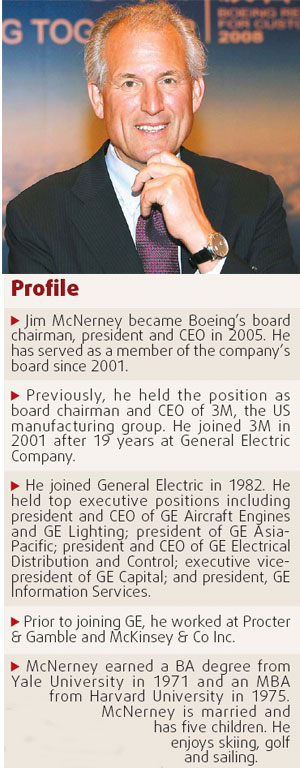
Updated: 2008-06-26 17:35 China ordered its first Boeing airplane in 1972, the same year that US president Richard Nixon made his historic visit to the People's Republic of China. More orders followed after 1979 when a strong relationship between the US and China was established. Today about 60 percent of China's fleet are made up of Boeing jets. Earlier this month Jim McNerney, board chairman, president and CEO of The Boeing Company, took a three-day visit to China. McNerney, 58, oversees the strategic direction of the Chicago-based, $66.4 billion aerospace company. He talked with China Daily reporter Lu Haoting about the development of the B787 project and Boeing's position in China's large airplane project.
Q: The first delivery of the B787 Dreamliner will be delayed until the third quarter of 2009. China ordered a total of 60 planes. When will Chinese airlines receive the first B787? How will they be compensated? And what is the impact of the delay on Boeing? A: The first delivery will be late next year. For Boeing the delay will have a financial impact - we will be making money later. We also have to work with the airlines to help them manage the delay of the B787, which will involve some costs. Every contract we have with airlines is different. But we usually find a mutually beneficial solution. We are working with the Chinese airlines right now to define that. It could mean a penalty, it could also mean helping with interim airplane capacity. Q: Boeing has outsourced an unprecedented large amount of work to its partners in the B787 program. So has Airbus in its A380 project. That has increased the risk in project management and both groups have encountered delivery delays. How do you see this problem? A: Global partnership is a good strategy. So we will keep implementing it. But looking back, we perhaps underestimated the difficulties in some of the partnerships we have and it took some our partners longer to get some things done. We will try to recover and learn from that. I think this represents start-up problems rather than fundamental problems with the cooperative model. Q: Boeing has a lot of industrial projects in China. Now China plans to build its own large airplanes. How will Boeing balance the role of being a partner and a competitor? A: First of all, China will have an entry in the large airplane market. China has experience in aerospace, both commercial and in the military. There is strong investment capability in China to build huge facilities that you need. There is a big aviation market here and a strong entrepreneurial capability in this country. If you put all these things together, China, more than any other country, except the United States and Europe, has the ability to get there first. Secondly, we feel confident of our ability to compete in a global market place. China is a huge market. So we might end up competing with China's airplanes for certain customers. But I think it is in China's and Boeing's best interest to have a fast growing aviation industry that will want more planes. I think it is synergistic. We can't be afraid of competition. China will be competing whether we help or not because they have the capability to build an airplane down the road. I would rather support the overall market and the overall capability of China. Both the Chinese airplanes and Boeing will benefit. And then, we will let the customers decide. Q: The last three years have been exceptional for Airbus and Boeing in terms of new orders. Last year, the two companies booked more than 2,800 orders. But Airbus has forecast a drop in new orders this year. What do you think about that? A: The credit crisis and soaring oil prices will probably have the greatest impact in the United States because the airline industry structure there is not strong. But outside the US we will see a smaller impact, but continued growth. So I think when it is added all together, we will see a moderate growth overall but not negative growth. We have a backlog of orders over the last five years that extend out for many years. I agree with the Airbus assessment that both of us will probably have fewer orders this year. But I still think we will get more orders than what we will be building.
(For more biz stories, please visit Industries)
|
主站蜘蛛池模板: 国产精品亚洲综合久久小说| 99久久这里只有免费精品| xxxxxl日本17上线| 免费观看日本污污ww网站69| 青草亚洲地区在线视频| 国产精品无码不卡在线播放| 久久国内精品自在自线观看| 中文字幕国产精品一区二| 国产一区二区三区禁18| 亚欧美日韩香蕉在线播放视频| 在线日韩一区二区| 亚洲欧洲自拍拍偷综合| 亚洲妓女综合网995久久| 爱豆传媒md0181在线观看 | 少妇久久久被弄到高潮| 国产精品一区二区插插插| 国产最新精品系列第三页| 成人无码视频在线观看免费播放| 成人午夜电影福利免费| 激情 自拍 另类 亚洲| 亚洲h在线播放在线观看h| 在线精品自拍亚洲第一区| 国产精品二区中文字幕| 亚洲一卡2卡3卡4卡精品| 精品乱人伦一区二区三区| 最新国产AV最新国产在钱| 秋霞无码久久久精品| 狠狠色丁香婷婷久久综合不卡| 国产成人精品久久性色av| 亚洲熟妇在线视频观看| 九九热在线视频中文字幕| 综合色久七七综合尤物| 狠狠躁天天躁中文字幕| 九色免费视频| 亚洲第一区二区国产精品| 中文字幕亚洲一区二区三区| 欧美疯狂xxxxbbbb牲交| 国产成人久久综合一区| 999国产精品一区二区| 国产欧美在线一区二区三| 精品国产成人国产在线观看|