BIZCHINA> Center

|
BIZCHINA> Center
|
|
Related
Analyst says decade of energy challenges ahead
By Fu Jing (China Daily)
Updated: 2008-09-16 09:36
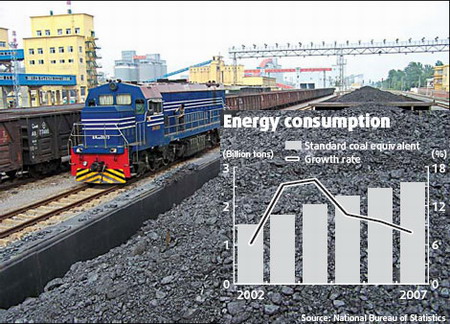
China's rapidly rising energy demand may ease off by 2018 when the nation is expected to have basically realized its industrialization and urbanization, according to a senior analyst. Speaking to China Daily, Chen Jiagui, vice-president of the Chinese Academy of Social Sciences, also warned of a "severe energy supply shortage" China may encounter if this coal-dependent country fails to accelerate its exploration of coal reserves and other energy sources. "We will encounter another decade of a tight energy supply-demand balance," Chen said. "Total energy consumption will continue to rise at a faster pace in China because more provinces will accelerate their industrialization," Chen said. Compared with international standards, out of China's 31 provinces, municipalities and autonomous regions, 24 have yet to become fully industrialized. In China's energy consumption mix, industrial development accounts for 70 percent. "At the early stage of industrialization, provinces will unavoidably consume more energy as they have to take off by developing heavy industry," Chen said. In addition, energy demand will be intensified, Chen added, as more rural Chinese become urban residents. The country aims to increase its urbanization rate to 60 percent by 2020 from the current 45 percent. Chen called for further measures to encourage businesses to conserve energy and stressed that China's energy strategy should prioritize thrift and rely on domestic resources. Statistics show domestic sources provided more than 90 percent of the country's energy needs, and its self-sufficiency rate was higher than Organization for Economic Cooperation and Development countries and the United States by 20 and 30 percentage points respectively. He warned that if China continued with the development model in place before 2007, it would double its energy consumption to 5 billion tons of standard coal equivalent from last year's 2.65 billion. However, if tougher energy-saving measures are implemented, China's energy consumption is forecast to reach 2.9 billion tons of standard coal equivalent in 2010 and 3.8 billion in 2020. "We cannot sustain the energy supply if the former scenario comes true," Chen said. "And we also cannot pay the environmental costs of burning increasing amounts of coal." As the world's second largest energy producer, China has relatively strong foundations in energy generation and supply, helping to maintain its economic growth at an average annual rate of 9.8 percent from 1980 to 2006. To complement these measures, the government is determined to increase the output of hydropower, nuclear and renewable energy by a large margin. The government expects renewable energy to account for 10 percent of the nation's total consumption in 2010, with the figure rising to 15 percent in 2020. The authorities have already taken measures to cut energy consumption per unit of GDP by 20 percent from 2006-10, with further reductions expected after 2010. Coal accounts for about 70 percent of the total consumption in the country's energy mix. Currently, only 145 billion tons of coal reserve can be extracted immediately despite official figures showing the country's coal reserve may reach 1 trillion tons.
(For more biz stories, please visit Industries)
|
主站蜘蛛池模板: 亚欧洲乱码视频一二三区| 亚洲AV高清一区二区三区尤物| 国产91精选在线观看| 无码刺激a片一区二区三区| 91精品国产91久久综合| 国产伦一区二区三区精品| 久久综合偷拍视频五月天| 久草视频在线这里只有精品| 免费一级毛片在级播放| 免费无码黄动漫在线观看| 国产欧美日韩视频一区二区三区| 青草青草伊人精品视频| 国产精品毛片一区视频播| 深夜精品免费在线观看| 成人在线观看不卡| 亚洲综合在线亚洲优优色| 人人妻人人做人人爽夜欢视频 | 国产一区韩国主播| 黑人巨大videos极度另类| 久久被窝亚洲精品爽爽爽| 精品国产精品午夜福利| 国产成人精品视频不卡| 亚洲老熟女一区二区三区| 日韩人妖精品一区二区av| 国产高清乱码又大又圆| 国产精品乱一区二区三区| 视频一区二区 国产视频| 国产午夜福利视频合集| 国产精品一区在线蜜臀| 亚洲熟伦熟女新五十熟妇| 亚洲一区二区偷拍精品| 国产成人午夜福利在线播放| 日本熟妇XXXX潮喷视频| 久久毛片少妇高潮| 少妇人妻偷人精品视蜜桃 | 无码精品人妻一区二区三区中| 91无码人妻精品一区二区蜜桃 | 久久a级片| а∨天堂一区中文字幕| 国产精品免费看久久久麻豆| 性xxxx视频播放|

