BIZCHINA> Top Biz News

|
BIZCHINA> Top Biz News
|
|
Getting wind of the future's energy needs
By Sun Xiaohua (China Daily)
Updated: 2009-05-04 07:49
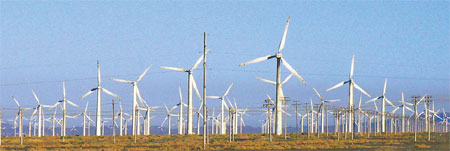
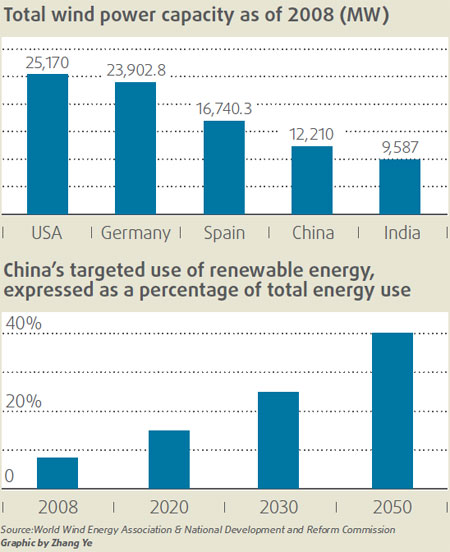 China has set a target for renewable energy consumption of 40 percent of the market by the year 2050. The news comes as it emerges that China will have 100 GW of wind power capacity by 2020, more than three times the 30 GW the government set as a target 18 months ago. It's also been revealed that China will become the biggest growth market for wind power generating capacity this year, ahead of the United States, which has been worse-hit by the economic downturn, according to the Global Wind Energy Council (GWEC).
The annual growth rate in wind power in China will be about 20 percent, Fang Junshi, head of the coal department of the National Energy Administration, told a Coaltrans conference in Beijing. China, the world's second largest energy user, has around 12 GW of wind power capacity and has said it wants to raise that to around 20 GW by next year. That means wind is set to be a bigger source of power than nuclear, despite a construction boom in nuclear power plants, and far bigger than solar, which is expected to hit 1.8 GW by 2020, according to a 2007 plan. More than 27 GW of wind power generating plants worth about $53 billion were built around the world last year. Demand for power in China has been spurred by economic stimulus measures. "China is powering ahead with no visible signs of slowing down," said Steve Sawyer of the Brussels-based GWEC. "If anything it is accelerating. They intend to become the largest market in the world, very clearly, and they probably will unless things take off in the US again in the relatively near term."
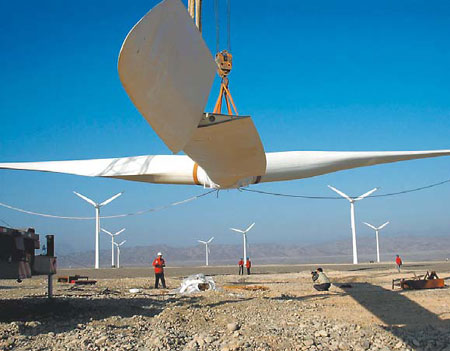
China's local wind turbine manufacturing industry has "grown dramatically" as power production has expanded, Sawyer said. Local manufacturers, dominated by Sinovel Wind Co, Xinjiang Goldwind Science & Technology Co and Dongfang Electric Corp, captured more than half the domestic market for the first time in 2007, rising to between 75 percent and 80 percent last year. "Although all the big international brands are there and their markets are growing in absolute terms, their market share is diminishing pretty rapidly," Sawyer said. The growth in Chinese wind turbine manufacturing means Chinese-made equipment is poised to emerge in the international wind market "in earnest", Sawyer said. Until now, Chinese suppliers have only won smaller contracts in the US, Cuba, Peru, Africa and the Middle East, he said. Danish company Vestas, the world's largest wind turbine maker, plans to invest $9 million in its factory in Inner Mongolia to produce about 800 sets of V60-turbines every year. These turbines are specially tailored for Inner Mongolia's low to medium strength winds, being shorter with bigger blades than standard turbines. The factory will employ an additional 1,000 Chinese people, about half of its current local employees. The company, which entered the Chinese market in 1986, has a market share of about 12 percent. This pales in comparison with local competitors such as Sinovel, Goldwind and DEC, which took about 65 percent of market share in 2008, according to Shi Pengfei, vice-president of the China Wind Energy Association.
The World Wind Energy Report 2008 predicts that Asia, under China's lead, will "become the worldwide locomotive for the wind industry" and "Chinese wind turbine manufacturers will be among the top international suppliers". Wang Jun, director of the National Energy Administration's renewable energy department, said: "Renewable energy will become the mainstream power supply in 2050 from a supplementary role in 2010." He envisaged a future with heating dependent on solar and geothermal power, cars driven using biofuels and families owning their own photovoltaic power stations, turning the country from the world's biggest emitter of greenhouse gases to one of its smallest. However, some are worried that too much attention and aid is being paid to the renewable energy industry. They argue China should focus on clean coal technology. "Renewable energy is our destiny, but it is not the solution to China's urgent problem of large-scale coal burning," said Feng Xiaoting, director of Jiangsu Coal Chemical Engineering Institute. He said he believes that in the next 30 to 40 years, traditional energy, especially coal, will still be the powerhouse for China's growth. He said clean coal technology research and development should be prioritized. (For more biz stories, please visit Industries)
|
|||||||
主站蜘蛛池模板: 亚洲a∨国产av综合av| 国产福利酱国产一区二区| 一二三四中文字幕日韩乱码| 国产精品自拍视频我看看| 办公室强奷漂亮少妇视频| 麻豆精品久久久久久久99蜜桃| 精品国偷自产在线视频99| a午夜国产一级黄片| 日韩视频一区二区三区视频| 国产在线乱子伦一区二区| 精品人妻一区二区| 伊大人香蕉久久网欧美| 婷婷丁香五月亚洲中文字幕| 视频网站在线观看不卡| 91综合在线| 国偷自产一区二区三区在线视频| 伊人色合天天久久综合网| 偷拍精品一区二区三区| 亚洲AV无码国产精品夜色午夜| 亚洲欧洲国产综合一区二区| 口爆少妇在线视频免费观看| 99网友自拍视频在线| 国产永久免费高清在线观看| 久久精品国产亚洲av亚| 亚洲国产成人AⅤ片在线观看| 口爆少妇在线视频免费观看| 国产 另类 在线 欧美日韩 | 亚洲男人天堂av在线| 内地自拍三级在线观看| 姐姐6电视剧在线观看| 久久99爰这里有精品国产| 国产高清在线男人的天堂| 亚洲熟妇夜夜一区二区三区| 肉大捧一进一出免费视频| 亚洲中文字幕乱码一二三区| 深夜av在线免费观看| 久久国产精品一国产精品金尊| 亚洲偷自拍另类一区二区| 国产精品一区二区三区精品| 四虎国产精品成人免费久久| 久久超碰极品视觉盛宴|