BIZCHINA> Top Biz News

|
BIZCHINA> Top Biz News
|
|
Worldwide goals in Sino-US climate talks
(China Daily)
Updated: 2009-06-15 14:53
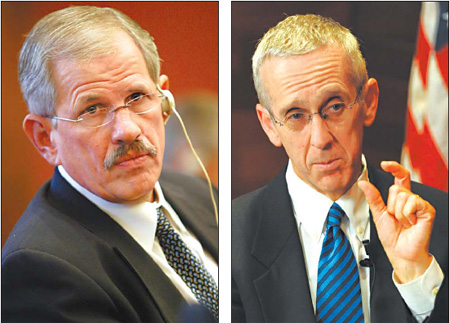
Editor's note: As 182 nations at the UN ended 12 days of talks on climate change in the run up to a final conference in Copenhagen this December, US and Chinese envoys held three-days of talks in Beijing to explore potential cooperation between the two countries. China Business Weekly journalists You Nuo, Li Jing, Fu Jing and C.J. Holtzman interviewed Daniel Dudek, chief economist of the New York-Based Environmental Defense Fund, and Todd Stern, US climate change chief negotiator.Q: There are only six months left until the Copenhagen climate change conference. People are hoping that the two biggest emitters in the world have a deal among themselves to see what they can do for the rest of the world to follow. Do you think that is a mission impossible? Stern: I don't think it's a mission impossible. We came here to pursue just that objective, but not a separate agreement, because there is a multilateral process going on with regards to climate change. So we're not trying to cut a separate deal just between two countries. On the other hand, we're trying hard to find common ground, to reach understandings that can bring us together. If that happens, it would have an enormous impact on the overall multilateral negotiation that will go on in Copenhagen. I think the single most important thing in Copenhagen is for China and the US to come together and of course this doesn't happen in a day. Q: China already has a voluntary plan and is making serious efforts. But why is a voluntary effort not enough for some other countries or at Copenhagen? Why is a mandatory cap for China so important even as some other countries are not fulfilling their commitments to reducing greenhouse gas emissions? Stern: First of all, I think what China has already done - the 20 percent energy efficiency target for the current five-year plan, renewable energy and nuclear power targets - is all very impressive. Second, we're not talking a national cap for China. We're talking a national cap for industrialized countries. We don't expect China to take a national cap at this stage. What we do look for is for China to continue to put in place even more significant steps like the ones I've mentioned, but further and important steps in the next five-year plan and after that so China's emissions grow slower and start to come down eventually. The reason is because there is only so much greenhouse gas we can all collectively put up in the atmosphere before it gets very dangerous for all of us.
Stern: The US is looking for the US to do more, and for all other countries, including China, to do more, because we have a good start, but that is not enough. The US is doing a great deal now since Barack Obama came into office. I understand that China is in the process of developing its own plans for the next five or 10 years. We understand China's paramount need to grow and develop for its people and we agree with that. Q: Dr Dudek, what is the context for discussions on climate cooperation between China and the US? How should any cooperative efforts between them be judged? Dudek: In my opinion and the view widely held among Western scientists is that warming of more than 2 degrees Celsius from pre-industrial levels could be catastrophic. It is vital to establish a mutual understanding that this limit defines the safe corridor of climate change. Actions and commitments to action must be assessed from the standpoint of consistency with allowable emissions. Global emissions must peak and decline before 2020. This is not a political judgment, but the scientific assessment of the problem we face. Q: What do you say about the progress made so far in talks between the two countries on climate change? What will be required of the US and China? Dudek: For the US, it must establish a rigorous national program that caps and reduces greenhouse gases. Fortunately, the US Congress has embarked on development of a serious proposal, HR 2454, which will bring the US back into action at international climate negotiations. This proposal from a very senior and seasoned legislator is a game changer that will not allow the US to use China as an excuse for non-action any longer. For China, a new sober assessment of this problem needs to occur. The points raised by the national leading group on climate change chaired by Premier Wen on June 5th are a good beginning. However, achieving these goals will require a comprehensive and systematic review of the real incentives that energy users face. Particular attention should be placed on non-compliance penalties. China needs to understand that its positioning on this will affect not only the US legislative process, but also the prospects for an effective Copenhagen agreement and a safer climate future. Q: Mr Stern stated that the United States is not going to push China to set mandatory targets on greenhouse gas emissions. What are your comments? Dudek: I think that it is quite important to understand that this is early in the process of engagement between the US and China. People, I think, are really trying to understand the negotiating territory and the art of what's possible between the two nations. I think from my understanding and experience in the United States, it's important to remember that our executive branch, while very important in terms of determining overall US government positions, is only one element of our policy-making structure. The other, that I mentioned previously, is the Congress, and the Congress right now is definitely moving with respect to legislation. I want to just remind ourselves that a very prominent senator, in fact a former candidate for president of the United States, Senator John Kerry from Massachusetts, who is also the chair of the Senate Foreign Relations Committee, has said that there's no way we are going to get an agreement in the US Senate unless China reduces its emissions. And we'll have to know that they are. If we don't get at it adequately, the problem is convincing colleagues that China is trying to do its share. (For more biz stories, please visit Industries)
|
|||||
主站蜘蛛池模板: 九九久久亚洲精品美国国内| 亚洲精品视频久久偷拍| 狠狠色丁香婷婷综合尤物| 精品 无码 国产观看| 欧美人与动牲猛交A欧美精品 | 俺去啦网站| 成人性影院| 99偷拍视频精品一区二区| 夜色福利站WWW国产在线视频| 不卡一区二区三区视频播放| 亚洲AV国产福利精品在现观看| 亚洲区1区3区4区中文字幕码 | 国产亚洲精品AA片在线播放天| 国产中文三级全黄| 国内精品自线在拍| 亚洲an日韩专区在线| 四虎国产精品成人免费久久| 国产不卡av一区二区| 小雪被老外黑人撑破了视频| 亚洲男人的天堂久久香蕉| 国产超高清麻豆精品传媒麻豆精品 | 午夜成人无码免费看网站| 嫩草成人AV影院在线观看| 久久精品夜色噜噜亚洲aa| 久久69国产精品久久69软件| 久久精品不卡一区二区| 亚洲欧洲一区二区精品| 狼人久久尹人香蕉尹人| 亚洲成色精品一二三区| 狠狠久久五月综合色和啪| 国产精品乱人伦一区二区| 精品精品自在现拍国产2021| 日韩精品专区在线影观看| 亚洲国产精品人人做人人爱| 亚洲精品国产美女久久久| 无码国模国产在线观看免费| 国产情侣激情在线对白| 亚洲色大成网站www久久九九| 涩欲国产一区二区三区四区| 2021亚洲国产精品无码| 饥渴老熟妇乱子伦视频|