BIZCHINA> Review & Analysis

|
BIZCHINA> Review & Analysis
|
|
China, US should find common ground in strategic dialogue
By Yuan Peng (China Daily)
Updated: 2009-07-27 07:43 The first meeting of the China-US Strategic and Economic Dialogue is due to be held in Washington today and tomorrow. As the first episode of the new mechanism that has replaced the previous strategic economic dialogue (SED), the meeting will provide the two powers with an occasion for all-round and indepth talks on bilateral ties under US President Barack Obama's administration. What it will produce is expected to directly determine the future of Sino-US relations. The dialogue should serve as an important platform for Beijing and Washington to evade risks, control crises and solve issues of common interest to push forward a smooth relationship. Since Obama took office, Sino-US relations have made steady and tangible progress although there still exist hidden troubles and risks, which, if not properly handled, could bring it to standstill or even plunge into retrogress. 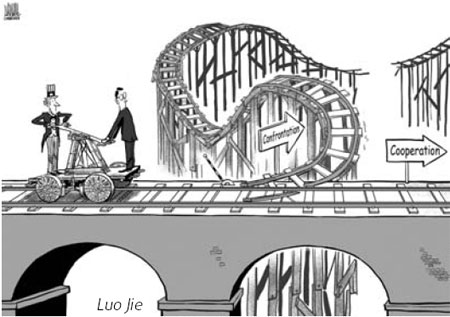
The deep disputes and conflicts between China and the US on the issues that closely relate to the former's core interests, such as Taiwan, Tibet and the Xinjiang Uygur autonomous regions, are likely to taint the improved Sino-US ties. Also, it still remains unknown whether the US will push forward a long-controversial arms sale to Taiwan in the remaining months of this year, or whether Obama will meet the Dalai Lama. What remarks Washington will make on China's Xinjiang will also test bilateral ties. If Washington is not careful, it could stoke the long-latent nationalist sentiment among Chinese people and thus affect their attitude toward the Obama administration. These are undoubtedly unfavorable to the development of Sino-US relations.
All these factors will impinge on the upcoming meeting between China and the US in Washington, ensuring it is placed in the context of a long-term development of bilateral ties. The dialogue should open a new start for a new-type of Sino-US relationship featured as a two-plus-two meeting. It will surely provoke intensive international speculation about the long-mooted Group of Two and a China-US co-governance of global affairs. As a concrete move to implement the concept reached between President Hu Jintao and his US counterpart Obama at a London meeting in April to replace the SED, the new and broader-range dialogue will help Beijing and Washington forge a new-two-plus-two (two officials from each side) mechanism. It would be much different from the two-plus-two model between the US and Japan, which is stamped with remnants of the Cold War and military alliance and is obviously targeted at a third party. Also, it would not be the same as the strategic dialogue established between the US and the Soviet Union during the Cold War period. As a dialogue between two rivals, the US-Soviet dialogue was aimed at containing each other but not promoting bilateral cooperation. The high-level two-plus-two dialogue between China and the US in strategic and economic scopes will not only follow the current of power-to-power relations, but also comply with both countries' common aspiration, via communications and talks, to evade potential risks, seek cooperation and realize a win-win result. The dialogue, if it achieves success, will create a new model for co-existence and common development between an emerging power and an established hegemony in modern history. It also sends a message to the rest of the world that China and the US are not preoccupied with a so-called Group of Two or a co-governance, but are committed to be equal partners. To ensure the dialogue's success, China and the US should try to find common grounds in the spirit of equal consultation and mutual respect. On the issues of climate change and emission reduction, Washington should understand Beijing's stance that the world's largest developing country undertakes common but differentiated responsibility and that attention should not be placed on a country's total emission alone; it should be placed on per capita emission. Also, the US should extend to China necessary technological assistance for the sake of its emission reduction. In the scope of security, China should show its willingness to cooperate with the US on anti-terror activities in Afghanistan and Pakistan, and Washington should also care about Beijing's concerns over Tibet and Xinjiang. The author is director of the Institute of American Studies under the China Institute of Contemporary International Relations。 (For more biz stories, please visit Industries)
|
主站蜘蛛池模板: 国产香蕉在线视频| 韩国三级+mp4| 99福利一区二区视频| 在线一区二区中文字幕| 99re在线免费视频| 麻豆亚州无矿码专区视频| 手机在线看永久AV片免费 | 国产睡熟迷奷系列网站| 40岁成熟女人牲交片| 国产成人99亚洲综合精品| 欧美人成在线播放网站免费| 国产精品毛片一区视频播| 94人妻少妇偷人精品| 综合99综合久久久久久久| 亚洲 制服 丝袜 无码| 狼狼狼色精品视频在线播放| 日本黄韩国色三级三级三| 亚洲国产成人片在线观看| 国产精品视频不卡一区二区| 天天做日日做天天添天天欢公交车| 国产一区二区三区亚洲精品| 久久精品av国产一区二区| 国99久9在线 | 免费| 女同久久精品国产99国产精品| 偷拍久久大胆的黄片视频| 国产精品香蕉在线观看不卡| 国产裸体美女永久免费无遮挡| 亚洲最大天堂在线看视频| 日韩精品a片一区二区三区妖精| 久久夜色精品亚洲国产av| 国产成人av片在线观看| 337P日本欧洲亚洲大胆精品555588 | 人妻精品动漫H无码中字| 国产精品视频免费网站| 国产精品二区中文字幕| 99久久精品久久久| 国产日韩一区二区在线| 国产成人精品久久一区二| 国产精品人成视频免费国产| 国产大片黄在线观看| 国产精品久久久一区二区三区 |



