Money
High liquidity may strain anti-inflation measures
By Gao Changxin (China Daily)
Updated: 2011-03-15 13:57
 |
Large Medium Small |
|
 |
|
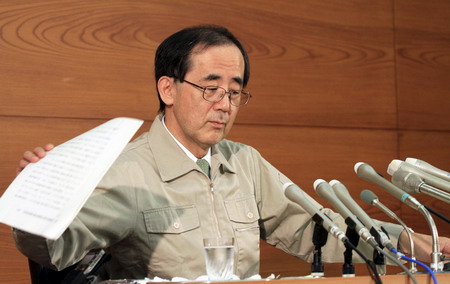
Masaaki Shirakawa, governor of the Bank of Japan, at a news conference in Tokyo, Japan, on Monday. The Bank of Japan has poured a record amount of cash into the financial system and doubled the size of its asset-purchase plan to shield the economy from the effects of the nation's strongest earthquake on record. [Photo / Bloomberg] |
Chinese exports are also likely to be affected as the trading pattern alters between China and its third-biggest trade partner following the quake, they added.
In its biggest single-day open-market operation, the Bank of Japan (BoJ), Japan's central bank, on Monday pumped a hefty 15 trillion yen into its money market.
The central bank also said it will offer to buy 3 trillion yen in Japanese government bonds with repurchase agreements in an operation that starts on March 16 and ends the next day.
The moves came as lenders become reluctant to offer loans after the 9.0-magnitude earthquake cast uncertainty over its economic growth.
Concerns that the quake would drag down the Japanese economy and slash corporate profits, resulted in the Nikkei 225 Stock Average slumping by more than 6 percent to 9620, the biggest drop since Dec 2, 2008.
On Friday, the 9.0-magnitude temblor and subsequent tsunami razed the northeastern regions of the world's third-biggest economy, resulting in power blackouts and the risk of a meltdown at a nuclear power station.
The death toll is expected to hit more than 10,000 and more than 350,000 people have been relocated in emergency shelters.
Wang Jianhui, chief economist with Southwest Securities, said that by flooding the banking system with cash, Japan's moves will have a similar effect to the United States' quantitative easing (QE) policy, which resulted in global commodity price hikes and higher prices in emerging markets, including China.
"Long story short, it means more money in the market. We are likely to see a new round of rebound in major commodity prices, on top of a major rally last year," he said.
At the center is crude oil, he added, as Japan will look to oil as an alternative resource to generate electricity because of the closure of quake-hit nuclear power plants, though the domestic demand will dip in the short term.
Japan's 54 nuclear reactors provided about 30 percent of the country's electricity, according to the World Nuclear Association. The quake-hit Fukushima Daiichi nuclear plant is Japan's biggest.
"A renewed hike in commodity prices will spell more severe imported inflation for China, and that plays a significant part in inflation overall," said Lu Zhengwei, chief economist with Industrial Bank.


In the aftermath of the stimulus package of 4 trillion yuan in 2008, China's inflation has been running at high levels for more than a year, despite a series of rate increases and other tightening measures starting last year.
China's consumer price index, a main gauge of inflation, stayed at a high of 4.9 percent in February after hitting a 28-month high in November.
Given that the central government has made stabilizing price levels a "top priority" in its macro-economic policies this year, Japan's liquidity injection on Monday will probably alter the pace of tightening measures in China this year.
Industrial Bank's Lu expects the central bank to hike the reserve requirement ratio - the money banks hold against their lending - again by the end of this month.
"Interest rate hikes are also becoming more imminent, likely in the second quarter," he said.
In the real economy, China's export industry will be hurt in the short term because many exporters, who have their parts supplied by manufacturers in Japan, will face delays in shipments, said Zuo Xiaolei, chief economist with China Galaxy Securities.
But in the long term Japan's investment in post-disaster reconstruction will provide export opportunities for China's steel, cement and other construction-related industries, she added.
"But overall bilateral trade won't have much of an impact, as the quake won't pull Japan's economy into a recession," she said.
Share prices in different industries reacted differently to the quake on Monday, the first full trading day after the disaster, resulting in an almost flat close in Shanghai Composite Index, which tracks the bigger of China's stock exchanges.
The index edged up 0.1 percent to close at 2937.63, with drug producers, steelmakers and cement makers leading the gains.
| 分享按鈕 |