Providing more food for thought
Updated: 2011-08-29 09:42
By Ding Qingfen (China Daily)
|
|||||||||||


|
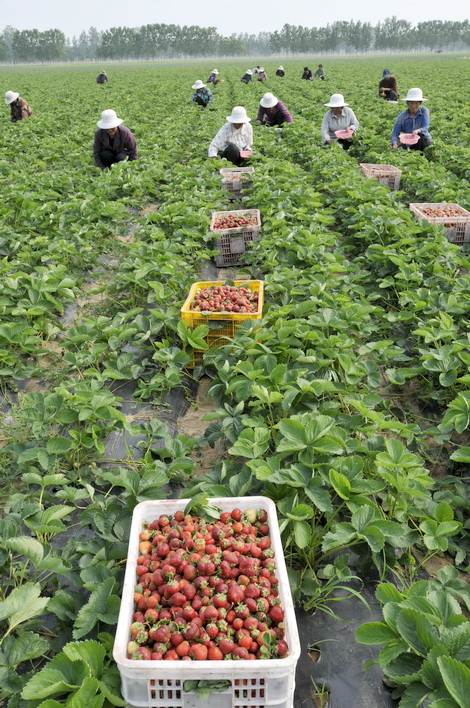 A strawberry farm in Rizhao city, Shandong province. Chinese farmers have been on high alert to maintain the quality of the agricultural produce they export.[Photo/China Daily]
|
Statistics from the Ministry of Commerce show that in Shandong there are 260 agro-companies with exports of more than $10 million last year, including three that had exports worth more than $100 million.
"The Chinese are hard-working and good at intensive and meticulous farming. As they make more of an effort to expand their sales networks, increase their research and development (R&D) capabilities and build brands, there will be great room for the growth of agro-exports," Wang said.
Hu Yumei, deputy general manager of Yunnan Tonghai Songwei Agricultural Product Import and Export Co Ltd, agreed. "The majority of Chinese exporters have limited sales channels overseas, which makes it possible for sales to explode in the future," Hu said.
As a leading vegetable exporter, Yunnan province-based Songwei's products are mainly sold to Thailand, and the company is a dominant provider of vegetables there, including cabbage, spinach, caraway and celery. Its sales revenue in Thailand has come in at between $30 million and $40 million annually in the past two years.
The company's export business began in 2001 after extensive research in the Thai market. "China enjoys the advantage of low labor costs and better agricultural techniques, and thus our vegetables in the Thai market are only half the price of those produced domestically," said Hu.
Hu's company gained popularity and market share quickly, becoming a major supplier to supermarkets in Thailand, including those owned by Carrefour SA of France.
Now that the company has gained more experience in marketing and branding, Songwei is considering expanding its sales network.
In 2010, it made its first foray into Vietnam, and it is currently preparing to enter the Middle East. It is also investigating the possibility of selling in Japan and some European markets.
"Our long-term goal is to make Songwei a well-known brand, even in developed markets", which generally set higher food-safety requirements for the inflow of agro-goods from overseas, Hu said.
Traditionally, the major destinations for China's agro-exports have been Japan, South Korea, Southeast Asia, the US and the EU. However, in the past few years, sales have expanded to many emerging markets and the network now covers more than 200 countries and regions.
Historically, China's agro-exports consisted mainly of primary goods, but this has now changed. During a news briefing in June, Yao Jian, a spokesman for the Ministry of Commerce, said local manufacturers are expanding their industry chains to include processing, packaging, marketing and sales. Most importantly, they are improving their R&D capabilities.
Although China is a large exporter, the R&D efforts of its agricultural companies are "far from enough", which makes them vulnerable to "green" trade barriers - environmental protection standards that may hamper trade - by developed nations for a number of reasons, including safeguarding the environment and food safety, said Wang.
After the exchange rate, these green barriers are believed to be the second most important factor influencing foreign trade.
A more promising development is that Chinese companies are trying to make their exports more competitive by increasing investment in R&D.
According to Tang, the Homey Group has built a complete industrial chain, from breeding and fishing to processing and sales.
The company has an aquatic breeding area covering 173.42 hectares, with the largest breeding area for sea pumpkins and jellyfish. It has 15 processing factories in China producing health-oriented seafoods and snacks, with a combined annual output of 100,000 tons.
In 2008, the company set up an R&D center focused on breeding and food processing, the first of its kind in the industry in Shandong.
"R&D decides to what extent we can expand our business. It decides our future," said Tang.
According to Li Jianyu, general manager of Xinjiang Saihu Fishery Technology Development Co Ltd, the R&D investment is significant for both the company and the Chinese aquatic-goods industry.
Despite being the world's largest exporter of aquatic goods, China has limited resources, and 80 percent of the nation's exports of this type of produce comes from imported primary goods.
"We have to build up our own breeding capability. Otherwise, we will have to rely on the imports, because the supply is not always stable," Li said.
Take saltwater eels as an example. East China's Fujian province is famous for its saltwater eel exports, but the eel larvae used by local companies come mainly from EU countries.
However, late last year an EU scientific review group announced the suspension of eel larvae exports for a year to protect the species. The suspension is reported to have badly hit production and exports in Fujian.
Saihu Fishery is China's largest exporter of northern whitefish (Coregonus Peled), a precious type of fish nowadays, selling to a number of European nations, including Finland. And the company is also the only one that raises northern whitefish in China, learning techniques from Russia, one of the few nations that has the species.
With diversifying demand from the EU and company plans to expand to other regions such as the US, Saihu Fishery is considering breeding a wider range of fish species, such as perch and rainbow trout.
"Breeding could create quite a lot of jobs, as well as bringing more commercial benefits for us," Li said.
It is estimated that every batch of agricultural exports worth $10,000 creates 20 jobs every year, and thus China's annual agro-exports have helped provide work for a large number of unemployed rural laborers, said Yao.
The government is also attempting to boost the nation's agricultural exports. China organizes teams for well-known exhibitions such as Anuga FoodTec, the world's largest food and beverage fair held annually in Cologne, Germany. China also allocates 30 to 40 percent of the display area at the Canton Fair - an important exports and imports exhibition held twice a year - to Chinese agro-goods exporters.