|
|
|
 |
|
|
|||||||||
|
 |
|
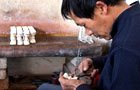
Photo illustration [China Daily] |
The fashion industry is no longer as glamorous as it may appear and by wearing a pair of jeans you may have contributed to the pollution of China's rivers.
"For ordinary consumers, it's hard to know how many polluting companies there are behind each of the popular fashion brands," said Li Li, the founder and director of EnviroFriends, a Beijing-based environmental organization.
Li made the comment in a recent report called Clean up the Fashion Industry, published by five Chinese grassroots environmental organizations, which alleged that 46 Chinese and international clothing brands are being supplied by textile companies that violate the country's environmental laws.
The brands named in the report include a slew of internationally famous fashion houses such as Levi Strauss, Burberry, Polo Ralph Lauren, Guess and Zara, along with China's 361 Degrees, Anta and Youngor.
The website of Nanjing Zhongtian Yuanteng Textile, headquartered in the capital of Jiangsu province, said the company supplies a range of clothing brands, including Esprit, Guess and C&A.
However, the Nanjing government issued its most serious "red card" warnings against the company in both 2008 and 2009 for failing to adhere to environmental regulations.
Meanwhile in 2010, Nanjing Zhongtian received a "yellow card" for illegally discharging waste water without an official permit.
While it comes as little surprise that the country is registering such high levels of pollution, the findings have prompted renewed concern about whether the high price it is paying, in terms of the environment and health, is worth it, especially now that China is the world's second-largest economy and could provide more funding for environmental protection.
According to statistics from the China Textile Industry Association, the country processed 41.3 million metric tons of fibers in 2010, about 52 percent of the global total. In addition, the total export volume of clothing was worth $212 billion, 34 percent of the global total. However, those heady figures came at a heavy price.
Official figures from China's environmental authorities show that the textile industry discharged 2.5 billion metric tons of sewage in 2010, making the sector the third-biggest water polluter among 39 industries.
Water shortage
That fact is especially worrying for China, where two-thirds of cities lack an adequate water supply, one-fifth of cities have urban water sources that fail to meet hygiene standards and 300 million rural residents have no access to safe sources of drinking water.
The textile industry uses large amounts of water in its operations, from the washing of fibers to bleaching, dyeing and washing of the finished products. Moreover, the industry in China uses as much as three times the global average of clean water to produce the same amount of fabric, because of a lack of advanced technologies, according to the Ministry of Environmental Protection.
The industry is also less water-efficient than many other sectors in China. In Guangzhou, the capital of Guangdong province, the textile industry discharges a massive 127.4 metric tons of sewage for each 10,000 yuan ($1,600) of output, according to the report. The average for the other industries in the city is only 6.4 tons.
As many as 2,000 different chemicals are used in the textile industry, from dyes to transfer agents. As a result, the waste water from textile operations often contains chemicals such as formaldehyde and chlorine, and heavy metals such as lead and mercury, which are significant causes of environmental degradation and harmful to humans.
Water waste from textile factories is often discharged at extremely high temperatures and is heavily alkaline in composition, factors that are extremely damaging to the environment.
"It is true that the pollution from the textile industry is expensive and difficult to tackle, and there is still a technological gap in the industry's treatment of pollution," said Ma Jun, director of the Institute of Public and Environmental Affairs and one of the authors of the "Clean Up" report.
However, the report points out that the expense should not be an excuse for illegal dumping by companies or lax supervision by local governments.
The provinces of Zhejiang, Jiangsu, Shandong, Guangdong and Fujian are China's major textile bases, where 90 percent of waste water from the industry is discharged, and Greenpeace has found that textile towns are paying a high environmental price for the booming business.
For example, Xintang in Guangdong is known as the "blue jeans capital of the world" and produces 260 million pairs every year. More than 40 percent of the goods are exported to the United States, the European Union, Russia and other countries. Meanwhile, the town of Gurao is home to a lingerie industry that produces 200 million bras annually.
When Greenpeace asked an independent laboratory to test 21 water samples from the two towns, they discovered that 17 of the samples contained heavy metals such as copper, cadmium and lead. In one sample, the cadmium concentration was 128 times higher than the national environmental standard.
"Xintang and Gurao are symbols of the success of China's export-model economy, yet we were horrified by the environmental degradation we saw during our fieldwork," said Greenpeace toxics campaigner Mariah Zhao.
Soft regulations
But the existing environmental regulations are not tough enough to deter the polluters, according to Ma.
When Fu'an Textile Printing and Dyeing Co in Dongguan, Guangdong, was found to have illegally discharged 27,000 metric tons of waste water directly into a nearby river through hidden channels in 2006, it received a fine of only 217,000 yuan, the highest punishment the province has handed out for a violation of its environmental regulations, Ma said.
"Obviously, the punishments for violating the regulations are much lower than the cost of compliance, a common reason for the rampant pollution levels in China," he said.
A more worrying phenomenon, he said, is that as provinces tighten their supervision of the laws, some companies are simply moving their operations to regions where the regulations remain lax.
For instance, in the wake of the fine levied on Fu'an Textiles, its parent, Fountain Set (Holdings) Ltd, which is headquartered in Hong Kong, is moving its production base to Yancheng in Jiangsu.
Without strengthened supervision, the relocation of polluters simply means that they will take the pollution along with them, further increasing the environmental damage," said Ma.
Contact the reporter at lij@chinadaily.com.cn